

The global onslaught of hegemonic languages such as English means that nearly half of the world’s recognised languages will be extinct within this century. Irish may not face full extinction, but its future as a daily spoken language remains in grave danger.
In Colonialism and Neocolonialism, Jean-Paul Sartre argued that whilst traditional colonialism — in which one group dominated and exploited the other through material control and force of arms — had come to an end in Algeria, it had been replaced by new forms of cultural and economic domination which still held the colonised people under the influence of the colonial power. In Ireland, just think of how television has greatly extended British cultural influence over the country.
Saving the Irish language has therefore, from the foundation of Conradh na Gaeilge in 1893, required Gaeilgeoirí to take a confrontational attitude towards traditional colonisation and neocolonialism in Ireland.
The three major types of Irish-language activism surveyed below represent responses to differing circumstances for the language across Ireland, and have advanced decolonial ideas within Irish society by challenging preconceptions about education and language imposed by colonisation.
Gaeltacht Activism in the 26 counties
“An sprioc atá agamsa ná daoine a chruinniú le chéile atá sásta troid agus achrann a tharraingt le nach féidir neamhaird a dhéanamh orainn níos mó. Tá Éireannaigh ag iarraidh theacht abhaile, fanacht sa mbaile agus a gclann a thógáil sa Ghaeltacht... Teastaíonn athruithe le go mbeidh an deis sin acu.”
“My objective is to bring people together who’re happy to fight to show that we can’t be ignored anymore. Irish people want to come home, to stay there and to raise their families in the Gaeltacht. Change is needed to give them that chance.” Adhna Ní Bhraonáin, founder of Banú, writing in 2023[1] .
The 26 county Irish state designated those parts of the country where Irish was still spoken as a community language as the Gaeltacht in 1926. These were situated predominantly in Donegal, Connemara and Kerry with isolated pockets in Waterford, Clare, Mayo and Cork.
Daily life in the Gaeltacht areas was harsh even by the standards of the time. Abject poverty and emigration were a fact of life in these peripheral areas and led to the Irish language community being disproportionately affected by the recessions of the 1920s and 1950s[2]. This had linguistic consequences and saw the Gaeltacht areas shrink. The official perimeters of the Gaeltacht were revised drastically in the 1950s with the Clare Gaeltacht removed entirely.
One of the few successes was brought about after Gaeilgeoirí sought relief for families in Connemara after a famine in the 1920s. An advocacy group named Muintir na Gaeltachta successfully lobbied the state for the resettlement of 27 Irish-speaking families deemed to be living in inadequate housing to a colony in Ráth Cairn, County Meath[3]. This was done despite the objections of many locals in Meath to the idea, and created what is still a viable Irish speaking community nearly a century later. In doing so, Muintir na Gaeltachta addressed, on a small scale, the material circumstances that had driven language shift by providing housing and farms to Gaeilgeoirí who would otherwise have emigrated.
The long-term neglect of the Gaeltacht had reached breaking point by the 1960s, sparking protest movements. Máirtín Ó Cadhain formed Misneach in the mid 1960s, which held a number of hunger strikes and demonstrations in the Galltacht to draw attention to the demise of the Gaeltacht[4]. This was succeeded by Gluaiseacht Chearta Sibhialta na Gaeltachta after 1969, which held a number of direct actions such as demonstrations against school closures and pirate radio broadcasts on Raidio Saor Connamara to create a movement which operated in opposition to the ongoing colonisation of the Gaeltacht by an Anglophone state uninterested in providing adequate public services or support for Irish-speaking communities.
The movement would peter out by the mid 1970s, but not without having won several major concessions such as the establishment of Raidió na Gaeltachta, overhauls to Gaeltacht governance and the establishment of Údarás na Gaeltachta to attract investment into the Gaeltacht[5].
These forms of activism would re-emerge in the aftermath of the austerity policies which followed the 2008 financial crisis, which disproportionately affected the Gaeltacht and led to a decline in daily Irish speakers of 11.6% between 2011 and 2016. Much of this decline was driven by younger people who were forced to emigrate to find work.
This new movement began with the formation of Guth na Gaeltachta in Donegal in 2009. This represented the first major protest movement against the management of the Gaeltacht since the 1970s. Whilst the movement’s initial impact was limited, it was soon followed by the reformation of Misneach by activists in Dublin and Belfast, then spreading to Galway where Seanan Mac Aoidh, Ben Ó Ceallaigh and Naoise Ó Cairrealláin (AKA Moglaí Bap) were to the fore. Misneach were founded as a protest movement to seek a new direction from Conradh na nGaeilge who had been slow to effectively respond to an austerity agenda which disproportionately affected the Irish language[6].
These efforts succeeded in raising political consciousness amongst Irish speakers across the country, leading to Conradh na Gaeilge organising the largest demonstrations about the crisis of the Irish language since the 1960s in the form of the Dearg le Fearg protests in Dublin and Galway in 2014[7].
Whilst these efforts had a limited impact, they represented steps in the gradual politicisation of the Irish-speaking community across Ireland amidst a mounting awareness that language survival in the Gaeltacht required major reforms to the management of the Gaeltacht, particularly with regards to housing and education. The emergence of Banú, led by Adhna Ní Bhraonáin, in response to the housing crisis is the most important recent development in this regard. The ongoing Tintéain campaign against overtourism and state housing policy in the Gaeltacht led by Conradh na Gaeilge represents the mainstreaming of their position amongst Irish language advocacy organisations.
Any victories have been partial. The traditional Gaeltacht consists of a set of isolated and sparsely populated townlands with sporadic political engagement. For instance, the entire population of the Kerry Gaeltacht (8,749) is only slightly larger than that of the Dublin suburb of Walkinstown (7,422) , and is distributed over a much larger area. This makes political organisation difficult, particularly when population migration (both inward and outward) and overtourism are constantly changing the dynamic of these communities and affecting their social and educational infrastructure. The Gaeltacht remains critically endangered, with the constant encroachment of English intensifying on a daily basis.
Galltacht activism in the 26 counties
“There is among the people a latent enthusiasm for the Gaelic language. But their attitude to the language is effectively one of indifference. This indifference is the chief danger to the language. The effective indifference has a false basis; the ineffective enthusiasm has a true basis. It should be our object to remove the indifference and to make the enthusiasm effective.” Eoin Mac Neill, writing in 1893[8].
The efforts of Gaeilgeoirí to save the Gaeltacht have been complemented by those outside it to promote the language in what were, until the 1990s, almost exclusively Anglophone communities. These movements took a decolonial turn with the emergence of the contemporary Gaelscoil movement from the 1970s onwards, which sometimes challenged the prejudice amongst educational authorities against urban working-class efforts to engage with the language.
Whatever enthusiasm the twenty-six county state had initially possessed for reviving the daily use of Irish beyond the purely performative or academic had long evaporated by the early 1960s. Whilst Irish remained a compulsory subject at school, an hour of daily instruction was of little use at a time when almost all working-class and rural children completed their formal education by the age of 14. There were a mere 23 primary schools in the Galltacht which taught through the medium of Irish in 1972, a fall of 54% from the same figure in 1968.
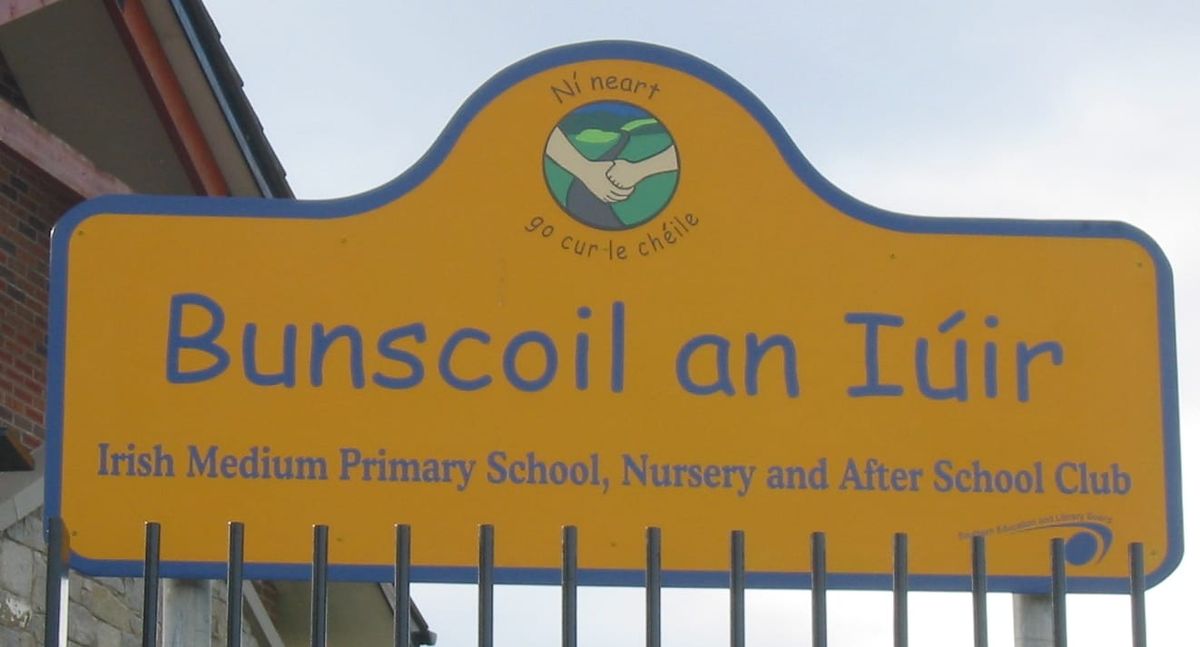
The first new Gaelscoileanna in Dublin were in middle-class suburbs like Raheny and Dundrum. The establishment, therefore, of Scoil an tSeachtar Laoch in Ballymun in 1971 by members of the Ballymun Tenants Association and Ballymun Parents Committee marked an important watershed in the movement, an early example of working-class empowerment in education[9]. This was not without opposition from educational authorities. One, possibly apocryphal, anecdote from the time involves a government functionary dismissing the idea by saying “why would they want Irish there? They barely have English”. Yet it was followed by the opening of Gaelscoileanna in working-class communities such as Tallaght, Clondalkin and Inchicore over the next ten years, and the beginning stages of Irish-medium secondary education in these communities with the foundation of Coláiste Chillian in Clondalkin in 1981. This was complemented by the opening of Gaelscoileanna and Gaelcholáiste in areas where Irish had not been a community language in centuries, such as Dundalk or Kilkenny.
These schools often had rudimentary facilities and their students faced long commutes to attend. Nonetheless, they often provided a meaningful educational choice for parents unable to afford private education. Interestingly, there are many places where Irish-medium education remains one of the few co-educational options at secondary level, meaning that these schools not only challenged the neocolonial idea that education had to be in English, but also the idea that it had to be segregated by gender.
In this respect, alongside the participation of the children of migrant families from the 1990s onwards (former South Dublin County Councillor Darragh Adelaide and broadcaster Ola Majekodunmi are two prominent Gaeilgeoirí whose parents were born outside Ireland), the Gaelscoil movement in the 26 counties can be said to have helped create a more inclusive vision of the Irish language and national identity.
There have also been a number of efforts to promote the use of Irish outside the education system through the creation of networks which take the language into different spheres of life such as the GAA club Na Gaeil Óga, Raidió na Life, An Páipéar or the establishment of Irish-medium businesses such as Aon Scéal café in Tallaght or An Nead in Monaghan. These have been complemented by more ambitious efforts to create neo-Gaeltachts, such as the Ard Barra estate in Glenmire, Co. Cork.
Whilst these operate on a small scale, they represent important efforts to decolonise public space and have provided a space for the language outside the education system which was previously absent, creating networks in which Gaeilgeoirí can meet one another to pursue different aspects of their lives as Gaeilge, such as Irish language LGBT groups or theatre companies.
Unfortunately, these efforts are limited in their impact. In the absence of a clubhouse or home pitch, Na Gaeil Óga have been forced to train and play matches anywhere that they can find. The expansion of the Gaelscoil movement has stalled due to austerity policies disproportionately affecting Irish language organisations. And the price of accommodation means that establishing a housing estate where Irish is spoken and where the children can grow up as native speakers is simply beyond most people’s financial capacity.
These have led to the politicisation of Gaeilgeoirí in the Galltacht, particularly as the impact of austerity on the Gaeltacht has become more apparent. Misneach have recently embarked on a campaign to decolonise public space in urban areas by protesting the British military origins of many street names and public monuments in Dublin and Cork. This has been complemented by Gaeilgeoirí in Donegal painting over bilingual road signs across the county. This new trend towards increasing politicisation was best represented by the broad coalition of groups which took part in the CEARTA march in Dublin on 20th September 2025, where 25,000 people protested government neglect of the Irish language[10].
Galltacht Activism in the 6 counties
“What do you need in order to create a Gaeltacht? You need people, you need Irish-speaking families, you need houses where you can live side-by-side. Everything else comes after that, in that they’re just practical considerations.” Seamús Mac Seain, founding member of the Shaw Road Gaeltacht, speaking in 2020[11].
The Irish-language movement in the six counties, in contrast to the other two examples discussed, has come closest to achieving an athgaelú or reconquest of English-speaking areas, albeit within a narrow geographical base heavily concentrated in West Belfast and the village of Carn Tochair in Derry.
The new Unionist government strongly discouraged the teaching of Irish in the aftermath of partition by gradually ending subsidies for its use in the education system from the 1924 Education Act onwards[12]. Only 22% of primary schools catering for the Nationalist community taught the language at all by 1970, and the few native Irish-speaking communities remaining were already in terminal decline.
The onset of the Troubles in 1969 provided the impetus for the modern six county Irish language revival. This was brought about as a result of the political consciousness-raising which the war provoked amongst republican volunteers and within their wider communities, as they sought to develop new forms of identity which would repudiate nearly fifty years of Unionist efforts to marginalise Irish culture. One group of enterprising Gaeilgeoirí took it upon themselves to establish an urban Gaeltacht within the Shaw Road area of the Falls Road in 1969 by building a group of five houses next to one another, proceeding to gradually extend the spaces in which the use of Irish was expected on a building-by-building basis to incorporate cultural centres (popularly known as Cultúrlanna) and the first Irish-medium school in the city in 1971. This school was not recognised by the Unionist government until 1984[13].
This was complemented by the Jailtacht movement amongst republican prisoners over the course of the Troubles. Irish-speaking areas were established within prison blocks and classes held between prisoners in what were often extremely challenging circumstances with an absence of learning materials, teaching experience on the part of those involved and the threat of violence from prison staff. Yet these conditions bred an increased awareness of the decolonial significance of the language amongst republican activists outside the prisons and their families.[14]
This explicitly decolonial approach was based on the empowerment of working-class people to make decisions on their education for the first time. The language was made part of the community’s daily life through its incorporation into sporting and cultural life, particularly that of children and teenagers. The movement has also been effective at utilising existing supports for adult and vocational education by providing classes for school leavers or technical education in Irish, tying the language project with the needs of the community.
This has been accompanied by the creation of a neo-Gaeltacht in the village of Carn Tochair, where the establishment of Irish-medium primary and secondary schools in the early 1990s was complemented by a comprehensive effort to engage the entire community in Irish-language social and cultural activities[15].
This has sparked a new engagement with the language across the region as part of a broader political programme which, whilst not exclusively appealing to the Nationalist community, is nevertheless overwhelmingly drawn from the same constituency as institutions such as the Gaelic Athletic Association. Sinn Féin adopted a commitment to press for an Irish Language Act in the aftermath of the end of the Troubles, which mainstreamed the cause amongst the Nationalist community and made it easier for protest groups like An Dream Dearg to generate interest amongst parents and adult learners. This may have also limited the appeal of their efforts. The Shankill Road Gaelscoil or Turas in East Belfast remain exceptions to the rule amongst a largely disinterested Unionist public.
This revival has also been geographically limited. For example, despite the Troubles raising political consciousness in Derry in a similar manner to Belfast, and the establishment of a Cultúrlann there in 2009, the language revival remains at a much earlier stage there. This is despite a favourable demographic balance for the Nationalist community. This is mirrored in other areas with strong Nationalist majorities such as South Armagh or South Down. The approach which has succeeded in Belfast or Carn Tóchair is the result of particular circumstances and can’t be reasonably expected to have similar success elsewhere without considerable patience, flexibility and resourcefulness amongst Gaeilgeoirí.
No activist tradition should be dismissed. These different traditions represent different responses to very different historical circumstances. What comparing and providing an account of all three can tell us is that the achievements of the Irish language movement, as well as the limits on its growth, are brought about by the willingness of Irish speakers to act ar son na cúise in their own community, decolonising different spheres of life by doing so.
Any translations are the author’s own efforts and corrections are welcome. Míle buíochas don Dr. Kerron Ó Luain as a chuid aiseolas cuimsithe ar an céad dreacht den alt seo.
[1] D’fhill mé ar an nGaeltacht lán dóchais, ach níl mé in ann teach a cheannach, a thógáil ná a fháil ar cíos – Tuairisc.ie
[2] Ó Ceallaigh, Ben : Neoliberalism and Languge Shift
[3] Suzanne_M_Pegley_20140624112826.pdf
[4] Físeán/Video: Máirtín Ó Cadhain and Irish Republicanism — Misneach
[5] Mac An Iomaire, Ronan : An Ghluaiseacht
[6] Dunbar, Ciarán: Síolta
[7] Ó Ceallaigh, Ben: Neoliberalism and Language Shift
[8] Mac Neill, Eoin, A Plea and a Plan for the Extension of the Movement to Preserve and Spread the Gaelic Language in Ireland, The Gaelic Journal, March 1893
[9] Ó Luain, Kerron : Cath Idir an Pobal agus an Murder Machine: Gluaiseacht na Gaelscolaíochta 1973-2023, Bradán Leasa, 2025
[10] Irish language activists march through Dublin demanding change
[11] Pobal Bhóthar Seoighe: Story of the Shaws Road Gaeltacht told in BBC documentary
[12] Mac Ionnrachtaigh, Fergal : Language, Resistance and Revival: Republican Prisoners and the Irish Language in the North of Ireland, Pluto Press, 2013,
[13] Dubar, Ciarán: Síolta
[14] Mac Ionnrachtaigh, Fergal : Language, Resistance and Revival: Republican Prisoners and the Irish Language in the North of Ireland, Pluto Press, 2013,
[15] Dunbar, Ciarán: Síolta
Pádraig Mac Oscair is a writer from Donegal based in Dublin. His writing can be read in Flotsam, Socialist Voice and Mionlach or on substack.com/@pmacoscair. His first play, Muinín, was premiered at Oireachtas na Samhna in November 2025.