

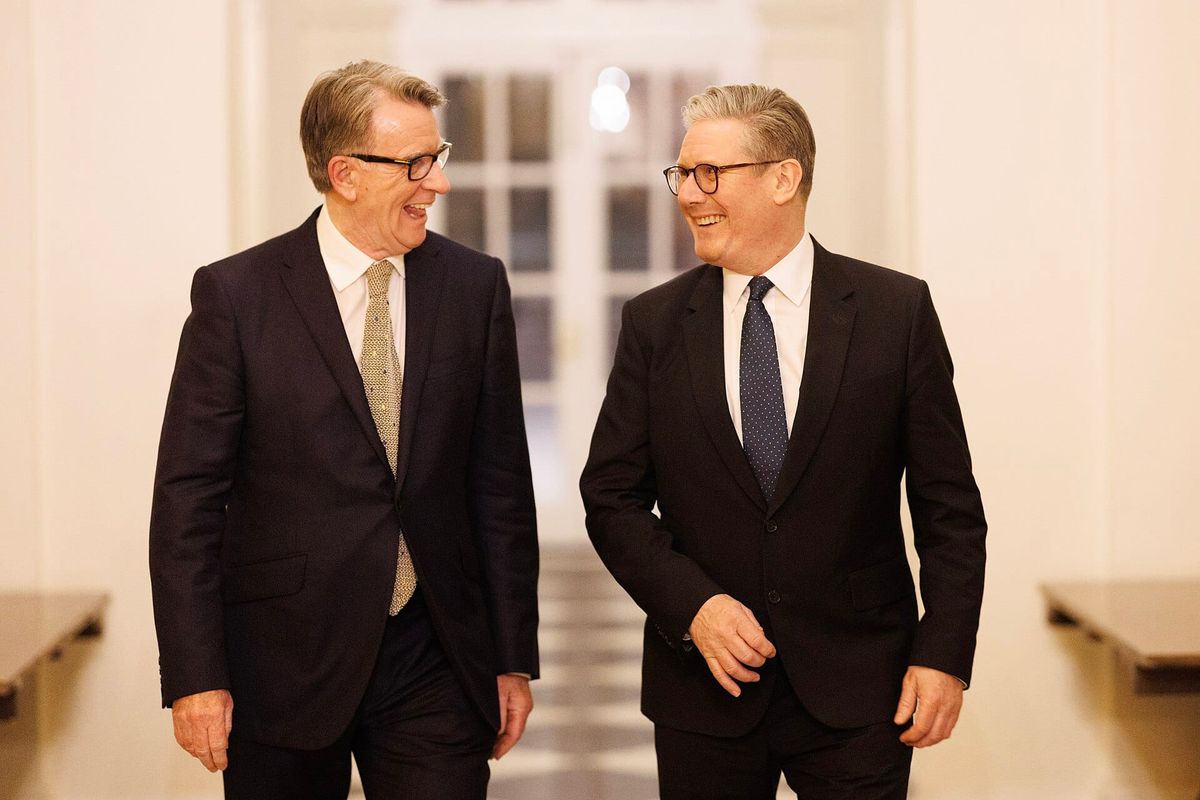
When the British Labour Party returned to government two years ago, it quickly became apparent that, much like the House of Bourbon, they had learned nothing and forgotten nothing.
Fourteen years in opposition, and the factional infighting that accompanied it, had paralysed the party machine and stymied any attempt to develop a fresh narrative. Instead of cultivating ambitious policies and building for government, time and energy were squandered purging the left and tightly monitoring the discipline of backbench MPs.
Keir Starmer placed his political confidence in Morgan McSweeney, a strategist moulded entirely by the factional machinations of internal Labour Party politics. The new Labour government might have cosplayed as a New Labour government, but at a fundamental level it lacked the initiative and ambition – and self-confidence – that defined Tony Blair’s first term.
'Bold initiatives and fresh policy need not apply', became the Starmerite mantra. It was sufficient that Sir Keir was more competent than the Tories. A political leader who could best be defined by who he was not. And not who he was. Sir Keir was not Corbyn. Sir Keir was not Johnson. Or May. Or Truss. Or Sunak.
But just who was Sir Keir? To the public, he was packaged as a 'forensic human rights lawyer', yet he stammered when confronted with Israeli war crimes. He was a 'decent man', who was forced to return £6,000 in luxury freebies. He purported to lead Labour but he banned his own MPs from picket lines.
Ultimately, he was an empty shell who coasted on the vague promise of competency and change. A twin-track strategy that was supposed to ensure stability and transform the country.
It’s nice, isn’t it? The quiet. That was the ambition of the Starmerite project.
Only it was not to be. Whether by instinct or institutional inertia, Starmer was unwilling to change all that much, and furthermore, politically speaking, he was not particularly competent.
Early decisions, such as cutting winter fuel payments and slashing the welfare budget, rapidly eroded public goodwill. Meanwhile, the resultant retreats and policy reversals only deepened a mounting crisis of confidence within his own party.
The Makerfield by-election might have ended his premiership, but the underlying vulnerabilities were there from day one. Ultimately, the structural fault lines of his administration were laid bare in his final resignation speech.
Alongside the usual self-aggrandisement and self-pity, Starmer still presented his entire premiership through the narrow lens of internal Labour Party factionalism.
The outgoing British Prime Minister chose to remind the audience watching at home how, “Six years ago, I inherited a Labour Party that was politically, financially and morally bankrupt.” A stale talking point that he had routinely regurgitated any time his leadership was questioned.
One might be tempted to ask why, if the party was indeed so bankrupt, was he so eager to serve in its Shadow Cabinet, and actively campaign to put Jeremy Corbyn into Downing Street in both 2017 and 2019? But that is another matter for another day.
The speech was pure factional score-settling, entirely devoid of genuine self-reflection.
It offered no accountability for how his administration had managed to spectacularly squander one of the largest parliamentary majorities in modern British history. Nor did it acknowledge that he now leaves his successor with a government that could itself be legitimately characterised as “politically, financially and morally bankrupt.”
To concede this, however, would mean acknowledging a far more uncomfortable truth. Namely, that the British State is terminally ill.
Death of the union
An administration that commands 411 parliamentary seats, out of a possible 650, should not find itself broken and hollowed out after a mere two years in office. A collapse of this magnitude is no accident; it is symptomatic of a dying constitutional framework.
The British public has now been subjected to seven Prime Ministers over the course of a single decade. This represents a staggering turnover when contrasted with the post-war era, where it took over six decades for twelve Prime Ministers to pass through Downing Street.
England’s traditional "two-and-a-half party system" is officially dead. The ancient Conservative Party is disintegrating, which, in turn, is clearing a path for an insurgent, neo-Powellite Reform UK to capture ground.
Because, as history teaches us, when establishment politicians abandon bold ambition for supposed pragmatism, political rot sets in and fascism takes root.
For Westminster’s political class, deep-seated convictions are juvenile. Long-term, values-based policy is passé. In this atmosphere, governance has devolved into a bureaucratic exercise of managing systems and balancing spreadsheets. With everything else contemptuously dismissed as “sixth-form politics”.
In the absence of a unified, coherent, overarching political project; conventional ‘politics’ has become a performative soap opera. One that sees ideologically identical politicians posture as bitter enemies during election campaigns, only to buddy up the day after the vote.
An act that ordinary people rightly see through.
Meanwhile, on the Celtic fringes, the fabric of the British state is rapidly unravelling. In Scotland, the SNP achieved a historic fifth consecutive term, while a political earthquake in Wales swept Plaid Cymru into power for the first time.
Three pro-independence First Ministers – sitting in Belfast, Edinburgh, and Cardiff – was never part of the Westminster plan. As John Curtice rightly noted on election night, “all three devolved administrations are being run by nationalist First Ministers. That wasn’t the idea of the original ‘devolution project’, which was to maintain the integrity of the United Kingdom.”
Like Brexit before it, this unprecedented electoral volatility and political fracturing is the direct consequence of a terminal, post-imperial identity crisis that has gripped Britain. What we are hearing is the unmistakable death rattle of the British State as we have known it.
Irish unity’s time has come
However, while everything has changed, in another very real sense nothing has changed.
The fundamentals between our two islands remain the same. Separation remains the only logical conclusion for anyone paying close attention.
Those sincere individuals who might have once believed that the failings of ‘the Union’ were the by-product of a chaotic Tory Party, can have no such illusions now. Instability isn’t a temporary aberration; it is a permanent feature of a system that is beyond repair.
Undoubtedly, Andy Burnham will bring a higher measure of political ingenuity to Downing Street than his predecessor. Although, in truth, that is a remarkably low bar.
The true test of his fêted advocacy for regional governance, will not be found in Manchester or Whitehall, but in Ireland. His commitment to local decision-making faces a simple, sharp, and undeniable challenge: will the new British Prime Minister step aside and allow the Irish people decide their own future?
His constitutional ambitions will not be measured by incremental tweaks to the devolution settlement. Instead, they will be judged by his willingness to permit a referendum on Irish unity, under the provisions of the Good Friday Agreement.
Naturally, any optimism on this front must be tempered. British Prime Ministers will do what British Prime Ministers do. Obfuscate. Delay. Deny. But that is alright. Irish republicans are well-versed with countering ‘Perfidious Albion’.
Because, in the end, political will is driven by ideas, and republicans possess an idea whose time has come. As Lafayette observed, “For a nation to love liberty, it is sufficient that she knows it; and to be free, it is sufficient that she wills it.” If the Irish people decide to end partition once and for all, then be in no doubt; partition will end. No British government can prevent that reality.
There is a tale that’s told of an exchange between Hanna Sheehy-Skeffington and James Connolly, shortly before the commencement of the 1916 Easter Rising. Knowing that the imminent rebellion could cost her dear friend his life, Sheehy-Skeffington sought to establish whether the socialist leader believed in an afterlife.
“Tell me, Jim,” she asked, “do you think there will be anything on the other side?”
“The British Labour Party?” came Connolly’s reply. “They won’t lift a finger to help us!”
Plus ça change, plus c'est la même chose.
Since July 2016, Joe Dwyer has worked as the London office manager and senior researcher for a series of Sinn Féin abstentionist MPs. He holds a Degree of Bachelor of Arts with Honours in Irish Studies and Politics from the University of Liverpool. He contributes regularly to Sinn Féin’s An Phoblacht magazine and the accompanying online journal Éire Nua. He is a member of Unite the Union and lives just outside of London.