

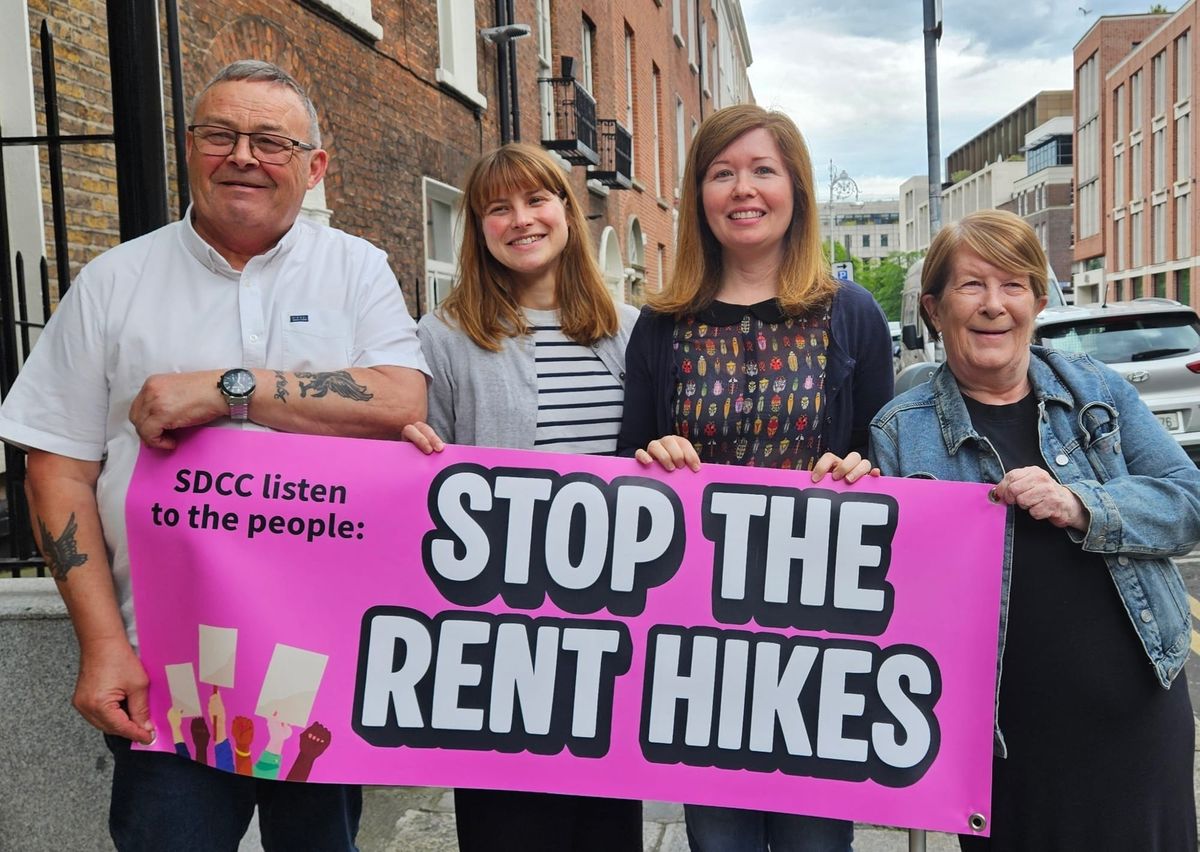
From 1 July, South Dublin County Council is pushing ahead with plans to reassess the rent of more than 20,000 households, council tenants, Approved Housing Body tenants, and those on HAP and Homeless HAP. For some, the increase will run into thousands of euros a year. For working families on the Working Family Payment, weekly rent could rise by over 50%, while a household with two pensioners on the state pension faces increases of up to 41%.
What's remarkable is that this is happening despite the elected councillors of that same council having voted to stop it. The Chief Executive is pressing ahead anyway. If that sounds like something is broken in our local democracy, that's because it is.
There are two arguments to make about this, and the left needs to make both. The first is economic: this is a deliberate choice to push the cost of social housing upward and bring it closer to "market logic", while leaving the wealth of South Dublin's biggest businesses untouched. The second is about democracy, and it's not getting nearly enough attention. What's happening in South Dublin should worry you regardless of what you think about rent schemes. It's a textbook case of unelected officials overriding elected representatives and we can’t let them get away with it.
A process built to avoid a vote
In November 2025, when councillors adopted the 2026 budget, they were told that rental income would rise that year. But the reason given was specific: "continued household income buoyancy and roll-out of the existing differential rent scheme". More people earning more, within the scheme that already existed. Not a new scheme charging higher rates.
No new rent scheme was put to councillors as part of that budget. Instead they said a review would take place in 2026, flagging that rents may go up “beyond 2026”. Compare that to what happened in Dublin City Council the previous year, where a new rent scheme was proposed and debated as part of the budget process itself, and councillors got the chance to propose alternatives. PBP Councillor Conor Reddy brought one such alternative, narrowly defeated by 31 votes to 30. Win or lose, councillors in Dublin City at least got a vote (and can again as part of the 2027 budget).
That was the process South Dublin councillors had every reason to expect too. On 9 February 2026, they unanimously passed a motion stating that any review of the differential rent scheme should be "based on fairness, not revenue-raising and must include consultation with tenants, tenants' unions such as CATU and organisations with expertise in tackling poverty and inequality". That's not a fringe demand. It passed without a single vote against it — its supporters included Fianna Fáil and Fine Gael, as well as Labour and Independents.
No such consultation happened. In May, council management presented a new rent scheme directly to the Housing Strategic Policy Committee, with implementation from 1 July, bypassing the 2027 budget process altogether and ignoring the consultation councillors had just told them to carry out.
What's wrong with the new rent scheme?
Differential rent schemes exist on a simple principle: tenants pay according to what they can afford, not according to what a property would fetch on the open market. That principle is being eroded. SDCC's new scheme raises the percentage of assessable income charged as rent by 25%, removes some of the protections that softened the blow for the poorest tenants, and brings the Working Family Payment into the calculation as assessable income for the first time.
Working Family Payment exists for one reason: to keep low-paid working families above the poverty line. It's not a bonus. It's the state's own acknowledgment that a wage alone isn't enough to live on. Counting it as rent-assessable income means the council lays claim to a slice of support that's specifically there to stop a family falling into poverty. A lone parent earning €450 a week and receiving Working Family Payment of €153 sees their rent rise by over 50% under the new scheme. Private tenants on HAP and Homeless HAP are affected too, and for them this could land on top of a separate rent hike from their own landlord.
This isn't some isolated local quirk. It's part of a broader pattern in how Irish local authorities are being pushed to treat social housing, not as a decommodified right but as a revenue stream to be optimised, with rent calculations edging closer to what the market would extract rather than what tenants can actually pay. Differential rent is meant to be the opposite of that. Every move that narrows the gap between social rent and market rent is a move against the basic purpose of having social housing at all.
Trying to stop the meeting
Faced with an executive that had ignored its own unanimous instruction, eleven councillors did something rare: they triggered Section 140 of the Local Government Act 2001. It allows councillors to formally direct the Chief Executive to carry out a specific act within his lawful powers, one of the few hard checks elected members have over the executive side of a council. Most of the day-to-day running of a council sits with the Chief Executive as an "executive function", well outside councillors' direct control. Section 140 is one of the only tools members have to reach into that space and issue a binding instruction.
On 10 June, the eleven councillors signed and submitted a Section 140 notice calling for a special meeting on 25 June, to direct the council to suspend the new rent scheme until the promised consultation had taken place, and not before the 2027 budget process. Under the Act, once a notice like that is properly submitted, convening the meeting isn't discretionary. The law says the Chief Executive "shall" circulate it and a special meeting "shall be convened". On 15 June, council management refused anyway.
This is exactly the situation the Supreme Court has already ruled on. In Cullen v Wicklow County Manager, the Court held that a council manager has no business acting as, in its own words, "a sort of shadow court of judicial review" over councillors' motions. Whether a motion is lawful is a question for the courts to decide after it's passed, not a gate the executive gets to close beforehand. If a manager genuinely believes a motion is invalid, the Court said the proper course is to say so and warn members of the risk, not to block the vote happening at all. That's the difference between an executive that advises elected representatives, and one that overrules them.
An unelected official threatens to defy the vote anyway
It took a solicitor's letter, threatening High Court judicial review and costs against the council, to get management to budge. On 19 June, the Chief Executive agreed to convene the meeting for 25 June. But he did so in an email to all councillors that also stated, in writing, that he would not implement the motion even if it passes, citing a further legal objection, and lecturing councillors about the "judgement" they'd shown in using Section 140 at all, given how many other council meetings were already scheduled that week.
An unelected official who had already ignored a unanimous council instruction once, who tried to block councillors from even voting on the matter, was now telling them in advance that he might ignore the result too, all while lecturing them for daring to use one of the only powers they have to hold him to account.
He was as good as his word. On 29 June, four days after the vote, the council's solicitors wrote to confirm that the Chief Executive considers the resolution void and will not be implementing it. The rent hikes go ahead from 1 July. The legal battle is now heading to court.
15 to 1: renters win the first battle
The vote on 25 June was overwhelming. Fifteen councillors voted to suspend the rent hikes and carry out the consultation that had been unanimously demanded in February. One voted against suspension — the Labour Party Mayor. With thirty tenants watching from the public gallery, the motion passed by a margin that left no doubt about where the majority of the chamber stood.
But forty councillors sit on South Dublin County Council. The other twenty-four (Fianna Fáil, Fine Gael, most of Labour and a block of independents) simply didn't show up.
These are the same councillors who voted unanimously for the February motion calling for fairness and consultation. They were perfectly happy to pass that motion when it cost them nothing. When the time came to actually enforce it, to stand up to the Chief Executive and side with the renters, twenty-four of them chose a third option: hide.
They weren’t brave enough to stand up to the council executive. But they also couldn't bring themselves to stand up in front of their constituents and vote to hike rents on lone parents and pensioners. So they did neither. They went missing.
What about the claim the motion is invalid?
The council's solicitors have now set out their legal case in full. The motion is void, they say, because it applies to a function "generally" rather than directing a "particular act". Suspending the new rent scheme for all social housing tenants is, in this view, equivalent to the Councillors wanting to set each individual’s rent one-by-one and that falls outside what Section 140 permits.
The counter-arguments are strong. The Councillors are not seeking to micro-manage the Executive. They are calling for a proper consultation process on the rent scheme, and for it to be considered in the broader context of the upcoming Council budget. Section 58 of the Housing Act 1966 gives a housing authority the power to charge rent "as they may determine from time to time" — a discretionary power, not a duty to revise the scheme on any particular date. There was no legal requirement forcing this change on 1 July. The Executive says that rent-setting is an executive function because a 2009 law that would have made it a reserved function has never been brought into force. But Section 140 exists so that members can direct the executive on matters that are executive functions. The fact that the rent scheme sits in that category is what makes the motion the right tool, not a reason to block it.
Under Section 149(6) of the Local Government Act, the Chief Executive is required to perform executive functions "in accordance with the policy of the local authority as determined by the elected council". In February, the council set policy unanimously: any rent review had to be fairness-based and properly consulted on. The executive went ahead without that consultation regardless. The Section 140 motion enforces a policy the council already agreed.
This case looks set to go to Court, and a major political battle looms over the upcoming Council budget process. Whatever the outcome, the political reality is clear: a Chief Executive set the rents of 20,000 households against the explicit wishes of the elected council, refused to allow a vote, and is now defying the outcome of that vote. That may or may not survive legal scrutiny. It has no democratic legitimacy whatsoever, and the Councillors will have nowhere to hide when it comes to setting the budget.
Seventeen years of an uncommenced law
The democratic issues here are even bigger than just council officials ignoring council votes. In 2009, the Oireachtas passed the Housing (Miscellaneous Provisions) Act, Section 31 of which would have made the adoption of local authority rent schemes a reserved function, a decision for elected councillors directly, not the Chief Executive. That section passed every stage of the Dáil and Seanad. It has never been commenced. Seventeen years later, the power to set the rents of hundreds of thousands of households across the state still rests with unelected officials, because successive governments have simply declined to switch on a law parliament already passed.
That's the structural root of the problem, and it has nothing to do with one Chief Executive's temperament. It's what happens almost anywhere in the country when the only formal check elected councillors have is a narrow, rarely used mechanism like Section 140, and even that gets resisted, delayed, and threatened with non-implementation.
The next fight: the budget
The court case is one front. The other is the budget, and it's coming sooner than people think.
South Dublin County Council will set its 2027 budget in autumn. Unlike the differential rent scheme, which management has treated as a purely executive function beyond the reach of councillors, the budget is a reserved function. Councillors vote on it directly. There is no hiding behind the Chief Executive. Every member of the chamber will have to stand up, take a side, and be counted.
The twenty-four councillors who went missing on 25 June will not have that option in November. If the budget includes provision for rent increases without the consultation that was unanimously demanded, they will have to vote for it, against it, or abstain and every tenant in their area will know exactly what they did.
That's the campaign that needs to be built over the next few months. The question to put to every Fianna Fáil, Fine Gael, Labour and wavering independent councillor in South Dublin is simple: will they work to find a fairer way to fund the council, rather than to squeeze more money out of pensioners, lone parents and some of the lowest-income families in the county?
What makes this a political choice, rather than a financial necessity, is what the council is choosing not to do at the same time. South Dublin hosts a good portion of the most profitable corporate activity in the country: Amazon, some of the largest data centres in Europe, and a concentration of multinational wealth that few local authority areas can match. Yet over 75% of the derelict site levies due in 2025 went uncollected, and more than €30 million sits outstanding in unpaid developer levies, some of it owed for years.
People Before Profit has repeatedly proposed taxing the biggest businesses in the county to fund services and housing investment, including a rates and rebate scheme that would protect small businesses while asking large corporations to pay more. Every time, it's been opposed by the same coalition of Fianna Fáil, Fine Gael, Labour and most Independents who now sit by while rents rise for the poorest tenants in the county.
Nobody is forcing South Dublin County Council to choose low-income tenants over large corporations as the source of additional revenue. The question for the autumn budget is whether enough councillors can be persuaded to choose differently.
The NoRentHikes.ie has succeeded so far, but in order to win the next battles the campaign must grow. Councillors across South Dublin need to hear from their constituents between now and November. The people who will pay the price of this rent hikes, the pensioners, the lone parents, the low-paid workers, are the people who live in those councillors' areas. They deserve representatives who will actually stand up for them when it matters.
That fight starts now.
An earlier version of this article was published on rupture.ie. The version published here has been updated following the Council vote on 25 June.
Cian Prendiville is an organiser with RISE, a member of the People Before Profit Steering Committee, and one of the founders of KeepLeft.ie.