

In late May 2026, I spoke at an event titled “Know Your Hedgerows”, organised by The Acorn Project in Kilkenny. Funded by The Heritage Council, The Acorn Project runs a tree nursery supporting the restoration of native trees, a local seed saving initiative, and a forest school. The venue for the event, the Old League House in Windgap, was built in the mid-late 1800s. Used as a meeting house for the Land League before its conversion to a residence and then dispensary, it passed into public use in the mid twentieth century. As the local story goes, the house was built in five days by the community to house the Brophy family after their eviction in 1881, where they lived until returning to their former home in 1890.
I was there to talk about the Irish rundale system of communal farming, once common across much of the Western Seaboard, now long eradicated. To ask what we could learn about community and cooperation from farming systems of the past, and how these systems left their mark on our culture, institutions, or landscape. To explore whether there was more to this kind of thinking than utopian idealism.
The location was fitting. Today we face a crisis similar to that of the Land League, but of international scope. This time the landlords are both local and global, and their reach extends far beyond property and land. They are the forces of capital and investment that shape the structure of our economies, that build the over-consuming data centres that dominate our national energy infrastructure. It is the system that created the incentives that make monocultures in food and timber attractive, and that now dictates the majority of our food supply. Its figureheads have left us a world that now looks certain to surpass the ‘net zero’ emissions target of 2050.
And while the richest will insulate themselves from climate change’s worst consequences, the rest of us will be left to fend. In the face of such a threat to our common good, there is much we can learn from the past about our collective capability to survive and thrive in the face of such forces. These lessons do not arrive as models for how to do things in the present by imitating the past. Sometimes they offer guidance on practices that worked, and could work again under the right conditions. More often they help us to shatter myths that insist the world of today is always how it will be, and that our condition is unchangeable because of our human nature.
What it was, where it was
‘Rundale’ was a system of partnership farming organised at village or townland level, where property was held in common, and land was allocated in shares by community lottery. It was governed by a customary legal framework that some have claimed originated in Brehon code. Described as a system of pre-capitalist ‘primitive communism’, by Engels and Marx, it has equivalents in Germany (The Mark), Russia (Mir), and Scotland (Runrig). The term seems not to be native, and may have been imported by outside observers or seasonal migrant labourers. Its similarity to the Scottish Runrig suggests this is possible. Others trace its roots to the Irish words ‘Roinn’ (to share) and ‘Dáil’ (assembly).
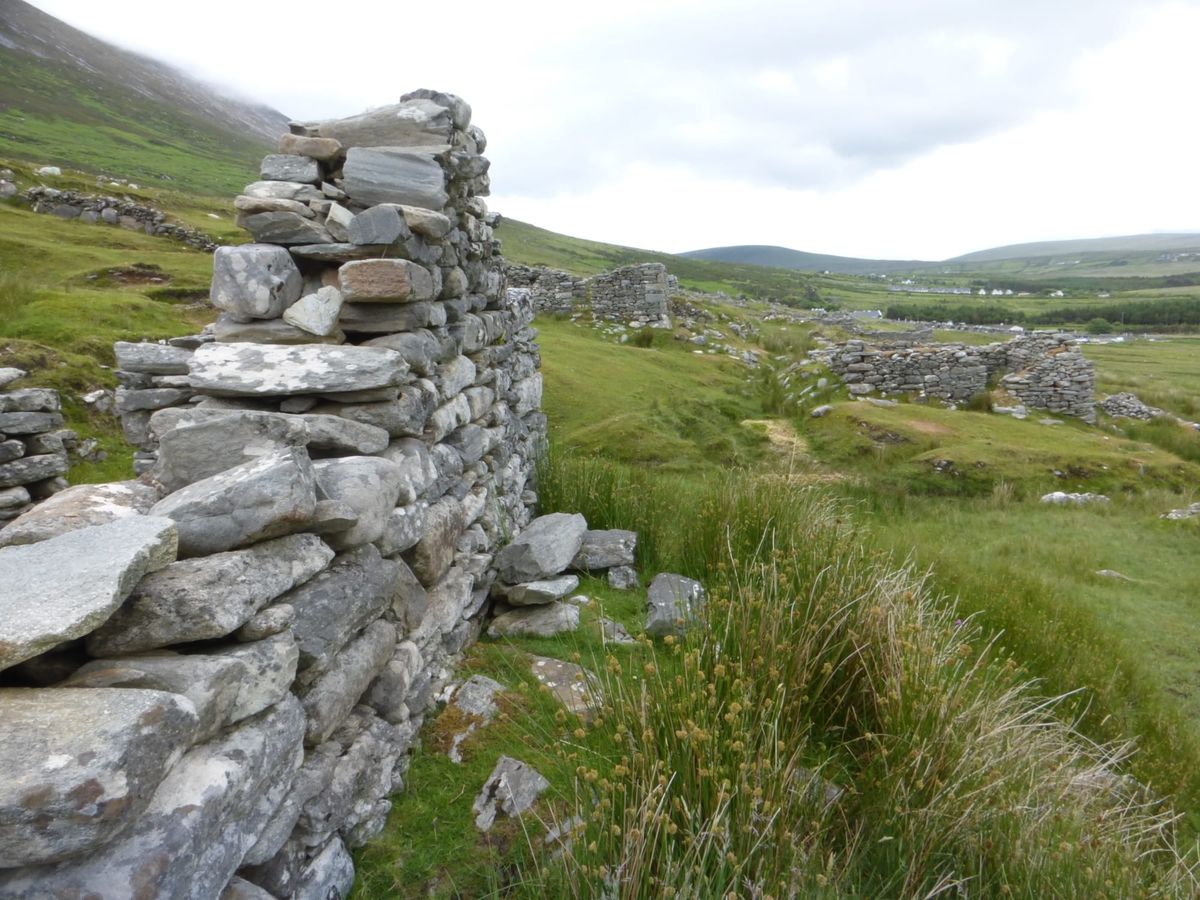
Looking just to the eighteenth and nineteenth centuries, rundale was found predominantly across the Western seaboard from Kerry to Donegal, and North into the Glens of Antrim. Rundale villages were established on marginal lands, upland wastes, and sometimes far from main thoroughfares. Their ‘open field’ form of agriculture meant that boundaries such as ditches and fences were absent, or minimal. Cultivated lands were divided between a permanently cultivated infield close to the houses, and an outfield beyond, where stock were herded seasonally during the growing season. This kind of transhumance or booleying gave rise to temporary settlements beyond the outfields, where herders would shelter during the summer to supervise stock.
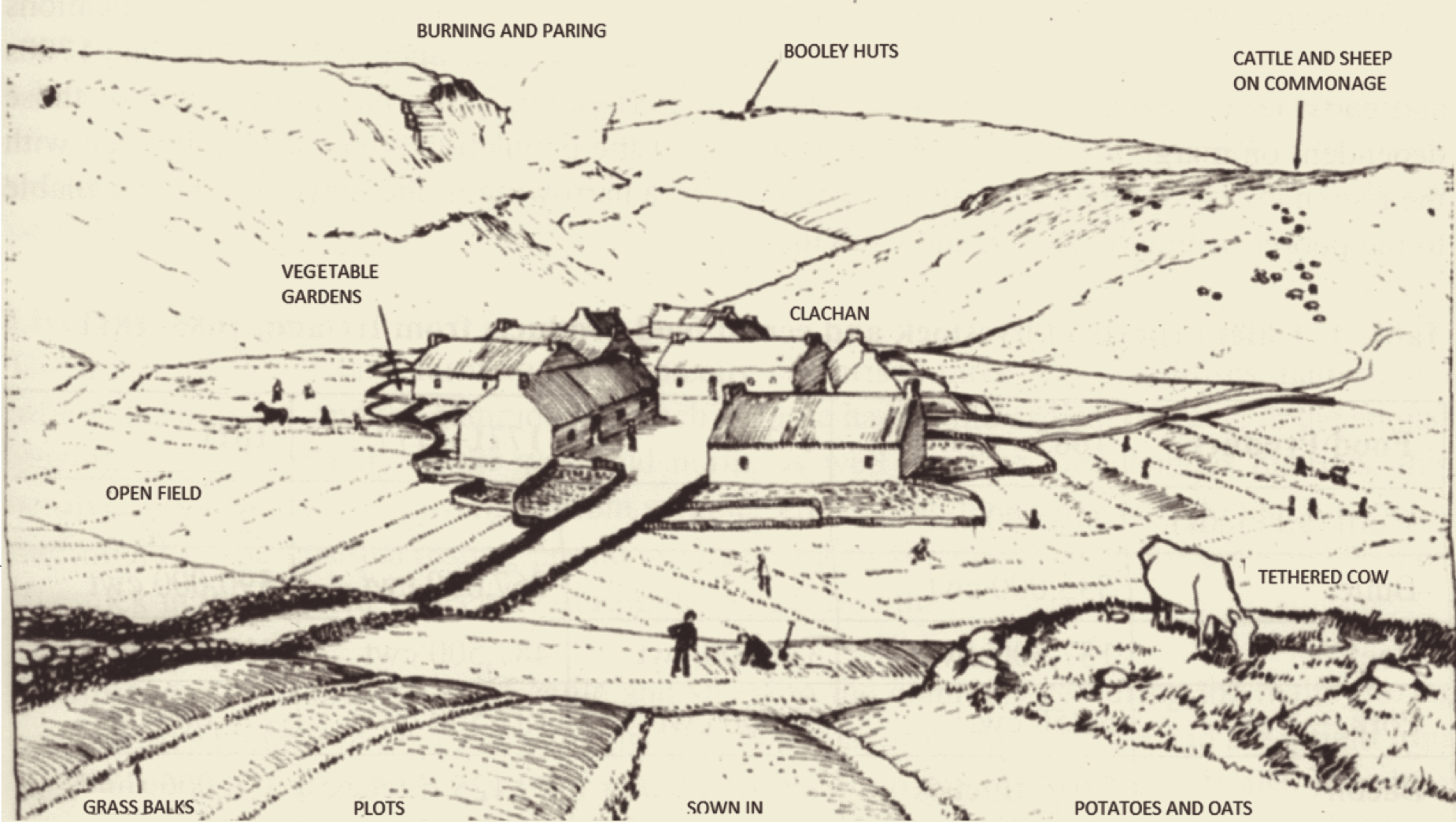
Community leaders were elected locally to liaise with agents, organise collective works, and resolve disputes. The local Rí or ‘king’ remained in practice as folk custom in parts of Ireland long after the rundale system ended, and the last Rí of Tory Island, Patsaí Dan Mac Ruaidhrí died in 2018. Fertility was often high, aided by early marriages and facilitated by the practice of ‘gavelkind’, or partible inheritance that allowed communities to subdivide land between inheriting heirs. This allowed new members and families to be accommodated either by subdividing the community infield, encroaching upon the outfield, or reclaiming new land. From this a system of mixed farming could be sustained with tillage of oats and potatoes, keeping of livestock, dairying, domestic spinning, and other craft.
What we know of rundale from the historical record is limited, but fascinating. It shows a system as varied within itself, as it was different from our established impressions of society in pre-famine Ireland. Yet its core of community and cooperation is consistent in written accounts. Henry Piers first observed the casting of lots in a Westmeath townland around 1682, where strips of land in varying quality were identified and dealt to households by public lottery. In 1836, Peter Knight saw similar in the townland of Kilmore, Co. Mayo where equality between families was maintained by allocating each shares of land in differing quality. Queen’s University geographer Estyn Evans thought that rundale originated in ‘Celtic times’, whilst others saw it as an adaptation to population pressures on marginal, unproductive lands.
Decline and eradication
There was no love for rundale amongst the colonial classes. Many were happy to tolerate subdivision of holdings amongst families to increase the number of rent-paying tenants. This was part of the story behind Ireland’s extraordinary pre-famine population growth from an estimated three million in the mid-eighteenth century to over eight million by 1841. After the Napoleonic wars, as stock prices were on the increase, consolidation of smallholdings and enclosure for grazing became the path to profit. Piecemeal enclosures denied the system the flexibility it needed to adapt to ecological, demographic, and economic pressure. On the eve of the famine in Donegal, George Hill took advantage of the lack of fences on rundale farms by impounding cattle straying onto his enclosed 12,000 grazing acres .
We do not remember the erasure of rundale nationally as an ‘enclosure movement’ like in England, or as a distinct epoch like the highland clearances in Scotland. Yet in Ireland, rundale was eliminated so effectively that the term all but disappeared from officialdom and folk memory. Its final traces were eradicated as part of an organised resettlement programme under the Congested Districts Board beginning in the late nineteenth century. By the time U.S. anthropologists Arensberg and Kimball arrived in Co. Clare in the 1930s to conduct their fieldwork for Family and Community in Ireland, they encountered a society founded on impartible inheritance, stem families, and homogenous peasant culture. Eventually, it passed into the accepted wisdom of social history, that Ireland had always been this way.
Challenging the myth of the irrational community
Defending the ideas of community and collective in the present faces difficulties. In the twentieth century, a kind of conventional wisdom about cooperation was laid down that claimed working shared resources together would inevitably lead to ruin. Driven by our basic human need to wring whatever we could individually from our natural resources, we were destined to ecological ruin without either strict rules and penalties, or the strong arm of the state. As Hardin described it, what we needed as a species was “…mutual coercion, mutually agreed upon”. This idea of the ‘tragedy of the commons’ would come to influence conventional thinking about how rules and regulation were the best way to ensure sustainability.
On the flipside, the idea of the tragedy also spun stories about how communities coming together to manage their own local resources would inevitably fail through individual over-exploitation. Worse still, the problem was not with the system of capitalist agriculture and its economic incentives, but within ourselves and our basic human tendency to hoard and overpopulate. By the time Elinor Ostrom won the Nobel Prize in Economics for her work on Governing the Commons, it was clear that the conventional wisdom was way off. Instead, Ostrom showed how commons-based ecosystems could thrive and endure for centuries, contradicting the tendencies that many assumed would drive such systems to ruin. We now know that under the right conditions, humans can and will “self-organize and devise institutions to extract themselves from tragic overuse”.
Writing on the nature of Republics, Sinead Mercier describes how adaptation to our ecological circumstances is enabled by deliberation. We have changed our environment immeasurably, warming our planet 1.1c above the 1850-1900 averages. The hazards resulting from this change to our climate are globally uneven, and our solutions must respond to local impacts and needs. As our environment has changed through human action, so too should the feedback from our environment in the form of climate hazards prompt us to change and adapt. By responding collectively to the needs of our time, and how our response should be rooted in an appreciation of the fundamentally communal nature of human life. The deliberative nature of rundale facilitated adaptation by threading ecology through its culture and institutions. Land and culture informed and conditioned each other. Land allocation through lottery was a necessary response to the needs of mixed farming, as a way of distributing risk amongst the community.
Ireland and post-growth communalism
Some of the lessons from rundale are concrete. Like the kinds of institutions it might inspire, or the systems of land management and property we might adapt for the needs of today. Part of the difficulty in speaking about the modern relevance of something like rundale is that different people usually want different things from it. The question that dominated discussion about rundale in the twentieth century concerned where it fit within the historical geography of Ireland. Others want something else, like the possibility of transplanting the model of rundale as a way of organising farming in the present. This resonates with modern land and food sovereignty movements, and indeed there are good cases from Ostrom and her followers of where this kind of organising has worked well under the right circumstances.
In 2023, the English translation of Kohei Saito’s Marx in the Anthropocene was published, building on Saito’s previous work Capital in the Anthropocene which sold over half a million copies in Japan. The book lays out in detail how capitalism creates a ‘rift’ in the connection between society and nature, or how it disrupts our capacity to sustain ourselves. It does this by forcing agriculture into a productivity-focused system, with increasing chemical and fuel inputs, and overworking of land. In the industrial age, this created an ecological gap between ever-growing cities and the rural areas that supplied their material inputs and processed their waste. In the present the problem is similar, but the scale is planetary. In its sixth chapter, Saito’s book turns to pre-capitalist systems of agriculture, suggesting that the solution to our modern crisis could rest in systems of the past. That we might discover how these communities, “..through the communal regulation of lands and property…realized a stationary and circular economy without economic growth.”
The inspiration for this kind of ‘degrowth communism’ is found in Karl Marx’s writings on precapitalist societies. In the classical Marxist view of social history, pre-capitalist agricultural systems, or what was termed ‘primitive communism’ fit into a sort of model of social ‘evolution’ on the path to socialism. Marx spent much of his later years thinking about this question and both Marx and Engels also wrote about Ireland. We now know much more about the extent of his interest in Ireland, and how he was intrigued by its revolutionary potential. His writings to Russian revolutionaries of his time show a positive view of agricultural communes, and how “…the commune is the fulcrum for social regeneration in Russia. But in order that it might function as such, the harmful influences assailing it on all sides must first be eliminated”.
Marx saw adaptive capacity in the Irish communes, and how they could fit within “the socialist trend” of his time. Important for today, this does not mean that the solution rests in a retreat to the countryside, an abandoning of technology, or a return to practices of the past. It means recognising that systems like this can co-exist in a world of complexity, and that true ‘sustainability’ in a changed world will involve groups working in common, at a variety of different organisational scales. In Saito’s sixth chapter on degrowth communism, he is clear that sustainability and social equality are inextricably linked, and that sustainability arises from cooperative production and communal property. In other words, abandoning the drive for productivity-driven growth, and working within the limits of our current circumstances according to local needs.
How we get there, and what needs to change
One of the most appealing things about understanding rundale is that it challenges us to rethink our relationships with nature and questions our assumptions about human social behaviour. The imprint left on our thinking by ideas like the tragedy of the commons should not be understated. It is the kind of thinking that expresses itself today in statements that blame simple, single factors like population growth for the climate crisis. The blame is not collectively ‘ours’ either. Taking the three decades from 1990-2020, the richest 10% accounted for almost half of global carbon emissions, with the bottom half of humanity accounting for 8%. We are not all to blame, and some owe a greater debt than others. If our legal systems are not equipped to consider the idea of common property, perhaps we need to start imagining alternatives. Everything should be on the table, from land sovereignty movements like Via Campesina, to the Chiapas peasant uprisings, to discarding and radically rethinking our national constitutions. The problems in Ireland are well understood: monoculture of grass, a production system that prioritises corporate power, and a food system where those who can afford it can access better quality food.
One question is how or where we might constitute the deliberative spaces that might overcome this. Association and deliberation require a kind of agency that feels alien to our modern sensibilities, but was possibly intuitive to the farmers of the rundale system, despite their constraints in a colonial land system. But if a kind of ‘deliberative democracy’ involving social movements is to happen, it is clear that our political and legal institutions lack the vocabulary to imagine a world other than it currently is. All action in this direction — practical, imaginative, or artistic — is an appeal to the principles that made rundale possible. And while there is no ‘best’ model for the future, there are better social foundations on which we might build alternatives. Maybe it is enough to take from rundale the possibility of cooperation, that its legacy lives in various ways in our landscape and culture, and that sentiments are changing in this direction. Through this, we can ignore passive readings of people of the past, and recognise that the material and ideological forces that eradicated our communal past are at work suppressing it today.
Eoin Flaherty is a lecturer in Maynooth University's sociology department. He is interested in the connections between social equality and ecological sustainability, Marxist social theory, and long-term analysis of social change processes.