

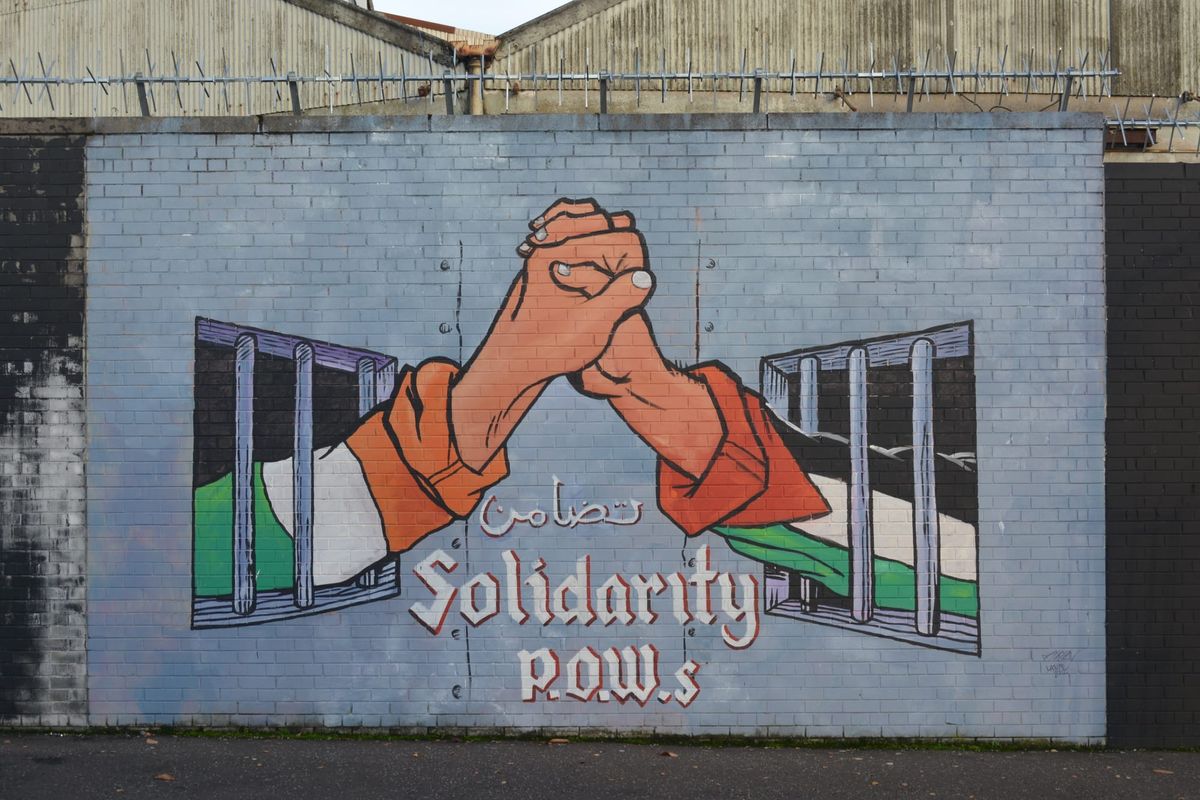
Widespread solidarity with Palestine didn’t come naturally or even quickly to Irish people. The flowering of support for those suffering in Gaza across Ireland since October 7th has been the direct product of the efforts of anti-imperialist and anti-racist organisers from the 1960s onwards to spread information, and of political organisers successfully reaching much wider audiences through effective messaging and action. This solidarity has been developed slowly and with great difficulty. What has happened amongst Irish activists organising for Palestine in the three years since October 7th is a story that is still being written.
The Irish-Arab Society
It was far from a foregone conclusion that Irish people would be pro-Palestinian by default, despite many commentators claiming that the outpouring of support for Gaza in the immediate aftermath of October 7th 2023 was the result of an obvious sense of kinship between Irish and Palestinian people due to our shared history of colonisation and displacement. Indeed, the first major Irish solidarity organisation related to the conflict was a pro-Israel organisation: the Ireland-Israel Friendship League, founded in 1967 after the outbreak of the Six Days War. It was only two years later, in 1969, that the Irish-Arab Society was founded, becoming the first major group in Ireland to advocate on behalf of Palestinians and other Arab populations affected by the Israeli state’s actions.
The first challenge confronting pro-Palestinian activism in Ireland at the dawn of the 1970s was the lack of knowledge of the Middle East amongst most Irish people. The Irish-Arab Society had been founded by three Irishmen and six Middle Eastern medical graduates with the aim of promoting friendship between Irish and Arab people. This involved much educational work to challenge negative stereotypes and create a space for Middle Eastern perspectives. The society addressed this by publishing The Irish-Arab News from 1975 to 1985, which provided extensive coverage of the Israel-Palestine conflict from a perspective which defended the Palestinian Liberation Organisation and Yasser Arafat alongside organising public lectures and the distribution of political literature.
The Irish-Arab Society was never a mass movement (its membership peaked at an estimated 150 to 200 members). Nevertheless, through its broader coverage of the Middle East the society exposed many in Ireland, particularly those in journalistic and political circles, to the Palestinian cause for the first time.
Irish Republicanism and Palestine
The Irish-Arab Society may have remained a small group largely confined to political and intellectual circles, but the same cannot be said of the Irish Republican movement of the same period which did so much to raise awareness of the conflict, particularly in the Six Counties.
The outbreak of the civil war in Northern Ireland (popularly referred to as “The Troubles”) in 1969 also saw an upsurge in political consciousness amongst the Catholic population parallel to that amongst Palestinians in the same period. The leadership of the republican movement in the Troubles drew attention to the analogies between the Irish experience of colonialism and partition and the ordeal of the Palestinians as they sought to place the violence in Ireland within a global context of anticolonial struggle. The leadership of Sinn Féin began to invite representatives of the PLO to their annual conferences, and to publish extensive and strongly pro-Palestine coverage of the conflict in their newspaper An Phoblacht.
The republican movement’s activist base were highly enthusiastic to learn about and make connections with anti-colonial movements across the world. Their enthusiasm created a receptive audience for Palestinian activists in Ireland which would develop into a network of interested readers and listeners, particularly in working-class areas of Dublin, Derry, and Belfast.
Working-class Catholics in republican communities in Derry and Belfast, who could remember being treated as second-class citizens in the years prior to the Troubles by the Unionist government, saw much of their own lives in the experiences of Palestinians living under occupation in the West Bank, leading to increasingly public displays of solidarity such as murals, poetry and the flying of the Palestinian flag from their houses. An intergenerational solidarity developed, as children growing up in these areas were exposed to the reality of the Palestinian struggle from an early age and came to view support for the cause of Irish unity and that of Palestinian freedom as one and the same.
Irish peacekeepers in Lebanon and Palestinian solidarity in Ireland
Whilst Ireland has a proud tradition of military neutrality, Irish soldiers have nevertheless served as peacekeepers for several decades. The most prominent of these engagements has been in Lebanon, where Irish troops have served on several major operations since 1978.
The first Irish defence forces mission in the country consisted of supervising an Israeli withdrawal from the country and preventing fighting between the IDF and PLO in the region. Many of their efforts over the next decade were to be dominated by the aftermath of the 1982 Lebanon War, which began with the Israeli invasion of southern Lebanon. Irish soldiers proceeded to spend much of the next two decades peacekeeping through a prolonged guerrilla war between Israeli forces and Hezbollah. From 1978 onwards, 48 troops died on duty (53% of all Irish fatalities on peacekeeping missions).
The involvement of Irish troops in Lebanon had a twofold effect on Irish attitudes to the Palestinian cause. Whilst organisations such as the Irish-Arab Society and the efforts of the republican movement were hugely important, their efforts were largely confined to urban areas and those who were already interested in the cause. By contrast, many people in rural areas where the army was one of the few major employers now had a very personal connection to the places they’d only ever read about in the Bible where their brothers, fathers and husbands were risking their lives, and came to take an interest in events in the region.
Ireland Friends of Palestine
The presence of Irish troops in Lebanon provided the impetus for the formation of the group Ireland Friends of Palestine in 1981, which was active until 1988. This was an explicitly political group with a specific focus on promoting the Palestinian cause in Ireland, distinguishing it from the Irish-Arab Society whose efforts had focused on promoting a general understanding of Arab culture and society in Ireland.
Ireland Friends of Palestine shared an emphasis on education with the Irish-Arab Society, but complemented this with direct action targeting visiting Israeli representatives alongside calls for the boycott of Israeli goods and the recognition of a Palestinian state.
Ultimately, Ireland Friends of Palestine suffered the same fate as its predecessor in only ever really being a small group rather than a mass movement. But it nevertheless changed the nature of pro-Palestine activism in Ireland by fully embracing protest tactics and lobbying.
The rejuvenation of Irish solidarity with Palestine in the 21st century
The 1990s were not a fruitful time for pro-Palestine activism in Ireland. Leftist movements in Ireland, as in many Western European countries, withered during a decade marked by an overall decline in union density and political party membership. The emergent peace processes in Ireland and Palestine, marked by the signing of the Good Friday Agreement in the former and the Oslo Accords in 1993 in the latter, led to a diminished sense of urgency amongst activists. The sense of solidarity between Ireland and Palestine remained strong, particularly within the republican movement. However, there was little in the way of organised pro-Palestine activism.
This was to change with the Second Intifada in 2000. This turn of events led to the foundation of the Ireland Palestine Solidarity Campaign. The impetus for the foundation of the campaign came from within the West Belfast republican community. A republican and Irish language activist named Feilim Ó hAdhmaill contacted the veteran leftist activist Tom Hyland, who was head of the East Timor Solidarity Campaign at the time, to pursue a potential collaboration. The Ireland Palestine Solidarity Campaign (IPSC) was inaugurated on 29th November 2001 in Trinity College Dublin, with a network of branches established across the country.
The IPSC rejuvenated pro-Palestinian activism in Ireland by incorporating many of the lessons learned from the anti-apartheid movement of the 1980s. Using sports and cultural exchanges to draw attention to the issue educated a wider public on the topic, and encouraged trade unions to incorporate opposition to apartheid into their platforms. In doing so, the anti-apartheid campaign successfully broadened its reach across class and political divides. It showed how the struggle against South African apartheid could be integrated into different elements of daily life, such as sport, workplaces, education or culture.
The generation of activists who would go on to successfully promote Irish solidarity with Palestine in the 21st century would learn much from these tactics. These were given particular impetus after a number of Irish activists were affected by the storming of the Gaza flotilla, which drew a major degree of public attention to the conflict.
The Gaza Flotilla
On 31st May 2010 the elite Israeli naval unit Flotilla 13 stormed the Mavi Marmara, the Turkish flagship of an international flotilla bringing humanitarian aid to Gaza where Palestinians had been suffering under a blockade initiated by Israel and supported by Egypt since 2007. Nine activists on board were killed by Israeli troops. Three Irish people were on board.
The Mavi Marmara was accompanied by the MV Challenger I, which also had three Irish activists on board. These three, alongside the three who had been on the Mavi Marmara, were detained by the Israeli state.
These ships were followed shortly after by the MV Rachel Corrie, which had five Irish activists on board. These included the Nobel Peace Prize winner Máiréad Corrigan-Maguire and former UN Assistant Secretary-General Denis Halliday. The MV Rachel Corrie was intercepted and boarded by Israeli forces, who proceeded to detain the activists for the heinous crime of bringing food and medical supplies to one of the most deprived areas on Earth.
The Irish state intervened to secure their release, forcing a diplomatic incident which drew the Irish public and media’s attention to Palestine like never before. A wide range of Irish public figures from differing party and organisational backgrounds would go on to sail on subsequent flotilla efforts over the coming years and be detained for their efforts, furthering the Irish public’s interest in these efforts and the context for them.
Marches against Israeli violence began to grow exponentially. On 10th August 2014, 10,000 people attended a protest at the Israeli embassy in Dublin against the 2014 bombing of Gaza. This figure marked an increase from the 2,000 protesters who had taken to the streets a mere nine days earlier, demonstrating how messaging and educational efforts had developed genuine public engagement with the cause.
Cultural Boycotts in Ireland
The IPSC introduced a campaign to boycott Israel across commercial, cultural and academic spheres from 2005 onwards, alongside direct action and organising protests. The anti-apartheid campaign’s cultural boycott was revived, with hundreds of musicians and artists signing a pledge not to perform in Israel. This did much to make the Palestinian cause visible to new audiences both within Ireland and elsewhere, most obviously in 2021 when Sally Rooney refused permission for her novel Beautiful World, Where Are You to be translated into Hebrew as part of this cultural boycott. Rooney was widely denounced as an antisemite for her trouble, but this action exposed many young people globally to the movement to boycott Israel.
The cultural boycott was mirrored by efforts to encourage universities to undertake academic boycotts of Israel, and for a commercial boycott of Israeli products. These have not yet met with the same success but have nevertheless provided an opportunity for activists to educate the public on the parallels between Israeli and South African apartheid as well as ensuring that people are reminded of the ongoing reality of life for many Palestinians during those periods when the mainstream media declines to cover the conflict. The IPSC has supplemented this campaign with a regular programme of cultural and social events such as annual Nakba Day commemorations, public lectures and film festivals.
Irish pro-Palestine activists have also incorporated trade unions into the struggle. Grassroots activists have campaigned from within their unions from 2005 onwards to encourage the adoption of Boycott, Divestment and Sanctions (BDS) resolutions against Israel. Trade unions across Ireland have adopted motions condemning Israel as an apartheid state over the last two decades.
While encouraging, these identifications have for the most part been rhetorical, with nothing comparable to the Dunnes Stores strikes in the 1980s or even the cultural boycott of Israel.
Sport and Palestinian solidarity
Sporting events have also been a central part of efforts to educate the wider public, echoing the anti-apartheid campaign’s protests against the South African rugby team in the 1980s. Events such as the football match in Dublin between Ireland and Israel on 4th June 2005 were turned into opportunities to draw attention to the plight of Palestine, with up to 1,500 people attending a demonstration for Palestine beforehand. This has been succeeded by petitions calling for the expulsion of Israeli athletes and teams from major tournaments on grounds similar to those applied to Yugoslavia in the 1990s or Russia after the invasion of Ukraine in 2022, as well as organising fundraisers for Palestine during events such as the Dublin marathon.
This effort to raise consciousness amongst athletes and sporting fandoms has been a major success, with sporting events becoming an opportunity to show solidarity. Dublin’s Bohemians FC were very prominent in this regard, with away jerseys being sold to raise funds for the Palestine Sport for Life project in 2023. This was preceded by Dundalk FC being fined €18,000 by governing body UEFA after their fans flew a Palestinian flag in the stands at a European game in 2014, such displays being a common sight at League of Ireland games.
The most important example of active fan engagement is the strongly pro-Palestine stance taken by elements of the supporters of the Scottish club Glasgow Celtic, which has a strong tradition of drawing support from the Irish republican community and Irish diaspora. Celtic fans regularly display Palestinian flags and banners. This has had the dual effect of making the Palestinian cause visible not only across European television screens – since Celtic have attained a profile unimaginable to any Irish club – but also to young people growing up as Celtic fans across Ireland and Scotland. Notwithstanding, several supporters have lost their season tickets and faced other sanctions from the club for displays of pro-Palestine solidarity, in an unfortunate echo of the backlash to the anti-apartheid movement.
The limits of solidarity
But for all the successes in educating the public and generating interest in the issue, Irish solidarity with Palestine remains largely rhetorical.
Conditions in Ireland are much less favourable for anyone attempting an action modelled on the Dunnes Stores strike against South African apartheid to protest Israeli apartheid and genocide in the 2020s. The 1990 Industrial Relations Act not only bans political strikes but prohibits unions from picketing outside any workforce with which their members do not have a direct dispute. It is now illegal for a trade union to take the initiative on Israeli apartheid as they did on South African apartheid.
Moreover, Ireland now has a much weaker trade union movement than in the 1980s. Even several of the Dunnes Stores strikers – despite their age and professed lack of background in activism – were already veterans of an earlier 1983 strike. By contrast, a 2022 survey found that 79% of workers aged under 24 had never been in a union.
Further constraints come at the European level, where EU agreements which list Israel as a preferred trading partner have made the Irish state much more reluctant to back a full boycott or to pursue a genuinely independent foreign policy. The increasing integration of technology and pharmaceutical multinationals across borders meant that Ireland was one of Israel’s biggest trading partners at the outbreak of the current genocide in October 2023. This economic integration has intensified since then. Despite the Irish state’s recognition of Palestine and calls for a ceasefire, Ireland was the second-biggest market for Israeli exports in 2024.
The wider Irish public may have been much more receptive and informed about the cause of Palestine now than they were about South Africa in 1984. But the challenges for activists in leveraging that goodwill into sanctions against Israel are far greater. Efforts to organise since October 7th, and what they have achieved, reflect both the achievements and difficulties of Irish organising for Palestine in the decades leading up to that day.
Many thanks to Dr David Landy of Trinity College Dublin, whose guidance was invaluable when writing this piece.
Pádraig Mac Oscair is a writer from Donegal based in Dublin. His writing can be read in Flotsam, Socialist Voice and Mionlach or on substack.com/@pmacoscair. His first play, Muinín, was premiered at Oireachtas na Samhna in November 2025.