

.jpg)
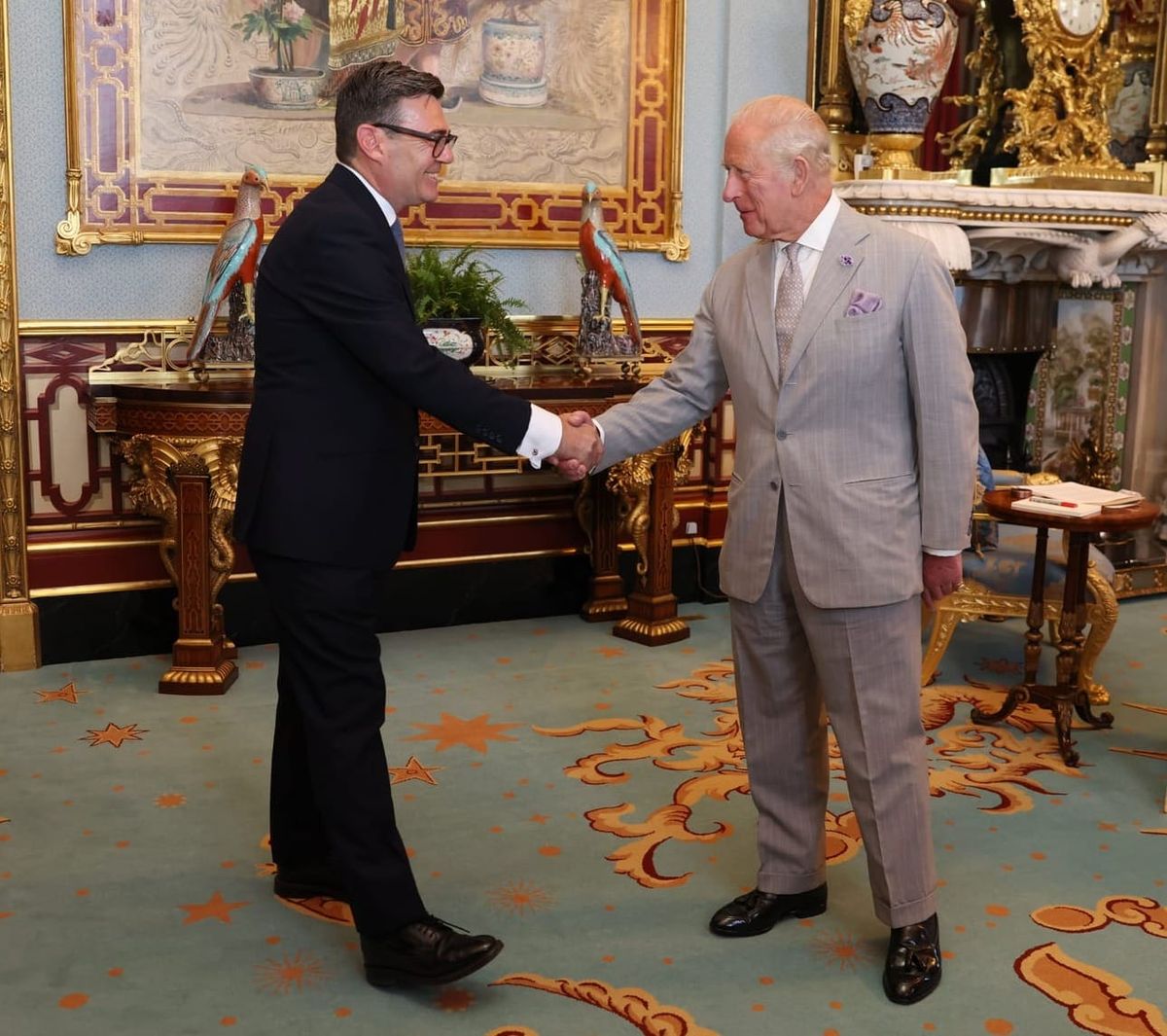
British prime ministers have historically observed Irish affairs with a sense of detachment and confusion. Following his first official visit to the North, Prime Minister Andy Burnham has proven that he is no different.
His dismissive claim that a border poll on Irish unity is “off the table” simply continues a long-standing tradition of patronising and indifferent governance from Downing Street.
Memorably, in the aftermath of the 1916 Easter Rising, Prime Minister Herbert Asquith vented to his wife, “You will never get to the bottom of this most perplexing and damnable country”. By 1921, future Prime Minister Winston Churchill grumbled that a “small, poor, sparsely populated island” could repeatedly “stop the whole traffic of the British Empire, in order to debate her domestic affairs”.
Post-partition, British policymakers were left even more puzzled and perplexed. Indeed, as the political situation in the North deteriorated in the late 1960s, the British Home Secretary James Callaghan advised his Prime Minister, Harold Wilson, not to get “sucked into the Irish bog.” Clearly, the bog had become a quagmire that had already broken generations of British politicians.
Even staunchly unionist prime ministers like Margaret Thatcher found Ireland, both North and South, to be bafflingly alien. As she openly pondered in her (otherwise highly self-assured) autobiography, “But what British politician will ever fully understand Northern Ireland?” A telling question that entirely discounted those loyal Ulster MPs who very much considered themselves to be British politicians! Her successor, John Major, certainly saw little domestic political capital in Ireland, as he privately confided to President Clinton, “For most people here, Ireland is just another island.”
Both “other” and “ours”
In more recent years, this emotional detachment has been coupled with a fundamental ignorance. We have seen British secretaries of state ask if they require passports to visit Derry, or express amazement that Irish nationalists do not vote for unionist parties and vice versa. During the heights of the Brexit process, Boris Johnson went so far as to compare the British border in Ireland to the boundary between the boroughs of Camden and Westminster.
To put it very simply, Britain’s political class does not love, value, or understand the North of Ireland. They never have. They never will. And most do not even pretend to anymore.
And this is where the frustration with Burnham’s recent remark stems from. The North is presently stuck in a constitutional set-up whereby those who least understand the place simultaneously feel comfortable issuing supposedly authoritative edicts about its future.
The people of the North are trapped in a situation where, so far as Westminster is concerned, they are simultaneously “other” and yet also “ours”.
Burnham is far from the first British prime minister to dismiss the prospect of a unity referendum. When his predecessor, Keir Starmer, was similarly challenged, he would lean on a stock answer that Irish unity was simply not “on the horizon” or “in sight”. Although the later trajectory of his premiership might suggest that his foresight was lacking.
What arguably sets Burnham’s remarks apart, however, is the breadth of the negative reaction they have sparked. Irish republicans expect little else from a British prime minister. But people who are open to the conversation on constitutional change, those who can see that current arrangements are not delivering, are increasingly fed up with Westminster’s tone-deaf pronouncements on their future.
The fact that Burnham prefixed his remark by saying that he was in the North “to listen”, before then ruling certain topics “off the table”, says it all.
That his Secretary of State to the North, Chris Bryant, was hurriedly pushed in front of television cameras to clarify that the Prime Minister only meant to say, “we’re taking that off the table today”, will do little to temper the annoyance. Do they expect the people of the North to wait on the day-to-day whims of visiting Englishmen to consider their future?
The entire affair encapsulates the shallowness of British engagement with the North. Hop on the plane. Smile for the cameras. Say nothing of substance. Fly home.
Perfidious Albion
Be in no doubt, despite efforts to present it as otherwise, this was more than a mere slip of the tongue.
It is notable that when he was pressed on why the topic was “off the table”, the Makerfield MP rooted his reasoning in entirely immaterial considerations, justifying his dismissal on the basis that “we’ve lived through a decade where there’s been a referendum on Brexit, we had Scottish independence just before it”, and that “the rifts that come from those situations take a long time to heal”. Instead, he would rather focus on discussing the cost-of-living crisis and the need to agree a budget.
While nobody disputes the importance of these concerns, governments are entirely capable of managing economic crises while simultaneously addressing future constitutional arrangements. We can walk and chew gum.
Ultimately, past referendums, societal divisions, and immediate economic pressures are irrelevant excuses. Despite Bryant’s protestations, one cannot pretend that Burnham was upholding the Good Friday Agreement when he explicitly referenced unrelated criteria.
Despite its shortcomings, the Good Friday Agreement does establish a codified mechanism for realising a united Ireland. However, while this mechanism holds undeniable potential, such potential only has value if it is fulfilled. Britain is not known as ‘Perfidious Albion’ without good reason.
As the response to Andy Burnham’s comments has highlighted, the 1998 Agreement dictates that an Irish unity referendum will only occur if “it appears likely” to the British Secretary of State that a majority would vote to leave “the United Kingdom”.
This clause is undeniably flawed. Its core weakness is that the criteria the Secretary of State might use to gauge such a likelihood remain entirely undefined. However, seen in another light, it is equally true that those advocating for change should be wary of demanding a rigid, British-defined threshold that might be intentionally designed to be unreachable. In this sense – and this is presently being tested – strategic ambiguity could be an asset for those advocating for unification.
Everything is on the table
By any measure, the path toward constitutional change in the North is heading in only one direction. Even former Prime Minister Gordon Brown admitted as much in a recent interview: “in the long term, Ireland will be united.” The issue is not so much if it will happen, but simply when the people agree to it.
Equally, it is worth noting that the specific wording of the clause, namely that “the Secretary of State shall exercise the power”, clarifies that this duty is not optional. A Secretary of State cannot adopt the position that they would never call a border poll, regardless of prevailing circumstances, as doing so would unlawfully ignore their statutory obligations.
So, when will it happen? In truth, no British prime minister would permit a mere Secretary of State to trigger a constitutional referendum based on individual intuition or impulse.
Neither will a prime minister push for a referendum while the Irish Taoiseach openly attacks his own party colleagues for supporting one. It is deeply unfortunate that the current Taoiseach fails to defend Irish self-determination as fervently as British prime ministers casually dismiss it.
Ultimately, political reality will force a referendum. It will be a high-level, joint calculation by the British and Irish governments. When the conditions are met, London is legally bound to act. The electoral growth of pro-unity parties, the expanding constitutional debate, and a growing network of allies will eventually make this reality impossible to deny. Both the British and Irish states have settled on this formula. The sovereignty of the North has been placed into the hands of the people of the North. That is the future.
Burnham may wish to claim Irish unity is “off the table”, but anyone watching closely knows otherwise. The fact that he was even asked about it signals its urgency. It is an active debate happening at kitchen tables, studio tables, and top tables across the island.
Irish unity was put on the table in 1998, and it has frustratingly sat there ever since. An unresolved question that demands an answer.
With shifting voting trends and evolving attitudes in the North, it is time for the Irish government to come to the table and press their British counterparts to do the same. Because rejecting the possibility of constitutional change is no longer credible or sustainable.
If Burnham continues to ignore the call for a referendum, he will go down in history as yet another out-of-touch English politician who did not understand Irish affairs.
It should not be forgotten that when Ian Paisley first sat down with Martin McGuinness in 2007 he famously told his new partner in government that “We don’t need Englishmen to rule us. We can do that ourselves.”
Strikingly, in late August a founding member of the DUP, Wallace Thompson, suggested that if Paisley were alive today, even he might be on a similar path toward accepting Irish unity.
Because as Enobarbus observed in Antony and Cleopatra, “The loyalty well held to fools does make our faith mere folly.” For those still undecided on unity, the core question is this simple: why let English politicians govern your future when Burnham has just demonstrated how rarely they even consider it?
Since July 2016, Joe Dwyer has worked as the London office manager and senior researcher for a series of Sinn Féin abstentionist MPs. He holds a Degree of Bachelor of Arts with Honours in Irish Studies and Politics from the University of Liverpool. He contributes regularly to Sinn Féin’s An Phoblacht magazine and the accompanying online journal Éire Nua. He is a member of Unite the Union and lives just outside of London.