
Fintan O’Toole argued recently in the Irish Times that the Orange Order's shrinking membership diminishes the case for opposing the Orange Order.[1] His interpretation understates the violence promoted by still-significant Orange prejudice. The question is not whether the Orange Order is declining – though it is due to sustained opposition to its sectarian practices.
The question is: does it remain a significant obstacle to a genuinely shared and democratic society? The answer is that it does, and only unrelenting non–sectarian public opposition undermines its influence.
All must suffer
Despite a diminished overall Orange footprint, there is still a lot of marching. Of the 2057 unionist and ‘loyal order’ parades conducted in 2025, 138 were designated ‘sensitive’ by the North’s Parades Commission. Of republican-nationalist demonstrations the commission counted a mere 96, of which just three were ‘sensitive’.
The Parades Commission is an exceptional body, with significant powers to circumscribe the right to protest. Ideally, such a body should not exist – but all must suffer due to the peculiar nature of Six-County society and the sectarian cleavage locked within its politically limiting borders.
It was the Garvaghy Road impasse of the 1990s that produced the Parades Commission. 21 deaths during 1996-99 accompanied futile attempts by the Orange Order to force a way through. The main purpose of the commission was to regulate the Orange Order, in particular its tradition of mobilising sectarian reaction on roads, highways and byways. For that reason it earned the Order’s undying enmity.
The most recent proposed Garvaghy Road march constitutes the thin edge of a sectarian wedge. Its particular symbolic and political importance explains why it is both supported and opposed. The Orangemen’s attempt to seek passage through a predominantly nationalist and Roman Catholic community in 2026, for the first time since 1997, amounted to an attempt to reclaim the streets as their own. In a community that fears and resents this display of sectarian triumphalism, the march is widely seen as an effort to reassert Orange dominance and push back against the long-term erosion of Orange and unionist power.
The Order’s history stretches back to opposing new secular and anti-colonial politics promoted by the revolutionary United Irishmen in 1798 and to partial relaxations of anti-Catholic Penal Laws in 1778, 1782 and 1793. Orange Order marching and anti-Catholic violence originated in Loughgall in 1795 and in nearby Portadown shortly afterward in 1807, though it can be traced to driving 7,000 Roman Catholics from Armagh in the late 1780s, early 1790s.[2] The attitude of the ruling Protestant Ascendancy, toward either support for plebeian Protestant violence or Catholic conciliation, vacillated. It depended on elite responses to the revolutionary situation in France, the American colonies and in Ireland during that period.
For the Orange Order, their capacity for success depends on the extent of visible opposition, both from outside Protestant community, and increasingly from within it.
When reaction mobilises on the streets, it is either circumscribed or facilitated by the state. The residents of Garvaghy Road, supported by an increasingly broad coalition of allies, sought to compel the British state to act.[3] Faced by broadening support, implacable nationalist opposition, and dissent from within the Protestant community, the British Secretary of State was forced to act. The parade was banned. But the Order, and the sectarian menace it represents, remains at large.
Revolt against modernity
The Orange Order has long been adept at deflecting questions about its sectarian outlook and practices. When accused of fostering supremacy and division, the Orange order resorts to a rhetoric of feigned inclusion and tolerance, and presents Orange sectarian exclusivity as a form of ‘diversity’.
In the 2000s, thousands of Orange parades were thus promoted as ‘Orangefest’, a thread in the fabric of multiculturalism (when that was flavour of the month). In 2006 unionist councillor William Humphreys referred to “accommodation” and “shared space” in relation to Orangefest. Complicating facts on the ground kept obtruding. That year the Irish News (18 Jul 2006) reported, “a banner commemorating UDA leader Joe Bratty was carried through Belfast city centre” in an Orange parade: “In April 1994 Bratty was questioned about the murder of mother-of-two Theresa Clinton.... killed after UDA gunmen threw a concrete block” through the window of her home “and opened fire with automatic rifles hitting her 16 times”. Bratty was also implicated in the notorious February 1992 UDA gun attack on Sean Grahamʼs Bookmakers on the Ormeau Road leaving five people dead. The Orange Order celebrated the Ormeau Road killers later in 1992, when Orangemen passing the massacre spot held aloft five fingers in celebration.[4]
This was not a one-off. For example, in 2003 Orangemen displayed a banner celebrating UVF sectarian killer Brian Robinson. The Orange Order member carrying it was Eddie McIlwaine who had been sentenced to eight years in prison for membership of the notorious ʻShankill Butchers’, who routinely tortured and killed Catholics during the 1970s.
Facilitated by the ‘Good Relations’ discourse of the post-1998 Good Friday Agreement (GFA), and its symmetrical framing, the large number of Orange and loyalist parades thus are presented today as positive expressions of Protestant culture. Any attempt at suppression is then portrayed as an assault on Protestant identity. It is rather like the argument that Zionism is synonymous with Jewishness. In recent decades, the unionist tradition has developed a political affinity with Zionism. Ironic, given that during the First World War Jews in the North, considered ‘German’, were driven out by unionists. Prior to the Second, in 1934 addressing Orangemen Unionist premier James Craig said that both they and the part-time sectarian B-Special police force “constitute all the fascism that Ulster wants”.
The inability to point to a similarly significant Irish nationalist comparator makes it a challenge for the Orange Order to normalise its sectarianism. Attempts to resolve the problem point to the very small Roman Catholic Ancient Order of Hibernians (AOH), as the Orange Order’s symmetrical counterpart. The AOH are a one-time adjunct of the old Irish Parliamentary Party, that sent Irish MPs to Westminster prior to Irish independence. But the AOH has not been a significant force since the early 20th Century, reflecting the general preference of republicans and nationalists for secularly-based politics.
‘Being Protestant’
Allegiance within the Orange Order is conditional on loyalty to a “BEING PROTESTANT” British monarch, a capitalisation preserved in the organisation's constitution and rules. A religious outlook is imbued with a Unionist political identity that is defined as ‘British’. The physical proximity of Ireland to Britain means the identification is largely unexamined, but bears resemblance today to 1950s-60s white-colonists in parts of Africa, who identified themselves as ‘British’ or ‘European’ rather than African. It is an essentially settler-colonial outlook in which British territory is often termed 'the mainland'.[5]
In common with all settler-colonial groups, the Orange Order resents ‘mainland’ interference with unionist attempts to administer the Six County territory solely in the interest of those loyal to the UK. Degrees of autonomy enjoyed by settler colonial groups can be constrained by metropolitan overlords. Where restraint is absent, as when autonomous settler colonists attained power in the 20th Century, it resulted in Apartheid South Africa, UDI-ruled Rhodesia, Zionist Israel, and 50 years of Unionist Party dominance of Stormont.
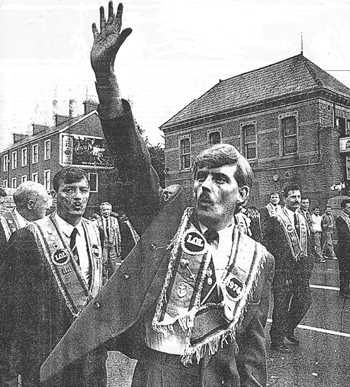
The virulent religious underpinnings of this period have survived. The Orange Order presents itself as a religious fraternity. Its public image centres on Protestant faith, accompanied by marching bands, serried ranks, swords, banners, bannerettes and parading in eccentric attire: bowler hats, junior-executive suits, white gloves and bright Orange sashes.
In practice religion is deeply intertwined with unionist politics. The Orange Order had a close historical relationship with the Ulster Unionist Party (UUP). Until 2005, it held one-third of the seats on the party's governing Ulster Unionist Council.[6]
Membership was agreeable since the Ulster Unionist Party also prohibited Roman Catholic membership. Having reiterated it in 1960, the ban disappeared at some point, no one knows when for sure. Suffice to say; at a certain stage after the unionist parliament was abolished in 1972, the ban had become an international if not a local liability. Better to be a party that Catholics largely would not join, as distinct from one they could-not, join. Demonstrating exceptional tolerance, after the UUP was superseded by the even more sectarian DUP, a few Catholic unionists joined.
Orange employment exchange
The 1922-72 the one-party dominated Unionist territory administered a system of sectarian religious discrimination against Roman Catholics and gerrymandered political discrimination against the Irish nationalists and republicans that Catholics largely voted for. This quasi-apartheid political mechanism was aided by the Orange Order acting as an unofficial employment exchange.
The Order received direction publicly in July 1933 from Basil Brooke, then Minister for Agriculture, later Prime Minister, who reported, “he had not a Roman Catholic about his own place (Cheers)”. He recommended similarly to the Orange Order in March 1934 that, “people not [...] employ Roman Catholics, who were 99 per cent disloyal”. Brooke was followed by then Prime Minister James Craig, Orange Order Grand master for County Down, who stated in Stormont on 24 April, “All I boast is that we are a Protestant Parliament and Protestant State”. Craig doubled down on 21 November 1934 in stating he was “carrying on a Protestant Government for a Protestant people”.[7]
Previously, Roman Catholics were hunted out of public employment, aided by unionist press investigation of any alleged infestation. J.H. Whyte observed, “As the years passed, evidence emerged of Orange Order surveillance of Catholic civil servants and even civil servants married to Catholics”. Consequently, their numbers “in the higher ranks of the NICS (Northern Ireland Civil Service consistently through the late [19]20s and early 30s”. Prime Minister Craig entertained detailed investigations, following Orange and other complaints that Roman Catholics were detected as gardeners, lowly civil servants and in similar positions. In rural areas the Order set up a fund to prevent Protestant owned land being bought by Roman Catholics.[8]
Discrimination in the private and public sectors had a purpose. It prevented Roman Catholics from becoming a majority. Because of the higher Roman Catholic birth rate, 51% of school-going children in 1961 were Catholic. Yet the proportion in the overall population was remarkably stable, at 34.4% in 1911, 34.9% in 1961. That is because, between 1937-61 Catholics constituted nearly 60% of emigrants. Barritt and Carter observed in 1962, that emigration was “just about sufficient to drain off the excess births in the Catholic community, and keep the population of Protestants and Catholics almost stable … Thus the difference in economic opportunity is a regulator maintaining the status quo”.[9]
The minority population was socially controlled by poverty, discrimination and overtly sectarian policing at the hands of the overwhelmingly Protestant RUC and B-Specials. Catholics lived under threat of pogroms organised by the Orange Order and ancillary sectarian bodies. In the early days of the Peace Process many thought they were witnessing the dying kicks of loyalism in the 2001-2 Holy Cross debacle in North Belfast. Loyalists organised a hostile blockade in an attempt to redraw ethno-religious boundaries. They prevented terrified Catholic primary schoolgirls from attending classes. The fact that it went on for months on end, accompanied by blast-bombs, bags of urine and faeces hurled at the children and their parents plus obscene sectarian chanting, illustrated a deep-seated right-wing political psychosis.[10]
Such violent reaction spills over in racist opposition to other groups. This very summer, loyalists erected signage on council-run play-facilities blocking Muslim participation. A recent incipient pogrom in Belfast and elsewhere, directed by loyalist elements towards migrant workers, illustrates how racism underpins parts of unionism. Contemporary Islamophobia harks back to 1920-22 pogroms when, as Fearghal Mac Bhloscaidh points out, “To its advocates, Sinn Féin was supposedly allied with both the Vatican and Bolshevism in a conspiracy to expel Protestants from Ireland and destroy the British Empire. The ‘great replacement theory’, it seems, has deep roots in the North”.[11]
Protestant enemy within
The Orange Order’s role in orchestrating intimidation and violence against the republic and nationalist community is well known. Less often spoken of is their promotion of a system of rigid social control preventing ‘betrayal’ by co-religionists.
At the height of the 1998 Garvaghy road crisis , Revd Tony Whitling of Mallow, Co Cork stated in the Church of Ireland Gazette (31 July 1998): "My heart goes out to fellow clergy in the North whose preaching of the gospel is all too often limited and frustrated by intimidation and fear of Orangemen within their congregations."
Similarly, on the same date the Provost of Tuam, the Very Rev Robert McCarthy, wrote: “Like most church people in the South, I am ashamed to be a member of a church which is so timid and craven as to have protested at the unauthorised use of its property at Drumcree only after such use had effectively ended.” Revd Whiting found “everything about the Orange Order distasteful and unchristian.” The Rev David Oxley of Tullow, Co Carlow, stated that the bishops and general synod “must take steps to clearly repudiate the Orange Order and what it stands for . . . we can either act decisively or stand condemned as ineffectual babblers and fellow-travellers with bigots.”
These critics expressed not merely the values of their immediate environment but also a long-suppressed tradition of Protestant opposition to sectarianism in the North.
It is under appreciated how everyday sectarianism is and was policed by the Orange Order within unionist communities. In 1985 the Revd David Armstrong, a Presbyterian minister in Limavady, was driven out after he invited a neighbouring Roman Catholic priest, Fr Kevin Mullen, into his church during a service, after Mullen’s was bombed. Armstrong wrote that afterwards: "I went through hell. The abuse towards my family was disgusting. My children’s lives were threatened. Men in bowler hats [members of the Orange Order] quoted the Bible at me, saying this was God’s work". (The Sun, 18 February 2005),
In Dublin’s Clontarf parish in August 1969, the Reverend Donald McClatchie mentioned Northern colleagues who ‘have their bags packed right now in case of physical attack by members of their own congregations’. He spoke also of others ‘not at all immune to the unwanted and unwarranted attentions of that hideous sectarian so-called police force known as the B-Specials’ (Irish Times, 19 Aug 1969). Around the same time, the O’Callaghan-Westropps, a landed Church of Ireland family publicly declared in the Irish Times ‘Personal’ section that they were "so thoroughly ashamed” they “no longer wish to be considered Protestant.”
A 1971 Irish Times article on ‘Paisleyism in the parish’ (19 Feb 1971), by a ‘Northern rector of the Church of Ireland’, revealed Reverend Ian Paisley’s sectarian influence in all Protestant denominations. Select vestries, composed of elected parishioners and clergy, “became transformed into places of animosity, rudeness, misrepresentations and lies. A clergyman was expected to be a political stooge or be almost unacceptable”.
One rector reportedly was informed that should trouble erupt locally, “two neighbouring Roman Catholics would at once be shot”. When the rector admonished his interlocutor in the name of ‘Our Lord’, the response was: “when he was here on Earth he did not have Roman Catholics to contend with”.
The Presbyterian Church, larger in the North than the Church of Ireland, suffered similarly. According to a 4 February 1972 survey in the Irish Press by John Feeney, liberal Presbyterian ministers were ‘swept aside’ by a ’wave of reaction’ within the laity. The Reverend John Miller’s wife, who was Chinese, “was subjected to hundreds of obscene phone calls from parishioners who objected to his theological leanings. He is now working in a London parish”.
This is further illustrated by the case of Revd István Kardos, a Hungarian Calvinist Minister who had fled Hungary after the 1956 Uprising. Protestant or not, he and his family were viewed as ‘other’ in the loyalist vision for the North of Ireland. Following an incident where his children were stoned, the Kardos family became refugees for a second time.
Feeney cited further instances of ministers being driven from their parishes. One clashed with Ian Paisley in 1969, after publicly disputing Paisley’s claim that children attending his parish school near the Falls Road needed military protection. The episode illustrated a recurring feature of unionist politics: aggression framed as a defensive response to alleged threats or grievances.
Policing the boundaries
It has been observed that Roman Catholic clergy exerted excessive influence over their congregations. In some Protestant communities the dynamic could operate in reverse, with clergy constrained by the congregation.
A 2008 report on Protestants living in Border areas highlighted this dynamic. The report by David Gardiner, commissioned by the Church of Ireland’s Hard Gospel Project, noted problems enforcing a 1999 Synod decision restricting flying of the Union Jack on church grounds. Clergy were reported to be “walking on eggshells” – worried even about being confronted by parishioners if they were seen entering a public house or attending the opening of a local GAA grounds.
The Order proclaims a need for separation between Protestants and Roman Catholics, a position that helps to justify its existence. It maintains a ban on Roman Catholic membership and a rule that any member who “dishonour[s] the institution by marrying a Roman Catholic shall be expelled”. While, according to Eric Kauffman, over 40% of expulsions from the Order from 1964-2002 were for marrying or cohabiting with Roman Catholics, as Susan McKay observed, (Sunday Tribune, 14 Jul 2002), “An Orangeman may not marry a Catholic. However, he may, it seems, kill one”. McKay’s piece instanced sectarian killers not afterwards expelled.
In addition, no member may attend “an act of Popish Worship” and all are obliged to persuade Protestants not to marry Roman Catholics, while the latter should be prevented from attending dances or playing games on Sunday (the Lord’s Day).[12]
Anti-Catholicism within unionism can be construed as a form of racism, in that Catholicic identity is a racialised identity in the northern Irish context.
In attempting to explain this, Liam de Paor asserted in 1971:
"In Northern Ireland Catholics are Blacks who happen to have white skins. This is not a truth. It is an oversimplification and too facile an analogy. But it is a better oversimplification than that which sees the struggle and conflict in Northern Ireland in terms of religion.... The Northern Ireland problem is a colonial problem, and the ‘racial’ distinction (and it is actually imagined as racial) between the colonists and the natives is expressed in terms of religion."[13]
In the 1960s, Stormont Minister for Home Affairs William Craig openly supported the racist South African white minority. He defended discrimination against "educationally and socially inferior" Catholic lawyers and also observed, "It is well known that in countries where there is a Catholic majority there is a lower standard of democracy".[14]
An economic advisor to the Northern Ireland government, Professor Thomas Wilson, observed in 1955 that Catholics were made to feel inferior because "they often were inferior".[15] Openly expressed prejudice reflected widespread unionist views and actions. Roman Catholicism was a sign of congenital disloyalty and inferiority. So much so that, as noted, in 1959-60 the permanently governing Ulster Unionist Party debated and reaffirmed a ban on Roman Catholics joining the party. In November 1968 BBC Northern Ireland broadcast a programme, Winds of Change, on proposed reforms in Northern Ireland, echoing the title of a 1960 speech by British Prime Minister Harold Macmillan, on growing demands from colonial subjects for independence from Britain.[16]
John D Brewer, a co-author of Anti-Catholicism in Northern Ireland (1998), asserted that: “It is as important to decommission this particular Protestant mind-set as it is to decommission weapons. It has killed people such as the Quinn brothers and [RUC] Constable Riley [in a blast bomb attack]” in 1998. (Irish Times, 16 November 1998).
Riley was described as a papist spy. The Quinn brothers – three boys aged seven to 10 – were burned to death in their home on 12 July 1998, by loyalists protesting against the ban on the Orange Order marching on the Garvaghy Road. Their mother Eileen observed in relation to loyalist and Orange denial of responsibility for violence in the mainly loyalist estate where she lived, “it has everything to do with it. It is everybody else that suffers every year because of them. It’s the Catholics that suffer. It hurts”. She said that though some neighbours received bullets through the post, “I never got one, I thought we were all right”, because she had sent her children to local Protestant schools. She wanted the boys “to make up their own minds”. (Irish Times , 17 July 1998)
From 1998 to 1999, Orangemen and other loyalists gathered weekly outside St Patrick’s Church in Harryville to harass and intimidate Roman Catholics attending Mass. Participants often justified the protests by drawing comparisons with nationalist opposition to Orange Order parades in Dunloy and the Garvaghy Road. As with Holy Cross, the authorities tolerated these demonstrations. Negative publicity eventually prompted Orange Order Grand Master Robert Salters to oppose the picket publicly. His picketing members ignored him. Salters was vigorously opposed by Orange leader Joel Patton’s ‘Spirit of Drumcree’ group.[17]
While sectarianism exists within nationalism, it does not command mass political support or organisational influence. It is generally met with an immediate and robust challenge from within nationalist communities. Sectarian views and actions within unionism persist in the absence of real or perceived provocation from nationalist communities. The mere existence of Irish nationalism suffices. Whether or not the IRA campaign against the Northern territory had emerged in the late 1960s, unionist sectarianism subsisted on the existence of the Northern Ireland entity. This is another factor Fintan O’Toole does not comprehend in facile ‘both-sides are to blame’ observations.
Fraternal solidarity
The Orange Order has long experience in managing and sanitising its public image, yet it remains acutely aware that periodic controversies can quickly expose the gap between its public relations efforts and its actions.
As a fraternal organisation modelled in part on freemasonry, the Orange Order places a strong emphasis on personal, communal and political loyalty. This was evident following the death of former Irish rugby player and unionist politician David Tweed, when his local Orange lodge provided a ceremonial guard of honour at his funeral. While Tweed’s attendance at the anti-Catholic Harryville protests would not have diminished his standing, his documented history of violently abusing his daughters and a niece might reasonably have been expected to do so. Although his conviction and imprisonment were later overturned on grounds widely understood as procedural rather than exculpatory, this proved sufficient for his readmission to the Orange Order. Following his death in a motorcycle accident, Traditional Unionist Voice leader Jim Allister publicly paid tribute. The resulting backlash was sufficient to prompt an apology from Allister, an admission one of Tweed's daughters, who had suffered his abuse, rejected outright (Belfast Telegraph, 4 December 2021).
The power-sharing arrangement that accompanied the Good Friday Agreement has freed elements of the Protestant population to speak out, as can be seen in their opposition to the Garvaghy Road. Unlike back in 1998, the Drumcree Parish Church has even taken steps to distance itself from the Order.
While it may no longer command universal support among Protestants, the alacrity with which the DUP supports the Order’s demands to march where it is not wanted indicates its continuing hold on popular loyalist sentiment. The Order’s prospects will depend on the strength of opposition it encounters on the ground. Continued support for residents of the Garvaghy Road, the Ormeau Road, and other affected communities will prove decisive in challenging practices that many view as damaging to community relations.
Fintan O’Toole is correct that the Orange Order is weaker than it once was. But he mistakes decline for insignificance. The historical evidence suggests something different: that Orangeism has receded where it has been challenged, opposed and confronted. Its future relevance will depend not on its remaining membership but on whether civil society continues to resist its claims to occupy public space, define Protestant identity and police dissent within unionism.
[1] Fintan O’Toole, ‘Drumcree is theatre of the absurd, straight from Monty Python’s Ministry of Silly Walks’, Irish Times, 6 October 2026.
[2] Oliver Rafferty, Catholicism in Ulster 1603-1983, U Sth Carolina Press, 1994, pp89-91.
[3] For example see, ‘Celebrities including Noel Gallagher and Susan Sarandon sign letter backing Garvaghy residents’, The Journal, 6 October 2026.
[4] Don Mullen said killer Joe Bratty was depicted in Orange attire with a five-nil hand gesture, https:// donmullan.org/about-don/work-experience/primary-work-experience/attachment/joe-bratty-oc-ulster-defence-association/.
[5] A theme explored in Ronald Weitzer, Transforming Settler States, communal conflict and internal security in Northern Ireland and Zimbabwe, U Cal Press, 1990.
[6] ‘Orange Order severs links to UUP’, BBC News, 12 March 2005, http://news.bbc.co.uk/2/hi/uk_news/northern_ireland/4342429.stm.
[7] in ‘Discrimination – Quotations’, https://cain.ulster.ac.uk/issues/discrimination/quotes.htm
[8] John D, Brewer, Gareth Higgins, Anti-Catholicism in Northern Ireland, Macmillan, 1998, p101. J.H. Whyte, ‘How much discrimination was there under the unionist regime, 1921-68?’, in Tom Gallagher, James O’Connell, eds, Contemporary Irish Studies, Manchester University Press, 1983, p13. Jonathan Bardon, A history of Ulster, Blackstaff, 1992, p497. Eric Kaufmann, The Orange order, a contemporary Northern Ireland history, Oxford, 2007, p137.
[9] Jardine, Edgar F, ‘Demographic Structure in Northern Ireland and its Implications for Constitutional Preference’, Journal of the Statistical and Social Society of Ireland, vXXVII, ptI, 1994, p203. Barritt, Denis P, Charles F. Carter, The Northern Ireland Problem: a study in group relations, OUP, 1962, p108.
[10] See, Anne Cadwallader, Holy Cross: The Untold Story, Mercier, 2004.
[11] Brian Feeney, ‘We don’t have an immigration problem. We’ve a racism problem’, Irish News, 10 June 2026, Fearghal Mac Bhloscaith, ‘The North’s Loyalism Problem’, History Ireland, Nov-Dec 20206.
[12] Orangemen were expelled for attending Roman Catholic funeral services. Thus Senator J.W. Gyle was in 1934 expelled for seven years for “having broken your obligation as an Orangeman by your presence at a Popish ceremony or act of Popish worship”. Gyle was present during “prayers for the soul of the late Mr. J. Devlin M.P.” at St John’s Hospital on the Crumlin road, Belfast, Derry People, 14 April 1934. Gyle ignored a summons to face his accusers. The stipulation is still enforced.
[13] Liam De Paor, Divided Ulster, Pelican, 1971, ‘Introduction’.
[14] Coogan, 2004, p303; ‘Northern Ireland is a police state says Fitt’, ‘Craig’s brick hit no target’, IT, 5 Apr, 4 Jun 1966. Lee 1989, p418 (Craig apologised later for his lawyers remark); ‘Path to unity’, IT, 17 Dec 1968.
[15] Joseph Lee, Ireland 1912-1985, Politics and Society, CUP 1989, p418. Wilson was described by Conor O’Brien in 1990 as ‘represent[ing] the most moderate, rational, and secular element in the general unionist tradition’, ‘A Tale of Two Nations’, NYRB, v37, n12 19 Jul 1990 (response to Denis Donoghue, ‘Ire Land’, New Republic, 18 Dec 1989, who described Wilson’s Ulster: Conflict and Consent, 1989, as ‘an essay in propaganda’). Jan 2001).
[16] Andrew Boyd, Brian Faulkner and the Crisis of Ulster Unionism, Anvil, 1972, pp36-8. Robert Savage, The BBC’S ‘Irish Troubles’, MUP, 2015, p35; ‘How Britain said farewell to its Empire’, BBC News, Magazine, at http://www.bbc.com/news/magazine-10740852, accessed 13 Aug 2015.
[17] See the Cain Archive Chronology: https://cain.ulster.ac.uk/othelem/chron/ch97.htm
Dr Níall Meehan is the retired Head of the Journalism & Media Faculty in Griffith College Dublin. He researched and campaigned against broadcasting censorship (Section 31). He also researched ownership and control of media and revisionism in Irish-history-writing on the War of Independence period (the Peter Hart controversy). Dr Meehan examined the position of southern Protestants and the treatment of marginalised Protestant women and children in institutional settings. He discovered over 200 dead Bethany Home children, buried in unmarked graves in Mount Jerome Cemetery. He is interested in the intersection of social class and religious intolerance across Ireland, plus media resistance to objective coverage.