
Newtownards is a market town in County Down. Once a thriving hub of the textile industry, today it's a commuter belt with rich farmland, family run shops and its fair share of hardship. Union Jacks line the streets in summer, and a big Irish flag is burned on the annual bonfire. If you draw in a little closer, you'll hear Christy Moore on the jukebox in my favourite pub and find a Dungeons and Dragons party at the game shop. The town was once home to an atheist cycling club and a small underground gay scene, which is now, for the most part, happily above ground. Our Bangladeshi and Polish neighbours' food is plentiful, and if you're lucky, you might get to share it at their homes. We all exist together in this fairly humdrum jumble. Watching the same Netflix, sharing germs in the overcrowded A&E, worrying about the price of groceries and the state of the coast road.
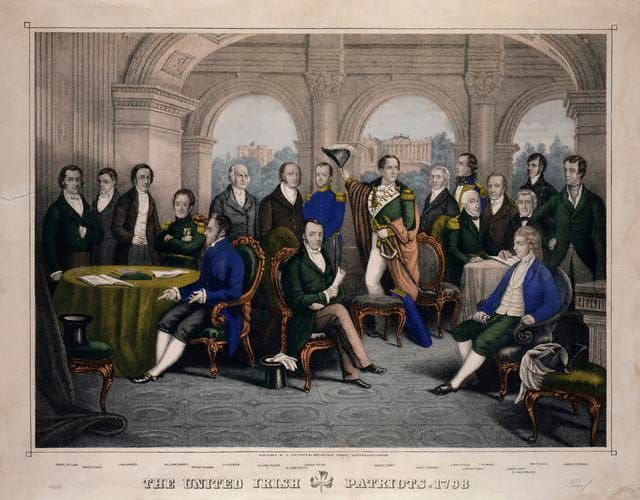
On 10th June 1798, Newtownards was declared for the Irish Republic. For a few days, it was run by a French revolutionary style committee, from the Market House in the square that is now the town hall. A few days is not very long, but it feels like a moment full of possibility. Just after the committee got going, the government militia sliced down the United Irish army at the Battle of Ballynahinch and republican Newtonwards fell. Any rebels still alive were scooped up and thrown in the town jail, most to be hung, exiled, or conscripted later. The Council opened this space up recently. I go there every few months and push my fingers into the marks on the jail windowsill, wishing I could have a conversation with the rebels.
It gets the blood up, saying Newtownards was declared for the Republic. That this now loyalist heartland was once a sea of republican dissent and radical thought. If I could have a conversation with the 1798 revolutionary committee, I would like to ask them, what did they plan to do with the Republic of Newtownards? These young Presbyterian men and women of County Down – merchants, reverends, blacksmiths and weavers. What did their declaration of independence mean? One of their only acts was to requisition cattle and meal from Lord Londonderry's demesne at Mount Stewart, which I think was a good start[1]. But what sort of democracy were they hoping for? Liberal? Egalitarian? Would it be run from a conservative Dublin parliament? Would the tenant behind on her rent get a say? What would the town and its townlands be like to live in?
****
I was born in Newtownards into a family of dissenters. Many of my ancestors were evangelicals who were much more interested in heaven than in earthly business. But I lucked out with leftist and anti-colonial parents, who forged their own politics in the crucible of the civil rights movement and the early years of the Troubles. They were appalled by the Protestant state for a Protestant people and by British state violence. Their faith as well as their politics led them to the charismatic renewal movement and ultimately to the Quakers. Both anti-sectarian and pacifist spaces, at least in their experience of them.
Unsurprisingly with such a rearing, my own politics has always leaned Irish. I am a lifelong Irish passport holder, who sees Michael D Higgins as my President, despite not being able to vote for him. Reunification has always been my aspiration, although I am unclear what that might mean in practice. This has been an awkward politics to have at times, as a Newtownards Protestant. I'm always looking for a flicker of comradeship in other people in the town. But really, between parenting, illness, and trying to keep a roof over our heads, there's not much time left to plan the revolution. My hopes and my struggles probably aren't so different to most of my neighbours.
One day in the Newtownards dog park, I was calling my hound, Winnie. A man approached me and asked if Winnie was named after anyone. I took a deep breath and went for it. 'Yes, Winnie Carney', I blurted, not adding that she was James Connolly's confidant and present at the GPO in 1916. The man gave me a funny look, and called over his own dog, Betsy Gray. A look of recognition passed between us - Betsy Gray being a local United Irishwoman who was killed at the Battle of Ballynahinch in 1798. A comrade in the town.
As we talked on, I learned that my new friend had just left Sinn Féin. He was unhappy with the party's views on vaccines and their general wokeness. I didn't mention my own wokeness or how I would need the party to go much further to join myself. I felt gutted that having found United Irish republicanism in the dog park, the connection slipped so quickly through my fingers. It left me thinking that there may be no great ideological cause that will ever truly bind people together in Newtownards in the mid-21st century. That we will probably remain a very similar jumble of humans, in an unremarkable peninsula town, whatever our constitutional future holds. The revolution, when it comes, may be a lot more ordinary. At least that is the good version of what happens.
****
A few years ago, I published a book, The Ghost Limb: Alternative Protestants and the Spirit of 1798[2]. I had set out to find United Irish style politics amongst northern Protestants today. And I found the spirit of equality, liberty and solidarity in generous abundance. Sometimes the spirit lived among 1798 re-enactors. But mostly it lived on in socialists and feminists, anti-racists and environmentalists, language learners and artists, engineers and carers, the pans and the trans[3]. All kinds of people who are questioning why the world - and the North - is the way it is. People who are already working together across creed, class, religion and place of birth to conjure a better island into being.
Since the book came out, I've been living in its afterlife, embracing all conversations that would help me imagine the new Republic I aspire to. I wanted to find out how a 32 county Republic could be more creative than what came before. More ambitious than a graft of a sectarian north onto a neoliberal south.
In my questioning, I found myself swept up in the current Irish unity movement. Reunification is something I would vote for tomorrow, without hesitation. Because I believe Northern Ireland has never worked. But being present as the case for a new Ireland was constructed had a funny way of bringing out the dissenter in me. I would depose King for President in a heartbeat, but it's the quality of democracy in a new Republic that I'm interested in. And that's not something that gets mentioned very often.
Over the last years, in many meetings, discussions and rallies, I have listened carefully to the economic case for a united Ireland - which is neoliberal bounty. I listened to the cultural case - which is that a new Republic must be flexible on symbolism and Protestants should chill out. I listened to the demographic case - a headcount that flies in the face of my lifetime of work arguing against predetermined identity cul-de-sacs. I listened to the social case - which is that we must aim for the best of both states in terms of safety nets, but we can't promise anything. I have rarely heard the environmental case being made in these rooms, when it seems obvious that this should drive the whole project. All of these things have held me back from campaigning unequivocally for reunification so far. Because a neoliberal Ireland is not enough.
But I've also listened carefully to the democratic case for Irish unity - which is that the North cannot have a good quality of democracy while bending itself out of shape around a remote careless Westminster. That we do not have access to meaningful ways to shape our society or exert control over our own lives. I found this case to be compelling and timeless. And it is not difficult to grasp how it applies to the 26 county Republic too. So I began to seek out spaces outside the mainstream political parties and unity movement, where I felt this deeper democratic work was flourishing.
****
Early on in this exploration, I joined a historical society, Reclaim the Enlightenment, dedicated to celebrating the histories of the 1790s in Ireland. A radical bunch, who walk in the shoes of our foremothers, eking out space for anti-sectarian politics in the mid-21st century. It was here that I imbibed that other tradition of Irish republicanism. That of Jemmy Hope and Mary Ann McCracken. Internationalist to its core. Civic not ethnic. Radically anti-sectarian and accepting of diversity. Forever failing itself in these principles. But endlessly in pursuit of people power. I learned here how to sit easily with difference. Orangemen, Irish republicans and 60s hippies gathering together for events. Reclaim the Enlightenment's elders tend to not sweat cultural identity, so long as the work drives persistently towards the rights of citizens. I found this radical tolerance liberating, and it informs my imagination of how a new Republic should feel to live in.
It was with activists that I located the political ideas I was looking for. Bridget Meehan, Dessie Donnelly, and Fintan Bradshaw, as part of a series of articles on eco-socialist approaches to Irish unity[4], write, "a renewed Ireland will only be born of the struggles our communities are engaged in today: one which stands for neutrality and non-alignment in global affairs and advances internationalism; prioritises the environment; puts people and planet at the centre of the economy; strives for a fair and just democracy; advocates for just class, race and gender relations; develops sustainable public services; protects minorities; welcomes immigrants and asylum seekers; actively promotes the revival of the Irish language and embraces other languages, and; distributes wealth justly."[5] I think that's a good mission statement for a new Republic. Something you could nail on the door of a town hall.
But this is the puzzle at the heart of the reunification project. The current Republic of Ireland falls short of most of these measures. So the question becomes - what would a good Republic be like?
And it's in Newtownards that I begin to imagine what a good Republic would feel like to live in. I think about the town square where I have watched the Twelfth of July, attended surrealist puppet shows and gone to history meetings about An Gorta Mór. Where friends organise multicultural celebrations so the town can wrap its arms around our Muslim brothers and sisters, whose small prayer room comes under sporadic racist attack. Where neighbours gave so much mutual aid to one another during the pandemic. Where a friend has begun a community supported agriculture project, so we can begin to build food security in a scarcer near future. Where we have crowded together against fascist meetings, collected wild cherry pips for the seedbank and protested the headquarters of a mining company. These things take time and commitment. They often involve hiking boots or bulk buying crayons, leaving the house when you want to go to bed. But it's these multiple small acts of community that build a commons capable of sustaining political change.
As well as organising many of the multicultural events in the town, Maurice Macartney has written about his vision for democratic renewal in - or perhaps after - late capitalism[6]. Maurice is a neighbour, so his starting point is also Newtownards. This is a town where a history of empire and enslavement is still held in its built heritage. Where many “communities”, “nations” and “races” have tried to claim territory and dominion over one another. Maurice argues instead for “neighbourhood democracy”, where people just show up as they are. They do not have to agree on all issues, or swear allegiance to any higher entity. Politics exists in their relationships and interactions with one another, in a “community of others” or “commoners on the one common”, working towards an equitable, sustainable neighbourhood democracy beyond denomination. I can't help wondering if the 1798 revolutionary committee might have aspired to something similar, given their own rejection of sectarianism and pursuit of citizens' rights.
The 1798 revolutionary committee also knew that to build democracy in Newtownards they would need independence. We can spend every day in the town square, but it is hard to make progress without access to the levers of power. For that, we need to take back control. This does not mean Brits Out, or a nation once again. It does not mean isolationism in an interconnected world. Independence could take many forms. But it must mean the practical empowerment of local people to take decisions about issues that affect them. It is where a nimble and well organised state enables neighbourhood democracy.
Lesley Riddoch, a leading figure in the Scottish independence movement, is a good spirit guide on these matters. Her films, journalism, and podcast with Pat Joyce highlight Nordic democracies' intertwining of local autonomy and national independence. Riddoch points to communities in Iceland who have harnessed volcanoes for geo-thermal power, underlining how small independent countries can respond creatively to unpredictable environmental conditions[7]. In Norway, a heterogenous state funded press ensures high levels of media literacy[8]. In Denmark, efterskoles (independent residential schools which 14-18 year olds can opt into) focus on personal development and democratic citizenship[9]. (Her documentary films on these topics are available on her YouTube channel). In Sweden the average person pays all their income tax to local councils, with a wealth tax funding the central state[10]. A micro council in Vágur in the Faroe Islands - a town of 1377 people - built an Olympic size swimming pool on donated land because they had the autonomy to do so[11].
A redistributive ethic underpins these examples - richer regions helping poorer regions. And also efficiency - the swimming pool was built at a quarter of the official cost. When national governments are committed to the model, neighbourhood democracy works.
These are not things that the North of Ireland could dream of doing at the moment. We do not have the levers or the vision. It is also difficult to imagine the ruling elite of the current Republic suddenly deciding on system change. Nor likely that the debate about reunification will naturally shift from market value to deeper values of sustainability, justice and care.
And this is where we come in. We must expand our imagination of what is possible. We must tell stories about what kind of nation we want to build. We must engage in our own world building to counter the world that the oligarchs and authoritarians are already creating. We need to gain access to the levers of power - planning, budgets and decision making. We can start by doing neighbourhood politics. We are already building the commons in towns across the island. We need a healthy independent media ecosystem. Education that nurtures critical thinking and active citizenship. We must court political parties, and lobby them hard, but not be enthralled by, or feel helpless in the face of, their power. The movement we need to assemble for a new Republic will be messy, and we should embrace this. Diversity and cross pollination, creativity and innovation, dissent and uncertainty will be its lifeblood. There are no sunlit uplands in a time of climate catastrophe, only communal problem solving and ready solidarity with our neighbours.
As tectonic plates shift in the mid-21st century, it is possible that neighbours across these islands will want to find better ways of forging relationships with one another. In the aftermath of storm Éowyn in January 2025, Ireland borrowed electricity generators from Poland, Denmark and Luxembourg; engineers from Finland, Jersey, England and Scotland came to help with repairs in Northern Ireland. A network of independent states with thriving neighbourhood democracies helping each other is a much more compelling future than one centred on identity, allegiance and hard borders. This is the good version of what happens.
****
There's a new distillery in County Down which proudly displays a trio of stained glass windows in its restaurant - portraits of Wolfe Tone, Thomas Russell, and a United Irishman charging on a horse with a pike. Recently, they sponsored an event in Washington DC, hosting Nigel Farage, to celebrate the inauguration of Donald Trump. I probably should have paid more attention to the absence of stained glass women.
The distillery party crystallised many thoughts. That there is no point eulogising United Irish politics if it is only for bros. No point performing republican ideas only to court American authoritarians. We must re-imagine what 1798 politics means in practice in the mid 21st century. There is nothing that special about Ireland or a Republic per se, if the people living there cannot thrive. Trappings, anthems and colour schemes are at the bottom of my list of priorities. A new Republic must have deeper roots. A good Republic is about bringing democratic decision making closer to ordinary people. It's about meaningful independence. The freedom to creatively solve our own problems, to have the economic and political levers to affect change in our own lives.
Much is happening in the world right now to make us feel powerless. But we do have agency. It lies in our relationships, connections and networks. I don't think a new Republic will be built by taking over the town hall with a pike. Rather by turning up to the town square over and over again. Sharing food, standing with our neighbours and doing everyday politics in all of its unglamorous brilliance. Engaging in slow and ordinary revolution. Working with one another across our villages, towns and cities to articulate and model the kind of nation we want to build. We do not have to wait for permission to imagine a just and sustainable new Republic. Our small acts and stories might even help bring it into being.
[1] Trevor McCavery, Newtown: A History of Newtownards (Belfast: White Row Press, 1994).
[2] Claire Mitchell, The Ghost Limb: Alternative Protestants and the Spirit of 1798 (Belfast: Beyond The Pale, 2022).
[3] I have borrowed the name of a friend's teenager's group chat.
[4] Z Network, “Ireland United Series,” https://znetwork.org/category/contenttype/series/ireland-united/.
[5] Bridget Meehan, Dessie Donnelly, and Fintan Bradshaw, “Out With the Old: Dreaming of a Different Ireland,” Z Network, 2024, https://znetwork.org/category/contenttype/series/ireland-united/.
[6] Maurice Macartney, Combinations: Denominations, Democracy and the Politics of Nonviolence (Lanham, MD: Lexington Books, 2024).
[7] “How Iceland Harnessed the Power of Volcanoes,” YouTube video, posted January 2024, https://www.youtube.com/watch?v=rXBEDk_o_hI&t=610s.
[8] “Norway: The Twin Nation,” YouTube video, posted 2018, https://www.youtube.com/watch?v=oUbMAFO6kA4&t=1s.
[9] “Why Denmark Is the Happiest Country in the World,” YouTube video, posted January 2024, https://www.youtube.com/watch?v=oUbMAFO6kA4.
[10] Lesley Riddoch, “We Can ‘Right-Size’ Democracy in Scotland,” Building a Local Scotland, 2022.
[11] Lesley Riddoch, “Time to Put Communities and Small Councils at the Heart of Local Democracy in Scotland,” The Scotsman, April 15, 2023.
Claire Mitchell is a writer and researcher from Belfast. A former sociologist in Queen's University Belfast, her current writing continues to dwell on people and everyday politics in Northern/ Ireland, using interviews, memoir, archives and storytelling. She is the author of three books and a wide range of journalism, essays and prose. Her latest book is The Ghost Limb: Alternative Protestants and the Spirit of 1798, published with Beyond The Pale in November 2022.