
In 2016, I took up a job working in the Oireachtas. On my first day in my new job, I learnt that the colour of Official Ireland is not green, but a rich, dark ultramarine. Perhaps green was considered too controversial to be the colour of the country – too linked with Republicanism. The people are sovereign, but not that sovereign. The carpet that lines the halls of the Oireachtas is a deep, midnight blue, the same as the Bunreacht’s cover: Bunreacht Blue.
Officially, it is known as St. Patrick’s Blue. In Anglo-Irish heraldry this was a light sky blue, but today it is the same colour as Marian Blue, which references the Virgin Mary, and serves as the backdrop to the circle of stars on the European Union Flag. Blue gained prominence around 500 AD with the mining of lapus lazuli, a mineral pigment more valued than gold. Some historians state that the colour blue was not even in Western European language until the arrival of the pigment from the east – there is that famous description from Homer of the “wine-dark sea”. This evidence may also bear out in the Irish language. A spéirbhean (women of the skies) of Irish nationalist aisling poetry would be dressed not in bright emerald green but a 'spéir ghlas’, a sky-green-grey. This was not a blue of a Microsoft wallpaper but a blue of shifting reality. I wonder if these shades of liath, glas and gorm are a recognition that there are no hard and fasts in nature, no binary thinking of ‘heaven and earth/sacred and profane/Madonna and whore’.
Binary thinking is fundamental to patriarchy. The way that we treat women, children and othered peoples as lesser and exploitable, stems from our relationship with the earth that sees it as a dead instrumental resource. We are locked into a pattern of behaviour with the land which sees it merely as some thing to extract from. The relationship is not a mutually constitutive one but a relationship of violence, extraction, waste and selfishness. A relationship with no giving, no duty – only taking.
Mother Ireland
A Republican Green represents the earth, the land. Mother as Éiriu – as the realities of life, childbirth and childrearing – lived without shame or constraint. The paps of Danu are denuded, bare and torn by wind and the wild. The soft folds and forms of Samhail Phite Méabha or Sliabh na mBan are no less beautiful and majestic for their being whipped by rain and sleet and snow. Do they – or we – have to be beautiful to be majestic and profound? To fill another with love and yearning, to feel like home? We can be old, and raw and beaten and yet be loved, be lovable. It is enough to simply be, belong, be part of the world. Is that not the nature of a Republic? That by virtue of your humanity alone, or being, you are enough. You are in the world, you belong to the Republic.
Instead, the deep blue of the Oireachtas carpet is a symbolic manifestation of an unattainable patriarchal ideal – a Virgin Mother. The colour represents Mary’s ascendence into the heavens. Her chosen (though not her choice) stance among all women who remain earthbound and fleshy. Marian blue represents the heavens, transcendence, the mystery of the divine. A maiden who never ages and bears Eve’s curse of childbirth and sin with grace and silence. The leaving behind of this world and its vale of tears to reach another plane. Justice and deliverance come in the next life; the poor and the meek shall inherit the earth, but only in the afterlife. This blue is transcendence, the spiritual plane of the mind, forever beyond the common green body of the earth. The mother of God is flesh and of the land, but the “fruit of her womb” brings about a divine lineage and the divine right of Kings and Lords to the land.
In Celtic Ireland, on his election, the newly appointed king was married to the land goddess. It was a symbolic union of man and earth. If consent was given by the land, the king’s reign would be prosperous and fruitful. Seeing the land as female is a trope common to many cultures. Máire Herbert, the great Irish historian and academic states that “in early Ireland women were not sovereigns, but sovereignty itself was conceived of as female.”[1] This contrasts with Abrahamic belief in male domination over nature and the feminised other:
“So God created man in his own image; ... male and female he created them. And God blessed them, and God said to them, 'Be fruitful and multiply, and fill the earth and subdue it; and have dominion . . .” (Genesis 1:27- 28, RSV).
This male god, and the divine lineage he brought forth from his earthly vassal/vessel, have a right to complete dominion over the earth and its earthly inhabitants. The spoils of our sinful green earth cannot be let be, but must be ‘improved’ so that men can meet the heavens, ascend to the blue of the divine. So the wild rainforests that cover the paps of Danu must be cut, criss-crossed with property lines. We move from husbandry to ‘live-stock’.
In her feminist reading of the early Irish Deirdre myth, Herbert notes that the concept of Irish sovereignty was one of “complementarity”.[2] The king, Conchubar Mac Neasa, seeks to control the beautiful Deirdre, locking her away from society and forcing her to accept him as a sexual partner instead of her true love Naoise. His greed, selfishness and avarice is a parable for those who seek to dominate. He brings about the ruination of Ulster, not only in seeking to control Deirdre, but in forcing the heavily pregnant sovereignty goddess Macha to run against his racehorses. Macha wins the race, but collapses in exhaustion, giving birth in roaring pain to twins. She curses the king and his useless, spineless, helpless men[3]. From that day forth, for nine generations, when facing battle each man of Ulster will face the same childbirth pangs as she did.
This curse lays the basis for the Irish epic, Táin Bó Cualigne, where, with the men of Ulster incapacitated, the great hero Cú Chulainn is forced to defend Ulster from the armies of Connacht alone. The fault of the king, writes Herbert, was to ignore the rules of a world, where “communal and individual welfare rested, not on the triumph of authority, but on mutual respect and cooperation” [4]. The relationship with the land was sacred, but it was a relationship; love defines it, though like a good Maeve Binchy novel, it also requires very ordinary work. The mother goddess brings forth fruit from the common land and the common people – the everyday, the kitchen sink, is divine.
The Land
The struggle that built the Bunreacht was the land struggle. This divorcing of land from debate and democracy was fundamentally rejected in the War of Independence and in the early days of the new Irish State. As Eimear Walshe phrases it in The Land for the People: “In terms of the colonisation of Ireland, the land is the land, right?”[5]
By the late 1800s England had completed its transition to a capitalist exploitation of the land. Land was defined by price and profit. One’s ownership of the land was predicated and dependent on one’s ability to ‘improve it’. Improvement meant increasing a land’s value in keeping with its exploitability for capitalism. A farmer could lose the land if it was not improved enough. The landless tenants who did the actual farming for him were at the mercy of his needs and whims. While England had seen the translation of land into capital, Ireland was roaring with militant land agitation against such reductive understandings – labelled as foreign and antithetical to an Irish way of seeing and living. In the words of Lorna Fox O’Mahony and Rachael Walsh:
“English and Irish land law can be understood as two pieces of a puzzle: a pair of parallel helices, intertwined around shared axes of the English common law (and its ‘first adventure’ in Ireland), and the politics of land reform; structurally connected through the British-Irish constitutional and economic relationship, each following a distinctive path, but shaped, at key moments, by their duality.”[6]
The idea of a Republic that would cherish all the children equally was born from a break with the uncaring cruelties of this capitalism. The Communist Manifesto describes how the rise of capitalism is a process where “all that is solid melts into air, all that is holy is profaned, and man is at last compelled to face with sober senses, his real conditions of life, and his conditions with his kind.” It was our sober senses that drove the Land War.
If Ireland is culturally unique enough to warrant independence from England, what does that mean for how it manages resources? Should land just be managed in the same way it was under the previous system? As campaigns to take ownership and militant agrarian unrest against landlordism on the island of Ireland grew in strength, so too did the opportunity for co-option and a hemming in of an alternative way of seeing nature and the land. Agitation had resulted in the Land Acts and the Land Commission which improved conditions, but they also cemented an English common law and capitalist form of land ownership, cleansing alternative regimes of communal landscaped management such as the Rundale (or Roinn Dáil) and the bailte fearainn.
The Land Acts may have shorn landlords of their estates, but not their existing fishing rights and minerals. The first iterations of the Oireachtas sought to overturn these avaricious principles and promote a more communitarian understanding of the land and its management.[7] However, though tempered by significantly more protection for the public interest,[8] the final Bunreacht’s understanding of the land and its elements remain encased within a capitalist and imperial understanding of ‘natural resources.’ As we know from Anna Parnell’s activism, this was in opposition to what ordinary people had sought.
Today, ‘natural resources’ are licensed out for extraction without democratic oversight. The removal of these regimes from the legislature under the wide discretion of the Minister protects them from democratic scrutiny. Why does democracy no longer mean democracy over how resources are used? Resources such as land, but also our time, our energy, our workplaces? These are core to our everyday lives, yet we are confined to liberal parameters of parliamentary democracy – representation and spectacle without real power. Can Ireland be said to be a republic if its most fundamental of features, its land and resources, are not administered in a republican manner, for the people?
What kind of a republic are we if the north of this small island remains what Fidelma O’Kane, Aisling Cowan, and V’cenza Cirefice have called a ‘sacrifice zone,’ still subjected to the levels of extraction and concentrated land ownership the republic built its identity in opposition to? Cú Chulainn stands in the window of the GPO; the Ulster Cycle gives myth and meaning to Irish sovereignty. Yet the destruction of the physical sites of those myths, such as Lough Neagh or gold mining in the Sperrins, is somehow not an Irish state concern.
The 1937 Constitution
On introducing the draft Bunreacht to the Dáil on 11 May 1937, De Valera intoned: “If there is one thing more than another that is clear and shining through this whole Constitution, it is the fact that the people are the masters.”[9] The nature of a republic is that a state is ruled by representatives of the citizen body, that sovereignty rests with the people. In law, this notion of popular sovereignty is given expression as “the people as immanent within, rather than as antecedent to, the democratic constitutional system.”[10] The will of the people in our Irish Republic is tied to the decisions emerging from a constitutionally governed democratic system.[11] The legitimacy of the people’s law does not require some ancient tradition or authenticity, as there is no “people prior to or apart from constitutional law, and all talk of the people as the historical author of the constitution is taken to be a fiction without normative relevance.”[12]
People, by virtue of being human, have reason and free will. The people, and therefore the will of the sovereign, are constituted through debate and deliberation. This is a powerful thought. The people are not some automaton, some prior existing silent force for whom their betters can act. The people, not monarchs nor their ruling elite, are sovereign. Despite the later constitutional change of the 27th Amendment, Ireland’s sovereignty is based not on the idea of a prior coherent, ethnic, whole.[13] This idea of an already constituted people was an ideal that ensured ‘the people’ were spoken for by their educated and cultured betters, as was the growing norm in the US and across Europe at the time of the Bunreacht/Constitution’s writing.[14] In opposition to this trend, the Irish republic represents the free will of the people, as expressed through free deliberation, debate and expression. The Republic is a Dáil.
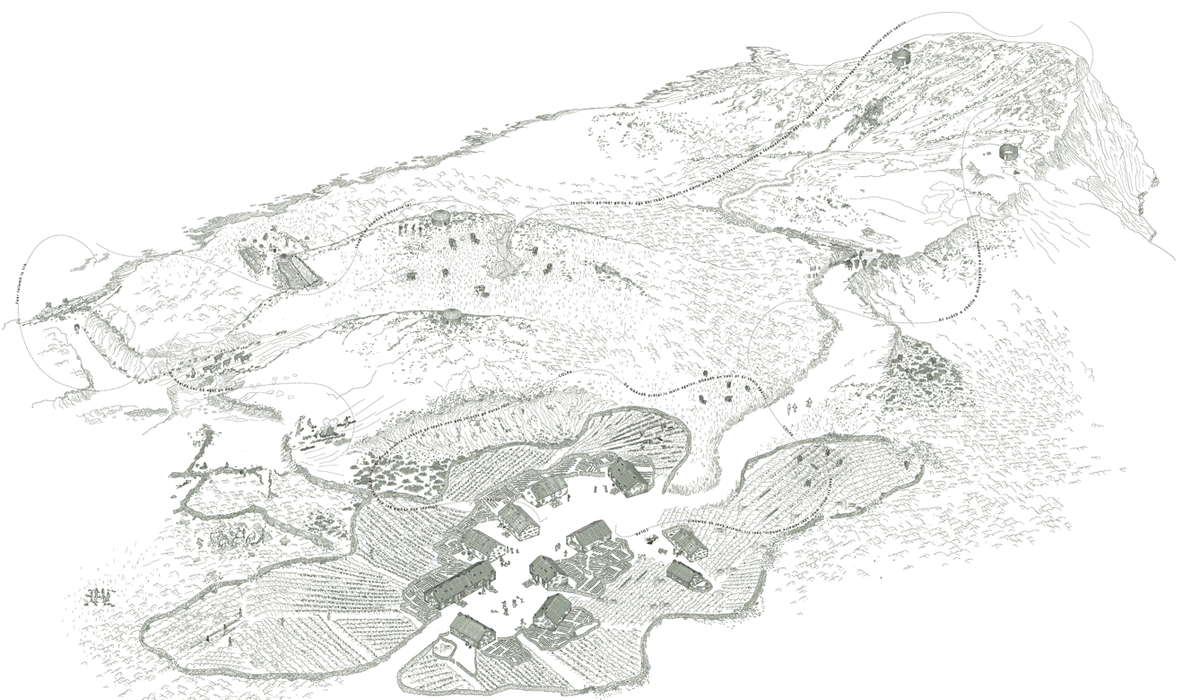
An example of the expression of such free will may have been the Rundale system – the Roinn Dáil. The Rundale system involved the coming together of families to manage the land in an ecologically balanced way. Law is about the management of resources and the creation of a social structure in which to do so. As Amanda Byer argues, the Roinn Dáil was a legal system that paid minute attention not only to the social needs of the community but to the ecological needs and realities of the land.[15]
Landscape management was intimately connected to science and to democracy. The Republic in the Roinn Dáil and in the Bunreacht is not a faceless mass that can be spoken for. The Republic is made real and is made legal through debate and reflection and contest. We are not all alike and we should be allowed spaces to talk and deliberate. This deliberation is positive, it allows changes in action to take account of environmental change and events, like the seasons, the storms, the wind, the rain, the coming floods.
The core problem with our Republic is that we have the Dáil but not the Roinn; the sharing out of resources and land according to principles reached through democratic deliberation. We have democratic deliberation in Dáil Eireann, accessible to most ordinary people. Yet this democracy becomes mere simulacrum without control or ownership over resources. In the words of James Fintan Lalor in his critique of Daniel O’Connell’s campaign to repeal the Acts of Union through parliamentary activism: “A mightier question is in the land."
A Change in the Seasons: Political Creatures
In classical environmentalist thought, democracy has a bad reputation. In classical environmentalist thinking reason, free will, logic and liberty are often pointed to as the downfall of the globe. The tone of such arguments is usually distinctly Abrahamic in character. Man once lived in a state of total harmless communion with the Earth; on being given the apple by Eve, he became Prometheus and woman was to be cursed with the pain of menstruation and childbirth. Much of the language around climate change has this religious narrative. We have entered a domain of sin because we sought reason. Democracy is to blame: too many people on too small a planet, too many people desiring cars and flights and washing machines. But is consumption truly democracy? Is consumption the end goal of the Enlightenment?
In their book, The Dawn of Everything, David Wengrow and David Graeber foreground the human ability to choose through political engagement, our political reality. Most accounts of humans before the Enlightenment paint them as either brute automatons obeying the “nasty, brutish and short” orders of nature, or being in a state of blissful hunter-gatherer innocence. These are both religious Western concepts of human organising – the fall from grace in the garden of Eden, or the mark of Cain and original sin. In contrast, Wengrow and Graeber propose that humans are necessarily political creatures; that for millennia we have ordered our societies according to choice, debate and deliberation. Examples of this in Ireland along are not only in Roinn Dáil, the land movement and the Celtic mythological cycle, but new archaeological evidence from Neolithic Ireland in the building of Newgrange.[16]
Moreover, Wengrow and Graeber argue that those aforementioned contributions of the enlightenment – reason, freedom, free will, and democracy – which are constantly touted as being essentially European – are not actually European in origin at all. They trace the roots of enlightenment thinking to debate and discussion between European settlers and missionaries and the indigenous statespeople and intellectuals in the Americas. These indigenous intellectuals broke down with logic and reason the steadfast claims of tyranny and monarchy in Europe: worlds encased and enclosed by rigour of fear and constant threat. Unshakeable beliefs that monarchies had a divine right to rule, publicly kill and maim their people. That god and religion were vengeful and cruel while professing love. That the divine is in the blue heavens not our solid green earth.
The indigenous revolutionary critique of this thinking was brought back to Europe by missionaries and writers, fuelling the great revolutions of the time in Europe – the claims for human dignity and rights of man, the claims to liberty and freedom from class and monarchies, the questioning of religious might and right. Governance should be driven by reason, not religion or notions of monarchy. All people have reason and therefore are deserving of human dignity and to be listened to, reasoned with. All people have a right to be here, to love and be loved, by the land.
While presenting itself as having arisen with the Enlightenment, liberalism in today’s understanding has required that this human capacity – indeed need – to reason and debate should not interfere with the management and of resources. Liberalism, enmeshed with empire and capitalism, reduced its claims to simply controlling electoral politics. A claim used to demand little more than free trade “OR Else!!!”[17] The understanding that democracy should mean democracy at work, over the land, over resources, over care and who does the dishes, was ever more diminished.
In the last decade we have devoured a sum of resources equivalent to more than three-quarters of the twentieth century’s total. It is a destruction beyond all precedent in human history. A destruction driven by lack of real democracy. We have less and less say over what happens to the land around us. De Valera said of the Bunreacht that the “the people are the masters’’ – now they are NIMBYs. At a business infrastructure summit, I overheard blue-suited men lament that the Irish public are “too educated”; we will lose out to other nations as our people are too clever and too adept at using the democratic tools of their sovereign state.
Those of divine lineage say they want a public that is “green” in another way; innocent and accepting of direction by their betters. But really, they don’t know what they want. They don’t know the colours of their own mind. The colour of the little palm-sized book that contains our people’s constitution is called Bunreacht Blue. But that colour has changed in tone with every reprint, a fact discovered by poet Julie Morrissy when painting her nails to match the book for Bunreacht Aloud, her durational reading of Bunreacht na hÉireann at UCD Sutherland School of Law.[18] If the colour of the constitution is fluid, we can change it. What if the carpet in the Oireachtas was a deep green instead? Or better still, outside.
[1] Máire Herbert, “Goddess and King: The Sacred Marriage in Early Ireland,” in Women and Sovereignty, ed. Louise Olga Fradenburg, 1992, 264–75.
[2] Máire Herbert, “Celtic Heroine: The Archaeology of the Deirdre Story,” in Gender in Irish Writing (Milton Keynes: Open University Press, 1991), 13–22.
[3] Seathrún Céitinn, Foras Feasa Ar Éireann, Volume 2 (Ex-classics Project, 2009), https://www.exclassics.com/ceitinn/foras.pdf.
[4] Herbert, “Celtic Heroine: The Archaeology of the Deirdre Story.”
[5] The Land Question, EVA International Biennial of Visual Art, 2020, https://www.eva.ie/thelandquestion/.
[6] R. Walsh and L. Fox O’Mahony, “Land Law, Property Ideologies and the British–Irish Relationship,” Common Law World Review 47, no. 1 (2018): 7–34.
[7] Donal K. Coffey, Drafting the Irish Constitution, 1935–1937 (Cham, 2018).
[8] Walsh, R., & Fox O’Mahony, L. (2018), 33.
[9] 67 Dáil Debates Col.40, May 11,1937: quoted by Colm Ó Cinnéide in (2012) “The People are the masters”: The paradox of constitutionalism and the uncertain status of popular sovereignty within the Irish constitutional order, Irish Jurist, 48, 249-274
[10] Tom Hickey, “Popular Sovereignty in Irish Constitutional Law,” Dublin University Law Journal 40, no. 2 (2017): 147–70.
[11] Lars Vinx (2013) ’The Incoherence of Strong Popular Sovereignty’, International Journal of Constitutional Law, 11(1) 101 – 124., 102. Quoted in Hickey (n 10).
[12] Ibid.
[13] Though arguably this argument is undermined by the 27th Amendment to the Constitution which removed the right to Irish citizenship for children of non-national parents. This was an amendment by referendum in 2004 which tied the right of citizenship to one’s genetic lineage, rather than place of birth. Described as deeply racist by many contemporary commentators, the amendment brought Irish citizenship law into line with the UK and rest of Europe.
[14] Indeed De Valera’s commitment to this ground-up republicanism was criticised in Ireland too. As Yeats lamented to Olivia Shakespeare: "Politics are growing heroic. De Valera has forced political thought to face the most fundamental issues. A Fascist opposition is forming behind the scenes to be ready should some tragic situation develop. I find myself constantly urging the despotic rule of the educated classes as the only end to our trouble (L:811-12).” In Peter van de Kamp (1995)‘Yeats’s Politics’ in Tumult of Images: Essays on W.B. Yeats and Politics, Peter Liebregts and Peter van de Kamp (eds.).
[15] Byer (2023) Placing Property, Palgrave Socio-Legal Studies., 34.
[16] Neil Carlin, Jessica Smyth, and Catherine J Frieman, “Ireland’s Neolithic Passage Tombs Were Not Just the Burial Place of the Elite – New Research,” The Conversation, April 4, 2025, https://theconversation.com/irelands-neolithic-passage-tombs-were-not-just-the-burial-place-of-the-elite-new-research-253774.
[17] From placards hung on the cannons of the 1778 Irish Volunteers. Source – LAURIE ROBINS: ‘FREE TRADE OR ELSE’*, part of Agitation Co-op Artist Exhibition, with Michele Horrigan, Catriona Leahy, Laurie Robins, Libita Sibungu, Temple Bar Gallery and Studios, 11 May — 10 July 2021.
[18] Maebh Harding and Julie Morrissy, “Reflecting on #Bunreacht Aloud,” Feminist Legal Studies 33 (2025): 105–16.
Sinéad Mercier is an activist and academic working in the areas of law and environmentalism. She is a PhD researcher on the ERC-funded PROPERTY [IN]JUSTICE project, focusing on international energy law, just transition, and local resistance to energy infrastructure in Ireland. She served as the primary policy researcher for the Green Party in the Oireachtas from 2016 to 2019, and has previously worked for the Irish Human Rights and Equality Commission, the National Economic and Social Council, the Irish Congress of Trade Unions, and the Irish Penal Reform Trust.