


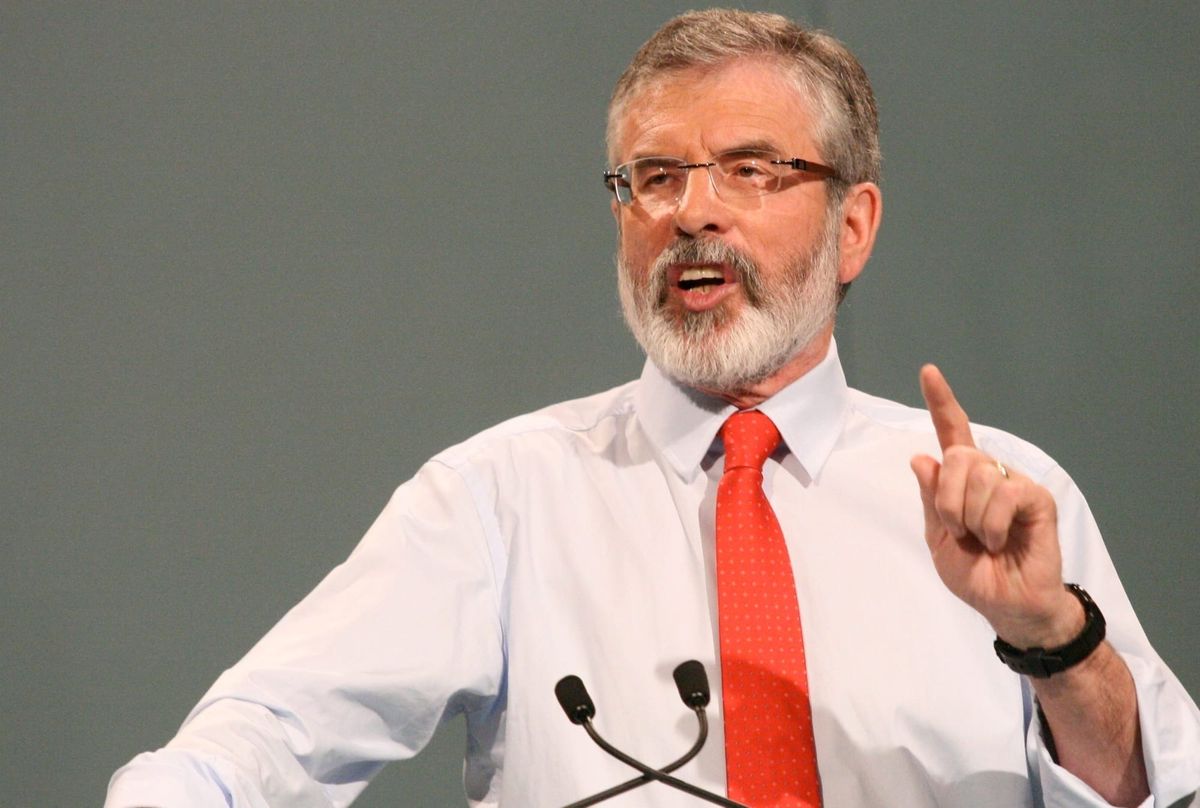
An Clogán: In a number of pieces you emphasise the importance of clarity regarding political objectives. In light of this I want to ask you a few questions about the long-stated end objective of the republican movement: a 32-county democratic socialist republic. But first, could you comment on this question of having clarity about political objectives?
Gerry Adams: I believe it’s essential to have a clear focus on your primary objective, especially if you adhere to the republican goal of a democratic socialist republic. That doesn’t mean those with different positions can’t be part of the effort for change.
But for those of us who believe in the vision outlined in the Proclamation, it’s crucial to be actively involved in leading or influencing the overall struggle. But there is also space for others who may not share our exact vision.
The big objective at this time is securing the right to self-determination, as outlined in the Good Friday Agreement. I believe there is majority support for this, and everything else depends on it.
If we compare where we are now to 50 years ago – or where we hope to be in 20 years – it’s clear that achieving a united Ireland and ending the connection with London would be a significant step. However, that alone wouldn’t necessarily fulfil our broader republican objectives.
We must avoid the trap of thinking we can’t make huge headway on social issues in the present. We can’t wait for a 32-county socialist republic, or for partition to end, before addressing the homelessness crisis or the failings in our healthcare system. These issues must be worked on every single day.
For those of us who want not just a united Ireland, but a united Ireland with a real republic; and not just a real republic, but a republic which is socialist: achieving that requires electing a government with the right philosophy, policy, and strategy to make it happen.
An Clogán: Republicanism and “The Republic” have been used as a political identifier for a wide range of movements, and this curious fact is explored elsewhere in this issue of An Clogán. But could you explain, what does republicanism mean to you?
Gerry Adams: Republicanism, in a way, is what republicanism does. Oliver Cromwell was a republican. Fidel Castro was a republican. Donald Trump – God bless the mark – is a republican. There are many different kinds of republics and many different kinds of republicans.
For me, a republic means that the people are sovereign. You are not just a person; you are a citizen with rights, and those rights should be your birthright. In many parts of the world, people lack even the most basic necessities – clean water, food, basic public services. But in a modern society like Ireland, what do rights truly mean? They mean that every person must be treated as an equal, regardless of gender, background, or circumstances. Whether you are from the Traveller community, have a disability, or live in a rural area, your rights should be guaranteed by the republic simply because you were born in Ireland.
That includes the right to be free from hunger, the right to a home, the right to education, healthcare, and a clean environment – basic conditions any modern society should provide.
A republic is ultimately just a particular form through which society is shaped or governed. But because it must be rights-based, it must also ensure these fundamental entitlements. And the reason the status quo refuses to enshrine these rights and entitlements in law is that doing so would limit the discretion of those in power. If people had a guaranteed right to public healthcare, for example, then privatisation would no longer be an option. That doesn’t mean private medicine couldn’t exist, but it does mean the state would be obligated to provide healthcare free at the point of delivery.
A meaningful republic must be one that acknowledges and upholds the rights of its citizens – not just in theory, but in practice.
An Clogán: Another aspect of the goal of a 32-county democratic socialist republic is socialism. Sometimes people use the word socialism to mean something like a Nordic style welfare state. But previously you have given a much more precise definition. In “Free Ireland: Towards a Lasting Peace” (1995) you say that socialism “is a definite form of society in which the main means of production, distribution and exchange are socially owned and controlled and in which production is based on human need rather than private profit. Socialism is based on the most thorough-going democratisation of the economic system, side by side with the most thorough-going democracy in politics and public affairs. Socialism includes and is a stage in advance of republicanism.” Could you explain what you understand socialism to mean and how is it related to republican politics?
Gerry Adams: I stand by what I said in 1995. I’m with James Connolly on this – he spoke about the re-conquest of Ireland by the Irish people, including economic re-conquest. In its broadest sense, this means undoing the historical conquest by England – ending partition if that is the will of the people. Socialism is, in many ways, a more advanced way of organising society than republicanism. Republicanism emerged in opposition to monarchies and the idea of divine rights. It asserted that people were citizens, not subjects, and deserved to be treated equally.
In today’s world, this means ensuring that the economy serves the people, not the other way around. It means democratic control of production, distribution, and exchange and ensuring that that's all socially owned. Even if we don't achieve our ultimate goal – and I believe we should strive, advocate, agitate, educate, and work toward it – there is still immense value in ending the union, empowering people to exercise their right to self-determination, and building a true republic.
From there, we can push further, advancing toward a system where economic rights are firmly secured through the organisation of the economy itself. Of course, we have to work within the realities of our time. Will there still be space for private enterprise and other forms of ownership? Yes. Some people have particular talents, ambition, or drive, and that should be encouraged. But the fundamental measure of our economy shouldn’t be how many millionaires we have – it should be how well we take care of those in the most vulnerable positions.
Ireland is one of the wealthiest countries in the world, yet we still see widespread suffering – families struggling to take care of a child with disabilities, people unable to afford basic necessities, communities where opportunities are limited by postcode.
Many people, especially women, feel the immense stress of struggling to provide for their family, unsure how they'll manage to put dinner on the table tomorrow, find clothes for their child to attend school, or even secure access to a school at all. This is preventing our society from nurturing every child's full potential. True equality must be social and political, but it must be economic as well. Society must be structured to reflect and uphold that principle.
There’s no reason for us to wait for systemic change to start making progress. We can start building workers’ cooperatives and community cooperatives. People coming together shaping their own communities, their own housing estates, their own villages, our own educational process, open to all and including Irish language education. Building a place where everyone knows and supports each other, where kindness, tolerance, and welcome are foundational. But beyond that, a place where people can truly be happy. At its core, this is about the pursuit of human happiness – about ensuring that no one is burdened beyond what they can bear. People should not have to live under the constant stress of economic hardship. In my time in elected office, what struck me most was how many people are crushed by economic and social inequality. Society simply moved on, leaving them behind.
An Clogán: You’ve highlighted the connection between a socialist, needs-based economy – one focused on meeting people’s needs – and the republican ideal of a republic of equal citizens. Despite our society’s vast productive capacity and wealth, many people still struggle to have their basic needs met. That contradiction is clear.
You also touched on a key point: to build an economy based on meeting people’s needs, we need the political tools to do so. That means ensuring that sovereignty truly rests with the people. This, in turn, connects to the broader republican goal of ending partition. Could you speak about the importance of ending partition in achieving this objective and advancing this political vision?
Gerry Adams: A key word in all of this is empowerment. I’m speaking to you in West Belfast. This area, especially the lower part, used to be a massive slum – similar to parts of inner-city Dublin in the late 1960s. But over decades, through people taking action and empowering themselves, conditions have improved.
The more people feel empowered, the more their expectations and potential grow. But when people feel trapped – when they see no way out of hardship – it breeds alcoholism, domestic abuse, apathy, depression, dependence on prescription drugs.
Empowerment isn’t just about marching with clenched fists under a red flag. It’s about people realising their own worth and taking an active role in shaping their communities. It’s about working together to improve life, especially for those who cannot improve it for themselves. There can be no progress without struggle and no effective struggle without a movement or movements of citizen activists.
Most of us – at least the people I work with – will do okay. But many people won’t, unless they receive real, structured support. And I don’t mean charity, though charity has its place. I mean support as an entitlement – as a birthright of citizenship.
But, returning to the issue of partition and self-determination – right now, we can't determine our own future. Theoretically, you could have a socialist republic declared in the 26 counties. It’s also theoretically possible, if you stretch your imagination, to declare a republic in the six counties. But the reality is that the purse strings, control and sovereignty remain vested in a parliament in London, not here. And, a London Parliament will of course take decisions on its own interest, not in the interest of anyone in Ireland.
No matter what steps we take to improve our society, we will always hit the barrier of a London parliament that prioritises its own interests over those of Ireland. Since the earliest days of republicanism, over 200 years ago, the connection with England has been identified as the root cause of disharmony and difficulty on this island.
While we are not facing the extreme conditions of the past – Cromwell is not here, nor is the Great Hunger – we still lack the ability to fully control our own affairs. You can introduce egalitarian measures and work to improve the conditions of working people, but you will always be limited. As James Connolly said, "The cause of labour is the cause of Ireland, the cause of Ireland is the cause of labour."
He debated this point with William Walker. Connolly described Walker’s ideas as "Gas and Water Works socialism" – useful in their own way but not enough. If we want to build a real republic today and create the kind of society we are discussing, we must end the connection with Britain.
In my opinion, that connection will end. We have approached this thoughtfully, with clear steps for how it can be accomplished. The Good Friday Agreement, despite its imperfections, provides a roadmap for this. It lays out a democratic process for ending the connection with England – if that is what people want.
Even though the Irish and British governments may not want to pursue this path, the option remains. That should be our main focus: the full implementation of the Good Friday Agreement. Regardless of personal views on socialism or republicanism, anyone who considers themselves progressive should support this.
It is simply common sense for the Irish government to plan for the future. We planned this interview – without planning, it wouldn’t have happened. For a government to refuse to plan for the future is utterly reprehensible. It goes against their own party objectives, their constitutional obligations, and the Good Friday Agreement.
What should unite all political perspectives is the principle that people have the right to decide their own future. That’s enshrined in the Good Friday Agreement. We need to start planning for that future now. Achieving this would be a major step, but real progress will only come through an empowered political movement. There is no room for spectators. We all have a role and a strong, cohesive, and ideologically grounded movement of Irish republicans is needed to drive this forward.
Given my understanding of Irish republicanism, that is what must drive us through these various – though I hesitate to use the word – stages, or rather, phases. First, the phase of self-determination: moving from partition into a new national democracy. The question then becomes, how do we transition from a post-union Ireland to a real republic? Could an empowered political movement, having brought us to that point alongside others, then go on to form a government and democratically implement the socialist measures necessary to serve the Irish people?
Beyond that, there is also an international dimension to consider. Ireland, small as it is, has a role to play in setting an example – not just in struggle, but in supporting others around the world who are fighting for justice.
An Clogán: Central to your account is the need for a republican leadership that is capable of continuing after reunification to build a more equal society. I’d like us to talk a bit about the kind of movement that republicans need to build. Of course, the big story in recent years has been the electoral success of Sinn Féin. Michelle O’Neill has become First Minister, and in the south Sinn Féin are by far the largest party of the left and may lead the government after the next election. But I wonder if you think the movement needs to be larger than electoralism?
Gerry Adams: Yes. We need to be and are a movement. It’s understandable that with our electoral successes, much of our effort is focused on power-sharing in the North, the Oireachtas in Dublin, and our elected representatives at all levels – MPs, MEPs, councillors. Electoralism is essential, but it takes significant resources to sustain.
However, not everyone can be a TD, a councillor, or a party staffer. We need to be more than just an electoral machine. While elections are crucial and we must continue to improve our performance, we must also remain radical, rooted, and relevant.
Republicans are diverse. We all have different abilities and commitments – some are more confident - some have family responsibilities. Not everyone can be a Bobby Sands or a Mary Lou McDonald, but everyone can contribute. Wherever we are, we should work to improve our communities, ensuring that people – whether they vote for Sinn Féin or not – see local republicans as decent people who make a difference.
We also need to convert passive support into active engagement. Many people vote for us, and we are grateful for that, but true progress requires building a politically conscious, active movement. People become involved in struggle because something moves them – something they see, something they disagree with, or something they are passionate about.
Young people are particularly important. We are fortunate to have strong youth involvement, but we must constantly ask: why aren’t more young people joining? Our movement has undergone generational shifts in leadership and strategy, moving from armed to unarmed modes of struggle. But for long-term success, we must be part of a wider movement, not just an electoral party.
An Clogán: How do you see the process of building the republican movement connecting with the idea of empowerment – both within the movement itself and in the communities Sinn Féin represent, whether electorally or more broadly? How can Sinn Féin foster both collective and individual self-empowerment in this context?
Gerry Adams: It’s not necessary – or even desirable – for everyone to be a member of Sinn Féin. The more the better of course but there are people in other political parties, in credit unions, sports clubs, community groups, and farming organisations who share our vision of a better society. They may not call it a political objective, but they hope for the same things we do.
In the North, where the republican community is more concentrated, this solidarity is more visible. But in the South, you realise – when you get out and engage with people – that many share the same aspirations as us. Our task is to work with them, cooperate with them, and avoid narrow party political sectarianism.
This is a key part of empowerment – walking into a room and realising that many others share our views. I have been to countless meetings where this becomes clear. Through Sinn Féin’s Commission on the Future of Ireland, we have made a real effort to bring people together and create spaces for discussion. Often, at these events, local activists will say, "I don’t know most of the people in this room." That’s a good thing – it means people are engaged, interested in ending partition, in building a united Ireland, and perhaps even in creating a real republic. But it also might mean some of us are not as connected to our base as we could be.
Success breeds expectation. The more progress we make, the more potential we have. We must never limit people’s aspirations for themselves, their families, their communities, or the world.
An Clogán: You've touched on this already, but I'd like to explore it further. You're suggesting that republicans should avoid only working with other republicans but also on connecting with people outside the movement – whether in other social, political, or cultural movements. Could you share your thoughts on how republicans can approach this and engage effectively with these broader movements?
Gerry Adams: I believe we need a mass movement to bring about the changes we’re discussing. If we get too caught up in technicalities – crossing every "t" and dotting every "i" – we can end up in exhausting cul-de-sac debates that drain our energy. Some on the left fall into this trap.
A broad mass movement should be enough for people working in their own localities. Naturally, a national movement will be stronger in some areas and weaker in others. We shouldn’t crucify ourselves over this. In the past, there was confusion about principles, tactics, strategies, and objectives. We must avoid those distractions, remain open, and not see ourselves as "God’s gift" to Ireland. We’re just ordinary people doing our best.
If we can gather a collective of people with good democratic practices, discipline, comradeship, a good heart and good communication, we will have the foundations of an efficient movement. Empowerment isn’t just about gaining political strength – it’s about how we use it. It’s about constantly increasing support, persuading opponents to at least be neutral, then open, then passive supporters, then active participants. We must use our political strength strategically to bring about change in line with strategic objectives and our primary aims.
An Clogán: We’ve talked a bit about party-political sectarianism, but a bigger problem in Ireland is religious sectarianism. How do you see the relationship between sectarianism and partition? And when we succeed in ending partition, how might politics develop in a reunified Ireland?
Gerry Adams: Sectarianism remains one of the unresolved issues in our society, particularly in the North, but not exclusively. In the South, where the majority are culturally Catholic – though not necessarily practicing – it tends to be less of an issue. Instead, racism is more prevalent. But in the North, sectarianism remains a deeply entrenched problem, making it a national issue.
Sectarianism was historically used as a tool of division – just as conquest in other societies was based on skin colour or nationality. When Ireland was colonised, they brought in settlers. My own surname, Adams, is of settler origin, so I have no issue with anyone who considers Ireland their home. Ireland belongs to everyone who lives here, regardless of their roots.
For centuries, the ruling class used sectarianism to remain in power. There was little economic or social difference between Protestant and Catholic working-class communities, yet sectarianism kept us apart. Generations were raised on slogans like “We are the people”, “What we have, we hold” and “No surrender.” Breaking through that conditioning is crucial.
History shows that major moments of unity were often led by Protestants – such as the United Irishmen movement. When it was violently crushed, particularly in the North, it was effectively erased from public memory. Tackling sectarianism means acknowledging this hidden history and moving towards a secular republic.
Modern Ireland is already shifting in that direction, especially with changes to constitutional rights and evolving attitudes in both North and South. There’s an “official Ireland” that lags behind the real Ireland, which is more tolerant and open. The overwhelming public support for marriage equality and reproductive rights proves this. Ordinary people live in the real world. People, especially mothers and grandmothers, know their sons or daughters are gay; they don’t need to be told. They see the harm caused by lack of recognition and fairness. The same applies to how women continue to be mistreated.
Ultimately, we should be striving for a caring, secular, and pluralist society – one that empowers people and treats everyone with kindness and respect. The way Ireland has treated the Traveller community, for example, remains a national disgrace.
An Clogán: In recent years we have unfortunately seen the rise of a fascist movement that calls itself Irish nationalist and that tries to claim the legacy of republicans and of dead Irish volunteers. As someone who knew so many volunteers who died during the war in the North, what do you think of the attempts by fascists to claim their legacy?
Gerry Adams: Racism has to be challenged, but we shouldn’t exaggerate the support racists have. And at the same time, we must recognise that if a government fails to properly integrate new communities, tensions can arise. In deprived areas, a lack of resources can fuel resentment, which is easily exploited.
I recall a conversation from about 30 years ago with a waitress in a café near our Ard Oifig. She was angry about immigrants arriving because her daughter, struggling in an overcrowded flat, couldn’t get a house. I’ve heard similar complaints countless times. But after a simple conversation – pointing out that the issue wasn’t new arrivals but government failures – she acknowledged that the fault lies with the Government and its policies and not the immigrants.
The Irish, of all people, should be the last to be racist, given our own history of migration and discrimination. But if people feel abandoned by the state, they can be susceptible to anti-immigrant rhetoric. That’s why engagement is key.
Certain groups exploit national symbols, quoting figures like Patrick Pearse to justify their views. They need to be challenged. But we must also stand up for the real legacy of our patriots. Take Bobby Sands, for example, his writings reflect a deep humanity and solidarity with oppressed people everywhere. If anyone doubts where he stood on these issues, they only need to read his poetry and prose.
So, we must stand up against racism, stand up for those forced to flee their homelands, and stand up for the true values of our patriot dead while understanding that it is wrong to brand as racists all those citizens who may be perplexed by the arrival of immigrants. Some have genuine concerns – like the waitress – so we need to engage with them and encourage them to direct their energies at the establishment instead of scapegoating immigrants or supporting racists.
An Clogán: Finally, could you explain the importance of the Irish language and Irish culture to Irish republicanism?
Gerry Adams: The Irish language constantly faces the legacy of colonialism and the threat posed by the growth of globalisation. The almost complete destruction of the Irish language took place as part of a policy decision by the British to eliminate the Gaelic way of life in their first colony. The belief that “as the tongue speaketh so the heart thinketh” decreed that any social or political discourse in Ireland must be in English. Despite this, elements of the Gaelic way of life persisted in many parts of Ireland up to the nineteenth century in one form or another, but by then the language had become the language of the poor, mainly rural and marginal regions. In the mid-century, a combination of factors around the Great Hunger and mass emigration and the school system all caused what Seán de Fréine named “The Great Silence”, when a generation stopped speaking the language and the next lost the language base from which to pass their knowledge on.
Languages die out when fewer new speakers replace those of previous generations. Irish used to be in that category, but today interest in the Irish language is growing and many young people north and south want to speak Irish.
The key to growth in the language is to ensure that it is seen as a vibrant language which is relevant to our everyday lives. So government support and a grass-roots revival is needed. Throughout Ireland there are initiatives which work, where individuals and communities promote the language in the face of governmental indifference or outright opposition.
A graphic example for me can be found in the North where the political prisoners, particularly in the cages of Long Kesh, created Irish language communities in prison. Because these prisoners had political status, they were permitted Irish language text books. Many benefited from the teaching of Prionsais Mac Airt, Cyril MacCurtain and others. This is where Bobby Sands became proficient in Irish. Many of these prisoners and others who had been interned continued with their work on the language when they were released.
Later when the cages were replaced by the H Blocks of Long Kesh, and when the Irish language became the daily language of most of the protesting prisoners at that time, this had a huge impact on the consciousness, particularly of young working-class nationalists. During the hunger strike of 1981 in which ten prisoners died, Bobby Sands’ leadership on the language issue and his death had a huge effect. When prisoners were released from the Blocks, many of them brought the language skills and teaching methods they had learned back into their communities, conducting classes in pubs, clubs, community centres and homes. Throughout the North, stalwart language activists had campaigned and pioneered for decades for language rights, including the right to education through Irish. Their efforts were greatly enhanced by the popularisation of the language among the urban working class in the 1980s.
This growth in the use of the language and of its status will be of enormous significance in the developing of a bilingual society. The way forward is through ensuring that the Irish language is retained and strengthened as the spoken language of the Gaeltacht areas, while promoting Irish language programmes and developing Irish language cultural centres in all parts of the country. The government has the responsibility to put in place the architecture to promote and sustain the language. However, it is up to communities to take ownership of the language and to make it living and vibrant.
In the North the repeal of the last of the penal laws - the Administration of Justice (Language) Act (Ireland) 1737 – is evidence of the strength of the language today. The campaign by An Dream Dearg was a very public manifestation of this. In March of this year First Minister Michelle O’Neill and Deputy First Minister Emma Little-Pengelly announced the launch of the appointments process for the Irish Language Commissioner and Ulster Scots Commissioner. This too is an historic, though long overdue, step forward and is an integral part of establishing the new identity and language bodies.
Belfast will host Oireachtas na Samhna (The November Gathering), the oldest Irish language and arts festival on the island of Ireland. The festival, which will run from 29 October to 2 November, celebrates the Irish language, arts and traditions and each year is packed with events that include debates, films, workshops – all through the medium of the Irish language. Thousands of gaeilgeoirí from across the island and beyond are expected to come to Belfast.
And finally, it was announced that the biggest celebration of traditional Irish music and culture in the world – An Fleadh Cheoil – is coming to Belfast between 2 August and 9 August 2026. Over the years I have had the great fortune to attend Fleadhs in towns and cities across the island. They are exuberant, hugely enjoyable sessions, with tens of thousands thronging pubs, hotels, community centres and streets to listen to wonderful music.
Well done to all of those who have played a part in these developments and in particular to the thousands of young people who through An Dream Dearg successfully put the issue of language rights on the public agenda. The growth of the Irish language in recent years has been amazing. I am confident that that growth will continue.
For me there is a great joy in being able to speak Irish. The key is to use what Irish we have – even a little will go a long way. For example, if readers of An Clogán resolve never again to say “cheerio” and always to say “slán” that could become contagious. Remember it used to be illegal. So be defiant. Slán. They failed. Slán, we are winning.
Gerry Adams has been a republican activist for over 60 years. He played a leading role in the struggle in the north of Ireland and served over four years in prison between 1972 and 1978. He was President of Sinn Féin for 35 years from 1983 until 2018. During which time he was an MP from 1983-1992 and again from 1997-2011, an MLA from 1998-2010 and a TD from 2011-2018.