

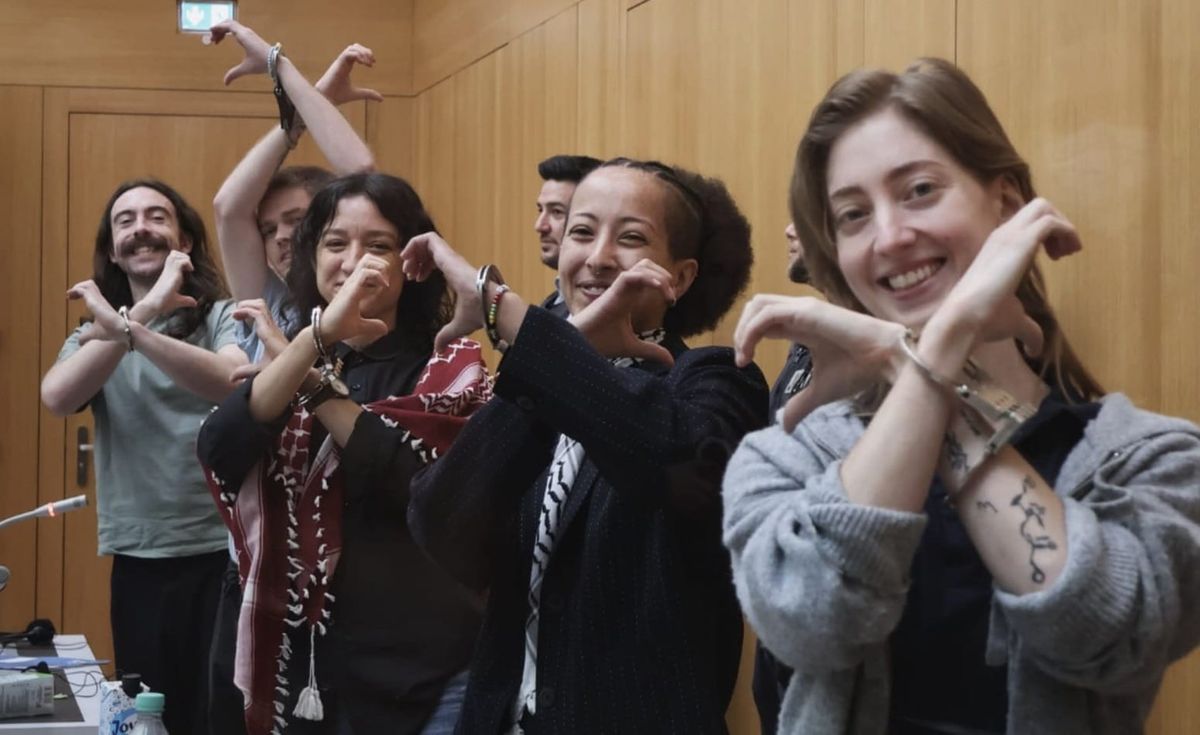
In Stammheim, two trials take place side by side. One involves the Ulm Five, who are kept in cuffs behind bulletproof glass, denied full access to their legal team and restricted in their ability to communicate with family and friends. The other, just across the corridor, involves Neo-Nazis accused of attempting a coup and shooting two police officers, who arrive to court in taxis. Within a few hours, the first group will leave in a prison van, while the second will return to society as normal.
Germany has chosen a soft hand for Neo-Nazis — and the full force of the law for those who acted against genocide. Having witnessed this farce, I know now that those enforcing this system will not recognise the dark irony before them.
On July 21st, I followed a delegation of Irish parliamentarians to Germany to observe the show trial of the Ulm Five first-hand. We were joined by parties from across the left and even a politician from Fine Gael, Barry Ward. On our first day we met a small but committed group of activists in Frankfurt airport. We spoke about what it meant to be in Germany and what we intended to do by observing — to apply pressure on the government and add to the urgent demand that they send legal observers to the trial to ensure that the defendants’ most basic human rights were being upheld.
We continued onwards from the airport, travelling deeper into the country. From the train window I watched the remnants of German heavy industry line the Rhine — the heartland that powered Nazi Germany’s war industry, and was now once again stirring in the latest rush towards war. At that very moment, further north along the same river, a line of police officers was removing activists from the entrance to a Rheinmetall AG arms factory. The same company had opened a heavy munitions plant in the nation’s capital just days earlier, setting off a week of local mobilisations called for by the Berlin Alliance Against Arms Production. Nothing better illustrated that we were entering a state well advanced along the path of mass militarisation.
Much like Ireland’s wilful ignorance of the Ulm Five up to this point, this story of confrontation and disruption would also be ignored. Meanwhile, the warhawks at home work overtime to convince us of the noble effort to die for arms dealer profits. Since 2022, Rheinmetall has seen a 2,000% increase in their stock valuation.
Solidarity in the face of dehumanisation
Disembarking in Stuttgart, we met the mother of the Irish activist who had now spent ten months in effective solitary confinement — four months longer than the German legal norm for detainees on remand. Like so many connected to this case — the family, the solidarity activists and the defendants’ legal team — she was a person of truly remarkable drive, a titan of organisation who made so much of what we experienced on this short delegation possible.
She had arranged for us to meet a number of veteran activists, journalists and documentarians who had travelled from across Germany and around the world to bear witness to what the German state was doing to the Ulm Five. That first evening I interviewed Palestinian journalist Hebh Jamal, who spoke to me about the hollowness with which Germany has managed to nationalise its own shame and wield it as a bat with which to defend the Zionist state.
Hebh told me that Germany has “only owned and identified it [genocide and dehumanisation] within the Holocaust context; it doesn’t apply anywhere else. Genocide and the concept of dehumanising a people are not embedded in the culture.” She said that we would be fooling ourselves to believe that the consensus in Germany will reckon with this contradiction. The status quo in Germany cannot accept that: “genocide is more violent than destroying a weapons factory.”
The sun set over the square where we had gathered, and as the evening stretched into night, Daniel’s legal team began making their way to our table. They prepared us for the trial ahead, explaining the restrictions the delegation would face inside the courtroom. There would be no transcript of proceedings, and we would not be permitted to bring a pen and paper to take notes. Apparently, within the logic of the German legal system, pens are considered potential weapons. The contradiction was difficult to ignore: this was a trial where the accused stood charged not with using weapons, but with dismantling them. Those who would fill the public gallery were undoubtedly supportive of that peaceful effort. And if there were any truth at all to the allegation that ballpoint pens are deadly weapons, it would be far more likely that the people in the gallery would dismantle them than use them for violence.
What became clear during the discussion that night was the belief that our presence in the courtroom might actually pressure the judges to behave differently. Their treatment of the defendants, and their efforts to conduct the trial as though it were taking place in a military court, might at least be tempered by the presence of representatives who would bring their experiences back to the public. A threat that the German state was clearly doing everything in its power to avoid.
Kindness against brutality
The following day we headed for Stammheim Prison, where the State Court was located. The same prison in which members of the Red Army Faction were imprisoned, three of whom were later found dead in circumstances officially ruled to be suicides but widely disputed. This is to say that this building has a history and holds a particular place in the consciousness of the international left.
It is a stark and austere building, accented by pristine coils of razor wire. It rises above the surrounding village and looks down on the tram line, which ends only a few hundred metres from its gates. As we approached the court, a crowd of around fifty people listened to speeches in the prison’s parking lot, where the anti-war group OTKM had established a base camp for those intending to sit in the public gallery that day.
As the speeches concluded, we walked towards the entrance of the State Court and filtered inside at an excruciatingly slow pace. Observers were permitted to bring only their ID — no phones, no belts (presumably also a deadly weapon). Their belongings were collected into zip-lock bags, and delegates, alongside friends, family members and solidarity activists, passed one by one through airport-style security scanners before being taken into a private room for an exceptionally thorough pat-down. Only then were they allowed to make their way into the public gallery.
While the morning’s proceedings were ongoing, I spoke with activists from OTKM who told me how many of their comrades were now languishing in prisons much like the Ulm Five. They spoke of how many were among the 15,000 people persecuted for their support of the Palestinian liberation struggle. Many such cases were simply banal and ordinary expressions of solidarity with the Palestinian people.
One activist, a young woman who wished to remain unnamed, told me about the brutality of the surveillance and repression faced by the anti-fascist movement, and how, through it all, she and her comrades had denied whole sections of their home city to AfD organising. She told me that the German state was attempting to make an example of the Ulm Five because they are deeply concerned that the actions they took to dismantle an Elbit weapons factory will only grow in popularity as Germany doubles down on its unwavering loyalty to the Zionist project and continues rattling its sabres for a major inter-imperial confrontation.
Inside the trial, the Ulm Five were escorted into their glass cage. One of them is Zo Hailu. I had met his mother, Nicky, on the tram to Stammheim, and noticed a rare kindness about her which I have no doubt, even from our brief introduction, informed a great deal of Zo’s humanity. At the time, I did not know who this woman was, but later, while scrolling through Instagram, I watched her read aloud, close to tears, a letter from her child. In it, Zo recounted how a poem from his mother reminded him of the children in Gaza, and how this had brought him to tears. He wrote how the poem had him “thinking of the child, who was blasted by an Israeli bomb, left hanging on a wall from being thrown into the air by the explosions. I am thinking of the countless children whose parents and families had to collect their body pieces into plastic bags. I am thinking of Hind Rajab, murdered by the IDF, who called the paramedics begging them to come pick her up who were also murdered by the IDF. May justice be brought for those babies who died, who were murdered. Whose only crime was being born Palestinian.”
Unjust laws
Nicky’s child was ushered into the court in cuffs, which, over several hours, had left increasingly red marks on his wrists. Zo, a person who was left with no choice but to take action, had reached the conclusion that the law as it stood was neither moral nor just. That, in reality, it did nothing to prevent immoral and unjust outcomes, and that, because of these objective realities, it could no longer be depended upon or allowed to restrict the actions necessary to prevent the murder of even more men, women and children. Children who know death in a way that so many of us, in the comfort of the West, will never even begin to understand.
Zo is treated in this case worse than the Neo-Nazi who sat in the neighbouring courtroom beside their lawyer, a fine watch resting on their wrist, far removed from the chafing pressure of heavy metallic cuffs locked tightly with little room for movement.
As the trial began, the defence filed a motion to call the CEO of Elbit Systems Germany, Mr Marian Rachow, to answer questions about what his company supplies to the Zionist state and its occupation forces. The state prosecutor poorly attempted to construct an argument opposing this before ultimately refusing to comment further. The court then watched a police edit of the Ulm Five’s statement videos, recorded by the five in the immediate aftermath of their action.
Daniel protested from behind the glass that the translation of the video statements is inaccurate, before members of the public gallery joined in raising concerns about mistakes in the German translation. This provoked an outburst from a judge, who shouted: “This is Germany — we speak German here,” as a defence lawyer began to read from an ICJ ruling. In what could only be understood as a cruel joke, Judge Lauchstädt allowed an item read out in English to be translated into German and then back into English again for the defendants.
Not only is there no record of the court’s proceedings, infringing on the Ulm Five’s ability to appeal based on the conduct of the trial itself; not only has the state repeatedly failed to translate the statements of the accused; but the judges presiding over this court also refuse any motion from the defence that would give context, evidence and especially legitimacy to the motives behind the action taken by the five.
Property does not dream — Children do
The delegation had to leave before the end of the day. It was only the eleventh of forty-two scheduled trial dates. From left to right, each observer agreed that what was happening in that courtroom was a show trial. The experience of the day, and the objective reality of the judge’s conduct, saw a socialist and a right-winger leave in agreement on the arbitrary and biased nature of the proceedings.
Shortly before leaving, I spoke with journalist Jara Nassar, who reminded us that the defendants are accused of “property damage” and that “they have not hurt a single soul.”
She finished our brief conversation by calling on all people of conscience to pay attention and see this trial for what it is: the normalisation of “massive police repression, legal repression and state violence”. This violence is designed to stop the Palestine solidarity movement in its tracks as millions finally come to see the Zionist state for what it is: a racist, supremacist state embedded within the global imperialist order, serving the strategic interests of the EU, the United States and Britain; a brutal settler-colonial project whose overriding objective is the ethnic erasure of the Palestinian people.
As we pulled out of Stammheim on the tram, I checked the comments under coverage of the trial in a number of Irish newspapers. Hundreds upon hundreds called these courageous activists “terrorists.” Many pointed to the fact that they had destroyed “property”. As I read these comments, I was reminded of Hebh’s words a day earlier: that the ruling class and its allies in the media have managed to so thoroughly dehumanise Palestinians that tens of millions cannot see how genocide is more violent than property damage. While many around the globe like to pat the Irish on the back for so often saying the right things or having the correct analysis, we have also seen in Ireland an enormous swing toward reaction which has been particularly effective in dehumanising the Palestinian people. Through the relentless spread of Islamophobia and the emerging alliance between the Southern far-right and Loyalism, a minority has managed to convince a substantial section of Irish society to attack the Palestine movement wherever possible. They have taken on the very talking points that German Zionists level at the Ulm Five and the movement in general.
I have not been able to shake the thought that, in the West, more value and more protections are afforded to inanimate weapons than to Palestinian men, women and children. That a state responsible for the murder of millions is once again offering a soft hand to Nazis, while arguing that anti-genocide activists have, through their actions against Elbit, “separated themselves from good society,” as an observer paraphrased the lead judge’s words from a previous trial date.
If I have anything at all left worth saying about this trial, it is this. To all those in both German and Irish society attacking these five for destroying an Elbit factory:
Property does not dream. Children do.
This trial has brought together many people who are now being forced to reckon with the reality that our governments have failed to take any meaningful action to prevent genocide. It has also confronted us with the fact that, when states and institutions abandon their responsibilities, some will inevitably feel compelled to act. Our responsibility is not simply to bear witness, but to politicise, organise and mobilise as many people as possible — to turn outrage and horror into collective action, and to continue the struggle in the spirit that the Ulm Five would want us to. To paraphrase a comrade:
In Stuttgart it is not only five individuals on trial. It is the entire movement.
Nathan O’Byrne is a socialist activist and organiser with People Before Profit.