


[Leagan Gaeilge le fáil anseo]
The force of great ideologies lies partly in their "mass-ness". An army of workers advancing under red banners is an argument in its own right; so is the lavish solemnity of an Easter procession. "For a mass of people to think coherently about reality and its problems,” Antonio Gramsci said, “is a far greater achievement than the dissemination of some new “discoveries” amongst a small corps of intellectuals.”
Gramsci spent the last decade of his life in a fascist prison, writing furiously despite his severely deteriorating health, and producing a wealth of startling if sometimes cryptic insights into history, politics, and culture. Surprisingly, for a Marxist, much of this work expresses a qualified if sincere admiration for the Catholic Church. Partly this was an anti-censorship manoeuvre – the Church was a codeword for the Party, which the fascist authorities would not permit him to write about. But the choice of codeword also reflected an essential commonality that Gramsci perceived between Communism and Christianity. Each was a universal ideas, capable of uniting the passions and the intellect, of connecting adherents to major currents of world culture, and of containing and dissolving contrasting perspectives into a broader sense of solidarity and collective purpose.
Unlike most other European countries, twentieth century Ireland possessed neither a mass Communist nor Socialist party. Nevertheless, I argue, Gramsci's analogy allows us to see the evolution of the Catholic Church in Ireland as the shadow trajectory of a mass leftwing party which never existed.
The Irish Church was successful at organising people into a singular perspective and sensibility. But this success depended on a particular social structure – the dense web of connections that characterised most of Irish society, which reinforced communal norms and facilitated cooperation. The Church reinforced this social structure, but could not weather the storm of economic and cultural modernity. Considering how the Church was interlaced with this social structure, how each declined, and how a residual Christian faith persists may in turn cast light on the unrealised past and potential future of leftwing ideas in Ireland.
The social web of twentieth century Ireland
For most of the twentieth century, southern Ireland was a rural country. Until the mid-1970s, most citizens lived in minor towns and rural areas. Communities were small and tight-knit, and people lived all their lives in the same place, among the same handful of familiar faces. This facilitated strong social bonds between people, which in turn facilitated strong social norms. Informal rules enforced by social punishments are more effective when compliance can be monitored – easier in small communities, where news quickly spreads – and when exclusion is more damaging. Social norms also require coordination: meaning the quick diffusion of common knowledge, and trust that others will act collaboratively.
While life in small communities governed by norms would have been oppressive in many ways, this dense and small-scale social structure also facilitated extensive cooperation between people. Unsurprisingly, therefore, cooperation was present in many areas of Irish life, as evidenced by “cooring” and the “meitheal” for example – traditional practices of mutual assistance between farmers. Other canonical institutions of nineteenth and twentieth century Ireland, from the GAA to local branches of the land league (and, later Fianna Fáil cumainn), would not have flourished were it not for the presence of what we might call “solidaristic social capital”, that is to say a social structure characterised by dense networks and the presence of strong communal norms.
No index of canonical institutions in rural Ireland would be complete, of course, without the Catholic Church. The Church, like the GAA club and the Fianna Fáil cumainn, was also based on a cellular structure: that of the parish. In fact, the parish was the unit of organisation that the other institutions were built on. And like these institutions, the Church also relied on solidaristic social capital. Dense networks facilitated monitoring of deviation from catholic norms, built trust, created common knowledge, and encouraged participation in shared rituals and broader church-related activities.
But the influence of society on the Church was not monodirectional, for the Church itself also reinforced solidaristic social capital. One key mechanism was the weekly mass. Every Sunday the parish congregated to partake in a highly symbolic and often emotionally charged social ritual. Liturgy emphasised the flock’s essential unity, their membership of a heavenly elect, and through these teachings, the Church emphasised – amongst other virtues – solidarity, cooperation, communality. Charity and mutual aid were promoted, while naked, individualistic, pursuit of gain was (to a degree) frowned upon, as much as can be within the limits of capitalist society. The priest’s sermon diffused common knowledge crucial for coordination: everyone heard what the priest said, and everyone knew that everyone else had heard what the priest said too.
In sum, through a symbiotic relationship between ideological framework and social structure, the Church fostered a “universal idea”: a language capable of relating every aspect of public or private life to a comprehensive system of thought, itself the product of centuries of philosophical debate. This language was exclusive, leaving little room for the penetration of other ideologies – especially of the leftist variety. Neither private reason nor conscience were permitted as an excuse for aberration, or for the tolerance of aberration. The Church fought a long battle, initially successful but eventually lost, against a series of ideological threats: Protestantism, republicanism, socialism, liberalism.
Nonetheless, as Gramsci observed, Christianity’s strength lay partly in its ability to subsume contrasting perspectives into one master ideology. In the sixties and seventies, when radical egalitarian movements were sweeping the world, many young Irish people saw the Church as the best vehicle for realising such ideals. After all, Jesus, as liberation theologists fiercely argued, had scorned the rich and argued forcefully for the liberation of the poor and the oppressed. Perhaps it is not surprising that Joe Higgins, one of Ireland’s most prominent Marxist politicians, studied for the priesthood in his youth before switching to more secular pursuits. Many of his generation became and remained clerics, and are still currently active. One priest, whom I encountered recently, told me that his most formative intellectual period occurred in the 1960s when he was actively reading and debating the work of Stokely Carmichael with clerical students.
Solidaristic social capital in action – and in decline
Solidaristic social capital manifested in the large quantity of Catholic voluntary organisations which provided relief to vulnerable or marginalised people. Going by the work of the sociologist Tom Inglis, it would seem that membership of these organisations totalled about 300,000 people in the early 1980s. These organisations depended on, and to a large degree constituted, the deep reservoir of solidaristic social capital that existed in Irish society. But as the century came to a close, this reservoir would be drained by profound changes to the social structure. Economic growth, geographical mobility, and urbanisation led to larger but more fragmented and transient social networks. People had more ties than ever before, but such ties were weak. Communal orientations were replaced with individual ones. Sources of common knowledge dried up.
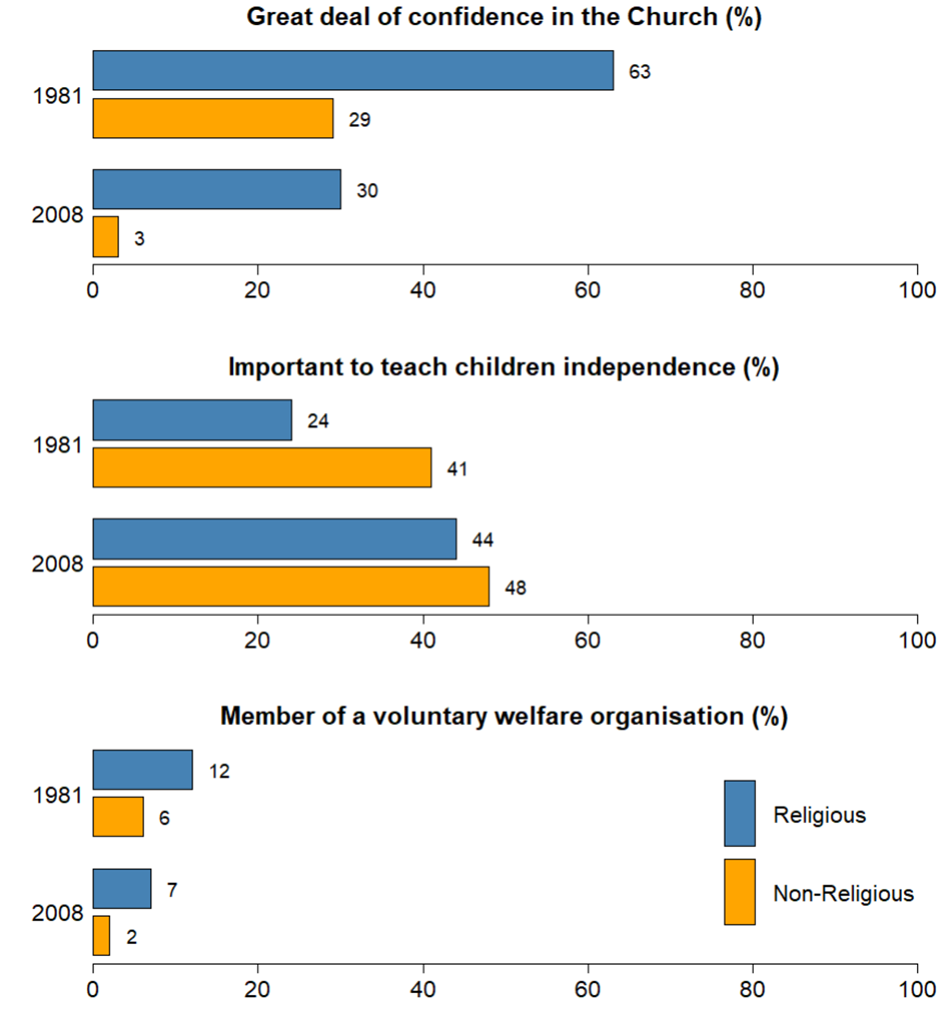
The result was a decline in both solidaristic social capital and the Church’s hegemony. This was not merely an intangible loss of community spirit – it can be traced concretely through shifts in social attitudes and patterns of voluntary engagement. The three figures presented display data from the European Values Study (EVS) – a recurring representative survey conducted across European countries since 1981. Each figure presents data for the Republic of Ireland, comparing two time periods – 1981 and 2008 – and two population groups: people who identify as religious and people who do not identify as religious. In both periods, religious people – over 90 percent of whom are Catholic – consistently make up about two-thirds of respondents. However, the ideological and practical meaning of religiosity changed substantially over the quarter-century.
The figures depict, in descending order, the proportion of respondents who: (1) believe the Church provides answers to moral problems; (2) believe it is important to teach children to be independent; and (3) report membership in voluntary welfare organisations. The first figure reflects the Church’s societal authority, while the latter two indicate the strength of the ideological and practical components of solidaristic social capital.
Figure 1 confirms a well-known trend – confidence in the Church declined between the end of the 20th century and the start of the 21st. More revealing is Figure 2, which shows a rise in the perceived importance of teaching children independence. In 1981, around 41 percent of non-religious respondents believed this was important – nearly double the proportion of religious respondents. By 2008, not only had the overall proportion risen, but the gap between religious and non-religious had narrowed considerably. This growing emphasis on independence suggests an erosion of communal norms – and a broader cultural shift toward individualism – in Irish society.
The third and final figure is perhaps the most telling. It reports membership in voluntary welfare organisations – charitable groups focused on supporting vulnerable or disadvantaged populations. In 1981, about 6 percent of non-religious respondents and 12 percent of religious respondents reported such membership. By 2008, these figures had declined to 2 percent and 7 percent, respectively. The persistent positive correlation between religiosity and involvement in voluntary welfare organisations underscores the Church’s role in sustaining solidaristic social capital – even as the overall decline in participation reflects a broader weakening of this social fabric in Ireland.
The analogy
These social changes are interesting in and of themselves. But they also fit with a broader pattern that holds outside of the Irish context. As discussed above, Gramsci’s motivation for studying the Church was partly as a way of studying the Communist party – not just á clef, but to expand the sample in his investigation of universal ideology’s social correlates.
Most European countries in the cold war era boasted either a mass communist or labour-orientated socialist party: the Italian PCI, French PCF, and Greek KKE; the German and Swedish Social Democrats; the British and Norwegian Labour Parties. Later, after the fall of the Iberian dictatorships, Portuguese and Spanish equivalents flourished.
While the communist ideology was more developed, elaborate, and inflexible – hence more akin to Christianity, in this analogy – the social democratic parties also had their own doctrines and mythologies which rose at least to the level of quasi-universal ideas. More than ideas, each ideology had its social base: elaborate networks of trade unions and social clubs, the equivalent of the parish church and voluntary welfare association in the Irish context. And while leftwing parties were largely urban phenomena, the urban communities in which they flourished were different to those of today. As evidenced from ethnographic works such as Hoggart’s The Uses of Literacy, or Eribon’s Retour à Reims, these were communities in which people lived their whole lives, in which everyone knew everyone else – they were dense networks with communal norms.
In other words, the mass communist and socialist parties also relied on solidaristic social capital. As social atomisation swept through Europe, these parties too either collapsed, or transformed into centrist bastions of the professional classes, shedding their activist rank-and-file. Union membership declined, neighbourhood fabrics frayed then tore, while the Workingmen’s Clubs and Case del Popolo became the haunts of an ageing and diminished cohort. The effects, while not always obvious, were deeply serious: a silent bombardment (to borrow Hobsbawm’s phrase) of communities and institutions, leaving only a solitude called freedom.
It is natural to understand the rise and fall of ideas – Christianity, communism, or whatever else – as reflecting the argumentative power of ideas themselves. If an ideology rises, it must have provided the answer to some vital question. If an ideology falls, then events – child abuse scandals or the Magdalene laundries; Prague ’68 or the show trials – must have supplied convincing counter-arguments. This explanation is only partially true because it leaves out the important role of social structure. Belief in universal ideologies was historically underwritten by a strong base of solidaristic social capital. While this structure persisted, the ideologies it supported would have the strength to ride out scandal and disgrace. But once the structure changed, these ideas and the institutions they constituted were at the mercy of events. Decline was inevitable, and the impact on human consciousness was profound. As Thatcher put it: “Economics are the method; the object is to change the heart and soul.”
What next?
There are, of course, still a good many Christians, communists, socialists, and other believers in the mass ideologies of the twentieth century. But as the ideologies they adhere to have lost much of their “mass” character, the nature of belief has become more individual: more idiosyncratic, more metaphysical, more focused on individual salvation and sense-making than collective emancipation. Even practising Catholics may comfortably dispense with the idea of hell or even an afterlife, deprecate church teaching on abortion and divorce, and profess faith in fairies and the healing power of crystals. Online communists post memes from their bedrooms. In many ways, none of it seems to matter anymore; all is dissolved into the restless, ever-shifting dance of post-modernity.
None of this is to deny that solidaristic social capital still exists, or that there are not serious leftwing organisations. Trade unions and activist-driven parties have not entirely vanished. But they are more and more a minority affair. We cannot turn back time, return to the dense, static, all-encompassing communities of half-a-century or more ago. What future is there, then, for mass leftwing movements, whether in Ireland or further afield?
A clue might be held in the conscious representations of millennial political subjectivity, as they appear in the work of Sally Rooney. Famously a Marxist, the degree to which Rooney’s political views meaningfully inform her novelistic output is a topic of debate in left literary circles and beyond. Less discussed however, but relevant to the questions raised here, is that Christian faith and practice is as often discussed in her work as socialism is.
One of the main characters of her third book, Beautiful World Where are You, is employed as a parliamentary assistant to a leftwing party but also happens to be a practising Catholic. Eileen, his eventual romantic partner, falls into personal-intellectual engagement with him not through his political activity, but through his active faith. She attends mass with him, marvels at his unselfconscious participation in ritual, and finds in it a satisfying spiritual complement to their night of lovemaking. Her co-protagonist Alice – also a Marxist – is enthused to hear about Eileen’s religious experience. She appears to have deep familiarity with the New Testament, is enamoured with the person of Jesus, and believes that humankind’s inherent appreciation for the aesthetic springs from a turning towards God’s eternal love. Christian faith likewise plays a recurring role in Intermezzo, the most recent of Rooney’s novels. Peter, a rationalistic leftwing lawyer, finds his thoughts returning to the concept of God’s commandment to love. Sylvia, his on-off lover and an intellectual in similar mould to Alice, is possessed with a “sincere and transcendent love of Christ”.
Well-worn biblical phrases mixed with Marxisant discourse and casual climate apocalypticism – are these, as Peter describes the familiar words of Christian prayer, mere “blank tokens now, long since expired, exchangeable for nothing”? Not so for Rooney. In a recent interview with the Irish Times, she acknowledged that – while she opposes Church teaching on homosexuality and abortion, and is sceptical about supernaturalism – Christianity has provided for her an (initially unconscious) foundational moral framework. It was this framework that provoked an outraged response to inequality and exploitation, and ultimately led her towards Marxism. Perhaps the priest who expressed admiration for Stokely Carmichael would say the same but in reverse – that Carmichael and his comrades were putting into practice certain Christian ethical principles.
Ethical imperatives to collective action
Great ideologies, to return to Gramsci’s perspective, provide universal languages; those who do not adhere to such a language will speak only in “dialect”, a localised jargon unsuited to deeper engagement. But a universal language must also be apt for describing the contemporary world, otherwise it cannot connect personal experiences to broader political perspectives. A socialism for our more atomised times should draw of course on Marxism. But it should also pay greater attention to the cultivation of an individual ethical perspective.
The latter requirement may seem in tension with Marxism, which in its classic forms tended to frown on “moralistic” arguments, preferring scientific prognoses of impending and inevitable revolution. But it is a necessary adaptation to a more socially fragmented world. When communities are looser, monitoring and the prospect of future interactions are less powerful incentives to cooperation. Lack of common knowledge makes the commitment of others to collective action less certain. Strong ethical commitments can substitute for these more utilitarian considerations – participation becomes the fulfilment of a deep inner need rather than an external expectation.
This should not be in and of itself an absolute novelty. The residual effect of Church ideology in Irish society is visible in the persistently greater participation of religious people in voluntary organisations, as discussed above. The leading lights of Marxism were also fired by a religious faith that sustained them through persecution and bitter struggle. Mass leftwing movements have always relied on more than just “spontaneous” emergence of cooperation.
Focusing on the ethical motivation to act therefore does not require an absolute change in perspective. Rather, it requires recognising that such an element was always a crucial part of leftist political struggle – complemented, of course, by collective institutions based on solidaristic social capital. It also compels us to accept that in today’s age, as solidaristic social capital declines, politics must increasingly appeal not just to collective community interest, but the ethical motivation to act. In today’s world, movements require people possessed of a deep need to take action regardless of what others do; a need which may have to be supplied by profound moral, or even spiritual, commitments.
What philosophical and organisational infrastructure emerges will depend on the exact sort of problems that movements face. For example, should movements focus on coordinating people to coincide on a single course of relatively low-cost action, or on motivating (at least) a minority to make costly sacrifices when free-riding is the “rational” response? Such dilemmas are at the heart – to take one salient case – of modern environmental politics. Pro-environmental activity seems to involve both relatively low-cost choices undertaken by a majority, such as recycling plastics or using public transport, as well as costly high-profile actions such as disrupting sports events or (temporary) vandalisation of precious artworks. Other tasks, such as re-energising class politics or halting the resurgence of Western imperialism will involve a similar mix of lower-cost majority and higher-cost minority strategies. Both types of activity will be needed at different times.
Whatever the issue, individual ethical motivation will need to increasingly (though never entirely) substitute for collective action based on organic communities. In determining what substance this motivation should possess, and how it is plugged into organised movements, some degree of philosophical experimentation is necessary. The test of a successful variant will be how it shapes the perspective of the many, getting them to think clearly about reality and its problems, and how to solve them.
William Foley is a research fellow based at Universidad Carlos III de Madrid. He is currently researching the spread of religions, the evolution of inequality, and the role of luck in life outcomes.