

In the second half of the second millennium after Christ’s birth, western European forces subjected most of the planet to colonial exploitation and constructed a global capitalist system. The ruling classes of European nations became extraordinarily rich and powerful, relying on the extraction of labour and natural resources from Africa, Asia, and Latin America. Then, in the first half of the 20th century, Europe went to war with itself – twice. From the wreckage, a young republic, a European settler colony in North America, rose to take its place at the top of the global system.
In the years after the second world war, it was unclear what exactly the United States would do with its newfound and extraordinary power. Despite the rivalry with the Soviet Union – now leader of the so-called “second world” – the US enjoyed an economic and military dominance unprecedented in human history. Dating back to the 1776 break with Britain, anti-colonial and revolutionary values were central to the self-conception of the United States, and the story it told about itself to the rest of the world. In practice, it spent the next 150 years carrying out genocidal conquest across the continent. Aggressive, expansionist militarism was routine policy. By 1945 it was not only unclear to the US government itself how it should deal with the “third world” – a population bloc already comprising the majority of humanity – it was also unclear to Marxist leaders of national liberation struggles like Ho Chi Minh and Mao Zedong, both of whom hoped to maintain good relations with the United States.
The answer would soon emerge, at the dawn of the so-called “Cold War”, whose title conceals as much as it reveals. While there may have been an icy calm between Moscow and London, the global south experienced a half-century of fire raining down from the north. When the countries of the global south sought to go beyond formal decolonisation and transform their economic systems – by taking control of their own resources and insisting on geopolitical independence from the first world – Washington responded by imposing its own manner of brutal subjugation. The US would (mostly) avoid old-style formal colonisation. At the same time, it gradually put together a package of responses that amounted to informal colonial relations, or “neo-colonialism” as it would come to be termed.
This package consisted of organising coups against popular leaders, mounting invasions or devastating bombardments, leveraging diplomatic and economic pressure, and even – employing a tactic I have studied closely myself – supporting the mass murder of leftists and those accused of leftism. According to my own research, this “method” – the extermination of socialists, feminists, labour leaders, and indigenous peoples – was employed in at least 23 countries in the second half of the 20th century. The countries of the first world consequently remained at the top of a hierarchically-organised global system. The basic contours of north-south relations, which relied as a matter of course on the extraction of labour and natural resources from around the world, remained unchanged by the end of the millennium, when the Soviet Union and the “second world” collapsed unexpectedly.
As a set of nations, the global south failed to catch up with the north Atlantic. The billions of people who had believed that decolonisation meant economic transformation were sorely disappointed. But while collective advancement stalled, individual nations – or individuals themselves – still tried their luck. With global inequality stubbornly high and the costs of transportation lower than ever, it made sense for desperate, impoverished people from the south – often fleeing horrifying conflicts that the first world instigated or participated in for its own benefit – to seek refuge in the richer, safer north.
An anti-imperialism in Europe
The above story is broad by necessity, relying as it does on giant categories like “first” “second” and “third world.” It is schematic, even if it is mostly true. But nothing in human history is quite so simple, and no country exemplifies that messiness, the complexity of that story, more than Ireland. In many ways, it just doesn’t fit in the north-south narrative. This misalignment will matter quite a lot to the future of the country, and perhaps even the future of Europe.
Ireland is unique in western Europe: a country that was colonised, rather than colonising. Imperialist Britain extracted milk, beef, and cheap labour from its neighbour, unconcerned with how many would die as a result. While other countries in the north Atlantic have long experienced an influx of migrants, Ireland has been a net exporter of humanity on a massive scale. And unlike the national revolutions in Canada, Britain, France and the United States, Ireland’s revolution would remain incomplete.
The American revolutionaries back in Philadelphia wanted liberalism and local rule (and they wanted to violently conquer the rest of the continent), and they were successful in getting all of this. The generation of the Easter Rising assumed Ireland would be a united and free country, where, in the 1916 Proclamation declared “the right of the people of Ireland to the ownership of Ireland”. So far, their descendants have gotten none of this. The class of 1916 was anti-imperialist, which explains why Irish nationalism is, historically, very different to most flavours of nationalism in Europe. At the first meeting of Dáil Éireann in 1919, a “Message to the Free Nations of the World” was agreed. It declared:
"Ireland to-day reasserts her historic nationhood the more confidently before the new world emerging from the war, because she believes in freedom and justice as the fundamental principles of international law; because she believes in a frank co-operation between the peoples for equal rights against the vested privileges of ancient tyrannies; because the permanent peace of Europe can never be secured by perpetuating military dominion for the profit of empire but only by establishing the control of government in every land upon the basis of the free will of a free people"
As a general rule, nationalism in Europe is right-leaning and chauvinist, if not outright fascist and genocidal. By contrast, 20th-century nationalism in the global south tended to be left-leaning and anti-imperialist, if not outright militant and communist. In the third world the nation itself, often an incomplete project, was forged through anti-colonial struggle. Despite taking place in the northwesternmost corner of Europe, the process of state formation in Ireland – relying as a matter of course on the bitter and heroic struggle against British imperialism – has more in common with the experience of nation-building in the global south. The leader of the 1798 revolution, Theobald Wolfe Tone, wrote that his project was “to unite the whole people of Ireland, to abolish the memory of all past dissension and to substitute the common name of Irishman in place of the denominations of Protestant, Catholic and Dissenter”.
Men like Pearse and Connolly had more in common with Sukarno and Zapata than they did with their putative counterparts in Europe. Irish nationalists’ solidarity with liberation struggles in the third world came much more naturally to them than any affection for some Kaiser or King closer to home.
We see this difference once more today on the question of Palestine. The Irish are different in this way. The English and the Germans know this, and they hate it. And the people of the global south know it, and many of them love it. Most people in the United States don’t know it at all, but this has started to change since October 7th 2023.
In the thirty-five years since the end of the Cold War, the story has gotten even stranger. Ireland was never granted full liberation – London blocked that – but it was granted full membership in the European Union, which formalised a kind of uneasy entry into the first world. Yet most of the global south, despite the mid-century process of national liberation, has remained trapped in permanent under-development, seemingly doomed to rip stuff out of the ground and send it, along with migrant labour, to the rich world.
Ireland, without ever even finishing national liberation, found a place (well, two different places) at the top of the global economic hierarchy. As the global system neoliberalised, the Irish people could extract real benefits from their new place in the system. Although the British pulled out of the EU in 2016 – in an act of post-imperial self-harm that was one of the decade’s many misguided responses to a real crisis of representation – the six counties remain part of a rich if floundering first world power.
The New Normal
In the 2010s, a global response to the failures of the neoliberal order and that same crisis of representation have only served to sharpen the contradictions. In the former second and third worlds, a wave of demonstration-revolts began in 2010, and only came to an end with the arrival of a virus. From Tunisia to Bahrain, Turkey to Brazil, Hong Kong to Chile, more people participated in mass protests than at any other point in human history. But the results were far from what the organisers, and indeed outside observers, had hoped for.
The focus of my more recent work has been attempting to understand how it was possible for so many of these movements to lead to something like the opposite of what they had apparently demanded. One answer – offered by many who participated in these movements – is that protests of the type dominant in the 2010s (apparently spontaneous, coordinated on social media, horizontally structured) were well capable of blowing holes in extant power structures but were poorly suited to afterwards carrying out revolutionary transformations. Many activists now wish that well-structured, democratic, and ideologically coherent organisations had already been in place before the explosion came.
Another reason for the failure is outside interference. Foreign powers responded – as they historically have in moments of revolutionary potential – with intervention, manipulation, and invasion, seeking to take advantage of the opportunities they believed they saw for themselves. The United States, for example, backed the Saudi-led invasion of Bahrain to crush the uprising there. It led a NATO regime change operation in Libya. And in Brazil it deployed a more subtle strategy, providing support to a right-wing "anticorruption" campaign aligned with leaders that horrified the leftist groups behind the original protests.
There is a universe of moral and strategic differences between the various types of intervention in the 2010s – between, for example, the quietly-supported assault on Manama and the very-public backing of Euromaidan protesters in Kyiv. And of course, other countries got involved in the response as well, from secret UAE scheming in Egypt to Russia’s obvious and brutal invasion. But it’s clear that events in Syria and in Ukraine – two major conflicts of the last decade that led so many to seek shelter in Europe – would never have gone the way they did without involvement from north Atlantic powers.
As these wars have generated new waves of immigration to Europe, once again the first world is in the awkward position of being forced to admit that many of its friends and allies are only friends and allies when they stay far away. Their citizens are welcome to fight Assad or Putin on their behalf, but they are not invited into fortress Europe.
Ireland may face in the coming years a fork in the road not dissimilar to the one faced by the United States in the middle of the 20th century. Will it remain special in the European context, committed to radical republicanism, anti-imperialism, and the "the control of government in every land upon the basis of the free will of a free people,”? Or will it become a “normal” western European country, shaped more by easy access to US capital than its historic commitments to the values of freedom, equality and self-determination?
Across the west we see the rise of right-populist anti-political movements that are comically inadequate to the task of confronting to the crises that generated them. While still weak, these movements are beginning to emerge in Ireland as well. From abroad, at least, one thing has been encouraging in the first half of this decade: Ireland still seems unique. If I were Irish, I would surely complain about the insufficiency of concrete political responses to the catastrophe imposed, brutally and repeatedly and seemingly endlessly, on the people of Palestine. But from thousands of miles away – and especially, in contrast to the dominant political culture in the United States – it is clear that common sense in Ireland is different. A sense of solidarity and a belief in universality still comes far easier, it appears, to the Irish than it does to citizens in the most powerful country in the world. If that were not true, then how could Irishmen and Irishwomen speaking out for Palestine be driving US Americans so mad?
Míniú an choimeádaí / Curatorial explanation
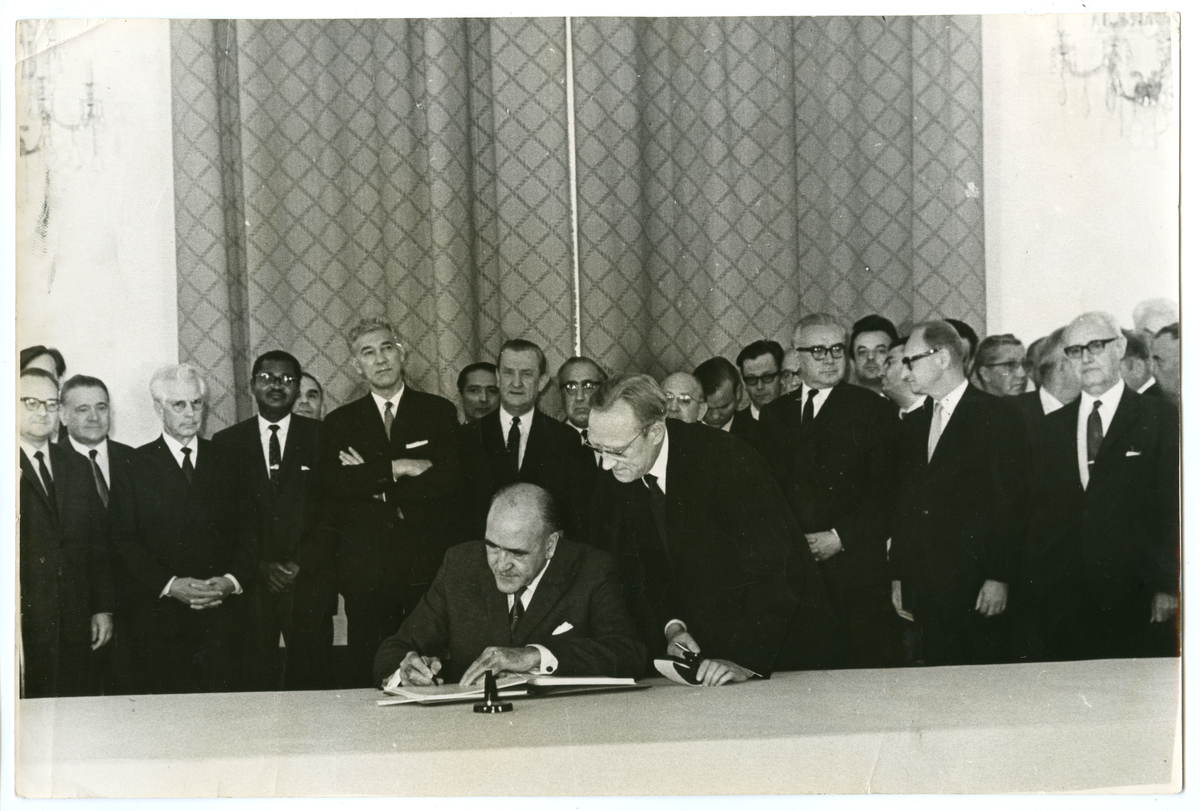
Gaeilge. An tAire Gnóthaí Eachtracha Proinsías Ó hÉicín ag síniú an Chonartha Neamhleathadh Armúrtha ar searmanas sínithe Moscó ar an 1iu Iúil 1968. Mar gheall ar an páirt i gcur chun cínn neamhiomadú núicléach ag an Náisiúin Aontaithe idir 1958 agus 1961, ba é an chéad duine a shínigh an conradh". (Gríanghraf ó pháipéir Proinsías Ó hÉicín, Cartlann Coláiste na hOllscoile, Baile Atha Clíath, uimhir mhíre P106/6942).
Mile buíochas le Ruairí Ó Ruáin, Ollamh Cúnta Tireolaíochta, Coláiste na Tríonóide, Baile Atha Cliath agus Cartlann U.C.D. as rochtain a fháil ar an ngrianghraf uimhir mhíre P106/6942, agus buíochas freisin leis an ealaíontóir Séaghan Ó Choilleann as an saothar a aimsiú agus a choimeád.
English. Foreign Minister Frank Aiken signing the Non-Proliferation Treaty at the Moscow signing ceremony on 1 July 1968. Because of his role in promoting nuclear non-proliferation at the United Nations between 1958 and 1961, he was the first person to sign the treaty". (Photograph from the Frank Aiken papers, University College Archives, Dublin, item number P106/6942).
Many thanks to Rory Rowan, Assistant Professor of Geography, Trinity College, Dublin and U.C.D. Archives for access to the photograph item number P106/6942, and also to the artist Shane Cullen for sourcing and curating the work.
Vincent Bevins is a journalist and writer from the United States. He has worked for the Los Angeles Times and the Financial Times. He is the author of two books: The Jakarta Method: Washington's Anticommunist Crusade and the Mass Murder Program that Shaped Our World (Public Affairs, 2020) and If We Burn: The Mass Protest Decade and the Missing Revolution, (Public Affairs, 2023).