

As a feminist historian whose work has always been influenced by my activism, I have spent over 40 years researching the various roles undertaken by Irish women in the centuries-old struggle for national, economic and cultural liberation from British rule. Belfast in the 1970s was a time of renewed conflict, when serious consideration of republicanism was frowned upon by the academy. So I had at the outset of my career little support from more senior members of my faculty.
My intention had been to develop a comprehensive history of nationalist women and the movements in which they were involved, but I quickly discovered that not only was there little archival material for the North, but an oral history approach was also impossible. Talking about involvement in republican activities in the past could lead to security force interest and possible internment in the present. Reticence in remembering was reinforced by the draconian laws of the unionist government, which had forced republicans underground, and rendered their organisations illegal under the Special Powers Act. Colum Ó Ruairc and Eireann Ni Uaitéir, editors of The Republican Dead 1916-1919, explained that information for the North was scarce because it had been too risky in the “hostile environment” following the establishment of the northern state to be able to remember the fallen: “In the South they would have had the photo on the mantlepiece but in the North it could place your family at risk.”
Those left on the “wrong” side of partition have had to deal with a legacy of hurt and abandonment. The discrepancy between North and South was uncomfortably apparent in the early years of the “Decade of Centenaries” (2012-2024), when 26 counties of Ireland celebrated the years that led up to the eventual formation of an independent Irish republic, albeit one truncated in size with the omission of 6 counties. In contrast, no nationalist celebrated the fact that the northern state remained in existence, despite the achievement of the Good Friday Agreement of 1998 and the institution of the NI Assembly, where republicans and loyalists now participated in a power-sharing arrangement.
In 1922 some who had played particularly prominent roles in the northern fight against British rule found themselves forced to leave their homes to make new lives elsewhere, while those remaining in the North had little option but to maintain low profiles. Fifteen years later, IRA officers in north Antrim who had been members of the Second Brigade, Third Northern Division, compiling a list of their main activities, emphasised “the overwhelming hostility of the Imperial population, which embraced over 80% of the inhabitants of our area. Our men ran grave risks in being even identified with an extreme National movement.”
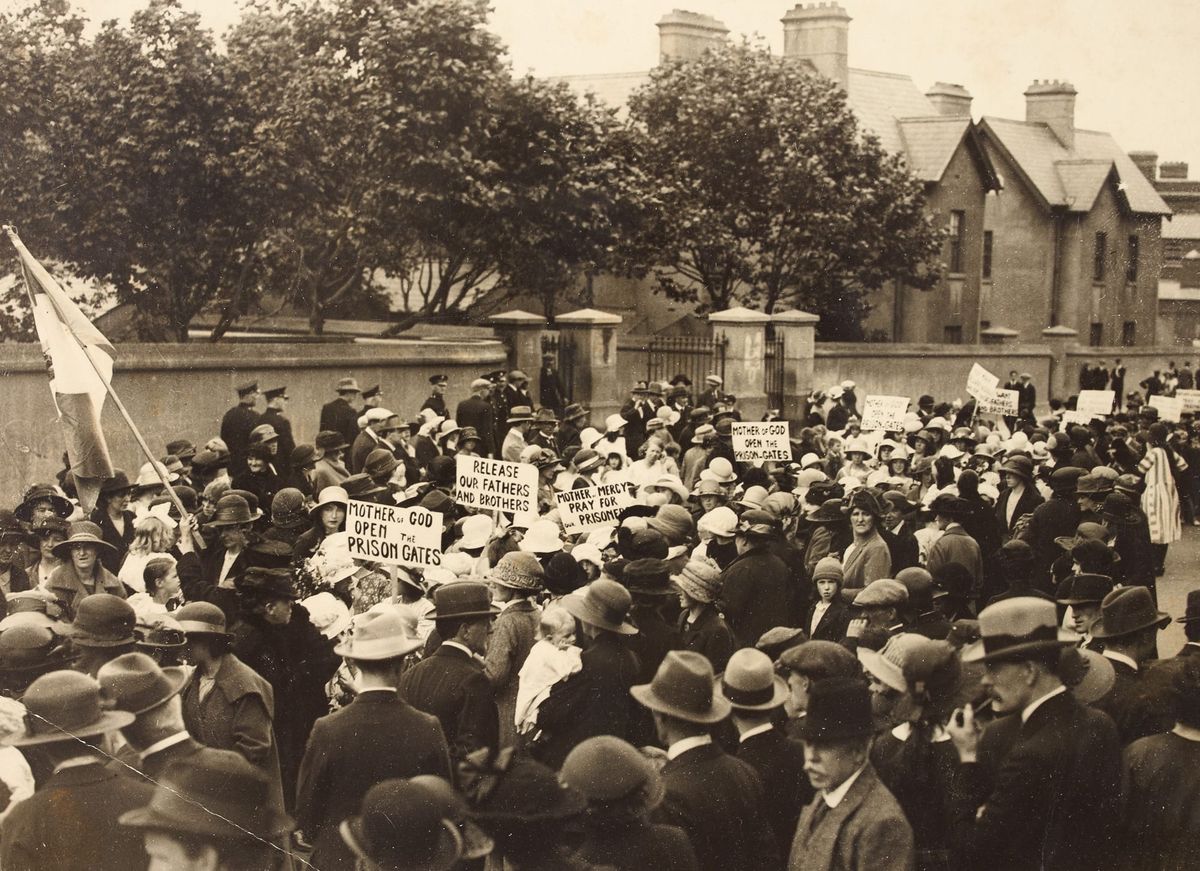
Many consider that the greatest achievement of the Irish government during the Decade of Centenaries was its support for the publication in digital form of the Military Service Pensions Collection (MSPC), the archive of applications for war service pensions made by republicans from all over the country, seeking recognition of their role in the independence movement. Historians have welcomed this invaluable source of primary material and families have at last been given proof of the activities made by their grandmothers, grandfathers, and others, during the years of revolution. We now have incontrovertible evidence that northern republicans had done their best to challenge partition, despite very difficult circumstances, and women played a considerable role as their comrades.
At long last northerners have been able to celebrate their forefathers and foremothers, a very different scenario to that in the 1930s and 1940s when their claims were made. At that time many northern claimants were forced to resort to having their applications posted from across the border, fearing their communication with the pensions authority would be seized by the northern postal censor, resulting in possible internment as someone “disloyal” to the northern state. Women who applied often found it difficult to find IRA members to support their claims, given the passing of time and the considerable movement of population. Elizabeth Delaney, O/C of the Craobh Iarthar (West Belfast) branch, spoke for many when making her pension application:
Situated, as we are in Northern Ireland, with a hostile censorship, it is very difficult to procure these statements, as most of the people who could vouch for my active service are now living in Eire.
Writing in 1982, the historian Elizabeth Fox-Genovese argued that the purpose of foregrounding the role of women in history – and thereby challenging the presumptions of mainstream historiography – was not to “substitute the chronicle of the female subject for that of the male”, but rather “to restore conflict, ambiguity and tragedy to the centre of historical process: to explore the varied and unequal terms upon which genders, classes and races participate in the forging of a common destiny.” With the voices contained within the witness statements compiled by the Bureau of Military History, released in 2003, and now the Military Service Pension Collection files, a more complex history of northern republicanism is revealed.
The MSPC provides a basis for developing a more gendered history of the republican struggle. It is evident that women experienced great difficulties in having their participation treated with the same respect as male colleagues. Between the periods 1924 and 1958 all the pension assessors were men, and women often felt they were treated with a distinct lack of understanding of their situation. Their contribution was limited to the two lowest ranks of D and E, with a mere ten percent of successful applicants deemed worthy of the rank of D, denoting an officer status. There were problems regarding definitions of “active service”, with numerous criteria applicants had to demonstrate. Dispatches had to be in an Active Service Unit (ASU) area or in dangerous areas; services had to be rendered in connection with places used as HQ; arms dumps had to have a considerable supply and be used frequently; responsibility for documents had to be demonstrated by having them in the claimant’s own house, etc. Their work had to be verified by IRA officers with whom they had served. Assessors often dismissed women’s claims on the grounds that the work described was “routine” Cumann na mBan work. Not only was this dismissive of women’s responsibilities but it also limited the amount of financial award that was made.
When we read women’s descriptions of the activities they were involved in, written down so factually and unemotionally, we have to put ourselves in their place and in their circumstances, to understand the tensions and the terrors engendered by carrying guns through road blocks, hiding guns in houses and fearing raids at any time, standing outside during curfew hours, guarding the men meeting or sleeping inside, or wearily walking miles through the countryside or up hills, carrying clothes and food for men on the run, terrified that a lorry load of B Specials might be lying in wait around the corner.
These testimonies clarify the crucial role of women, without whom the armed struggle would have been unviable. For example, the IRA in Belfast had a very limited number of weapons, relying on women to store them, deliver them for operations and to collect and hide them afterwards. Many women testified to housing arms dumps, to carrying armaments through security cordons, evading curfew restrictions, and suffering ill-health in later years as a result of travelling long distances in bad weather after attending to IRA operations. The Belfast resistance, happening in small working-class communities heavily policed by army and the RIC, would not have been possible without their support.
Partition
Following the defeat of the Collins-inspired “northern offensive” against partition, it was women in border areas and the Glens of Antrim who cared for the fugitive men hiding in dugouts in the countryside, fed and clothed them and spied on the whereabouts of security forces before escorting the men to the safety of the border. Around 600-800 IRA men avoided internment by moving to the Curragh army camp. Some became officers in the Free State army. There was no such provision for women. Between March and June 1922, 26,000 to 30,000 people left the North, some served with expulsion orders. While many Cumann na mBan left for America and a few moved across the border, many more remained, often living in abject poverty, some on family farms, with a few in Belfast able to return to jobs in the textile industry but many more barred from future employment because of their reputation as republican activists. The death of Collins in August 1922 led to northern republicans giving up all hope of an-island solution. They were abandoned by the Free State government. Ernest Blythe, a northerner from County Antrim, from a Church of Ireland background, and now a key figure in the Cumann na nGaedheal government, had strongly disagreed with any attempt to coerce unionism, arguing that Dáil Eireann payments to northern teachers should be stopped and “all relations with local bodies” ended. By October 1922, Richard Mulcahy, who had taken over Collins’ role as Commander-in-Chief of the army, was making it plain that “the policy of our government here with respect to the North is the policy of the Treaty.”
The imposition of the border created a political chasm – what James Connolly had predicted would be “a carnival of reaction”. Prominent figures from nationalist, labour and suffrage movements chose to move across the border rather than endure a unionist-dominated, highly reactionary political system. Some stayed initially, trying to make the northern entity a better place, but ultimately giving up.
Danny McDevitt, prominent socialist-republican, hoped on his release from Ballykinlar internment camp that there could be alliances between socialists in the new state that would cross the sectarian divide to include those “rotten Prods” recently expelled from the shipyards. His tailoring business was raided by the police in June 1922, compiling evidence to re-intern, and he and his family were forced to cross the border. He eventually established a successful business in Dublin.
Mary Kerr, suspected of using her position as court-missionary to liaise with prisoners and to obtain police intelligence highly useful to the Belfast Brigade, was interned in June 1922 as “not a loyal subject”. She was only released that November after she signed an undertaking to leave Northern Ireland within 24 hours and not to return for at least two years.
In November 1922 Róisín Walsh, a former member of Cumann na mBan in Belfast, was dismissed from her post by Tyrone County Council because of her refusal to sign an oath of allegiance to the government and the King. An exclusion order against her was then issued by the Northern Ireland authorities and she and her family moved to Dublin. Walsh became Dublin City’s first Chief Librarian, becoming a member of the editorial board of The Bell and retaining her involvement in republican and feminist circles.
Ellen Grimley (“Nellie Gordon”) had worked with Winifred Carney and James Connolly in the Irish Textile Workers’ Union. She moved with her husband James (who had been a socialist councillor in Belfast 1923-1927) to Dublin at the time of the 1935 sectarian riots, described by her as “pogroms and bad times in Belfast”.
Exclusion
In addition to expelling those whose home was in the North, individuals that the unionist government considered to be disruptive elements were served orders excluding them from entry to the six counties. Irish feminist Hanna Sheehy Skeffington, living in Dublin, was served with an exclusion order in 1926, the same year she described the “crazy patchwork frontier” dividing north and south in a speech to the feminists of the Congress of the Women’s International League for Peace and Freedom. It was an “arbitrary frontier, settled without consulting the Irish people, either through a referendum or any other way in which a people can be consulted directly…and in whose making the people had no voice.” Her husband Francis, murdered by the British in 1916, had come from Downpatrick, County Down, and she was now forbidden from travelling there.
Those who defied exclusion orders received no support from the southern government. In 1929 Ernest Blythe, now Minister for Finance, defended the right of the northern government to imprison de Valera when he violated an exclusion order to attend a function in Belfast organised by the GAA and the Gaelic League. In 1933, when Cumann na mBan members Mary Donnelly and Sarah Grimley were imprisoned in Armagh jail for protesting against a royal visit to Belfast, Sheehy Skeffington ignored her exclusion order and spoke at a public meeting on their behalf. In consequence she served a one-month jail sentence, protesting at her trial “I recognise no partition. I recognise it as no crime to be in my own country.”
Recovering lost voices
With the coming to power of the anti-treaty Fianna Fáil in 1932 and legislation passed in 1934, Cumann na mBan as an organisation was finally eligible for military service pensions. Despite difficulties, including for many the additional trouble and expense of travelling over the border in order to attend an interview with the pensions board assessor, northern members of Cumann na mBan began to apply for the meagre sums of money to which they were entitled. Many were isolated, with no idea how to contact former comrades. Many had no understanding of how to detail their forms with concrete dates and specific instance of operations in which they were involved.
Anna McNulty from Tyrone (a former president of the Dromore branch of Cumann na mBan), commented the following during the process of making her pension application. “[T]he people of the Free State and some of those in Dublin forget that we have not gained our freedom yet, we are still suspects.” It is those voices that enable us at last to appreciate more fully the role played by republican women in the north of Ireland.
In 1922 the northern IRA felt that “a useful blow” could be struck at the northern government before it had managed to establish itself. But in 1937 the officers of the Second Brigade in north Antrim wrote that they were “sadly disappointed” by the lack of support they received from southern divisions fifteen years earlier, as the latter were then preoccupied by the possibility of civil war. As a unit, the Antrim Brigade took no part in that conflict. They concluded, “we never knew if our position was clearly understood in Dublin.”
Now, in the 21st century, the MSPC has transformed our knowledge and understanding of those years when nationalists in the north were part of an all-island movement fighting against British rule. On a political level it should provide also the basis for reflection on the different fates of the 6 and 26 counties following partition, and the abandonment of the North. Only then can we seriously begin to address the prospect of a future shared Ireland based upon social, political, economic, racial and gender equality.
Margaret Ward is a feminist historian and Honorary Senior Lecturer in History, Queen’s University, Belfast. Her latest book is Rebel Women: Cumann na mBan in Belfast and the Glens of Antrim 1914-1924 (2024). Other publications include Unmanageable Revolutionaries, women and Irish Nationalism (republished 2021) and Fearless Woman, Hanna Sheehy Skeffington, feminism and the Irish revolution (2019).