

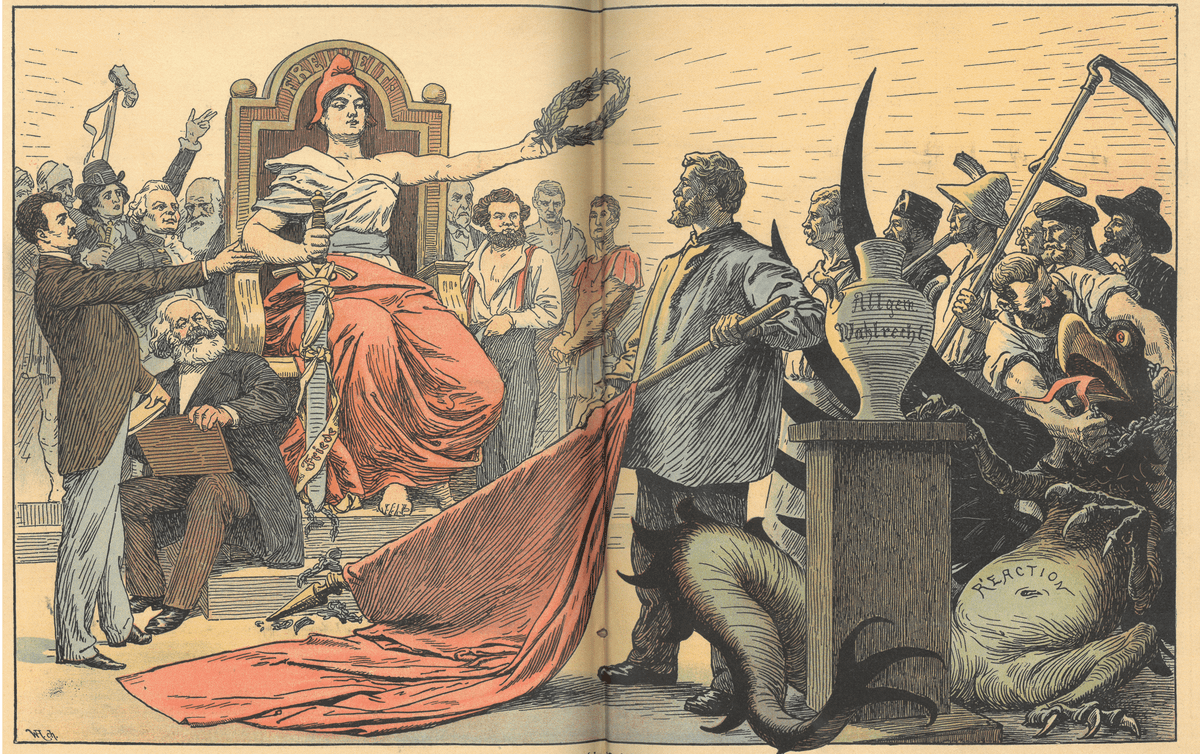
When Marx first entered the political arena in 1842 as a newspaper journalist, he did so as a committed republican. In one of his earliest articles, he argued for "transforming the mysterious, priestly nature of the state into a clearcut entity of the ordinary people, accessible to all and belonging to all, making the state the flesh and blood of its citizens."
His republicanism entailed an opposition to arbitrary monarchical power and a belief in democracy, popular sovereignty, and widespread citizen participation in government and public administration. But Marx was also a realist who knew that openly and explicitly declaring oneself for a German democratic republic – as some hotheaded republicans were doing – would only land his newspaper, the Rheinische Zeitung, in serious trouble with the authoritarian Prussian regime.
Manoeuvring within the tight confines of press censorship and the necessity of building alliances with moderate liberals, Marx’s early articles avoided direct attacks on Prussia’s absolute monarchy, while stridently defending a free press and attacking the arbitrariness of government censors and Prussia’s feudal legislators. Even this disciplined radicalism proved too much for the regime, who shut down the newspaper in 1843.
Despairing at the German political landscape, Marx made his way to Paris to work on a new journal with the well-known republican and Young Hegelian, Arnold Ruge. It was in Paris that Marx made the decisive shift to communism. Before Paris, he had publicly criticised existing communisms for their obsession with abolishing private property and neglecting political affairs – standard republican criticisms at the time. But within a few short months, Marx was declaring himself a communist and had privately and publicly broken with Ruge because of the latter’s failure to similarly transition.
Importantly, Marx’s conversion to communism was not a conversion to communism as it existed in the 1840s. As a republican, Marx had already criticized existing communisms and socialisms for being incredibly antipolitical. Most rejected the need for a democratic republic, arguing that a socialist society could be built, for instance, through voluntary small-scale communities that would spread through the moral force of their example.
That led many early socialists to completely neglect or oppose political struggle – some going so far as to expect that monarchs and the rich could be won over to their social ideas by reasoned appeals. Robert Owen, for instance, called on workers to reject the Chartists’ struggle for democratising Britain’s oligarchic constitution, arguing that "[I]t is not Universal Suffrage, Vote by Ballot, and Annual Parliaments that can affect that which is now required for the people," instead counselling them to address the "ignorance of their rulers and instructors."
Marx was part of an emerging trend of socialists who objected to these naïve antipolitical ideas. Such republican socialists combined socialism’s call for abolishing capitalism with the older republican call for a political regime controlled by the people. As critical as Marx sometimes was of bourgeois republican institutions, he was absolutely insistent that manhood suffrage and civic rights (especially freedom of the press and of association) were critical tools in the fight for socialism. That might seem like a commonplace position today, but in the 1840s, it was a significant political breakthrough.
Republicanism and Anticapitalism
But the republican aspects of Marx’s communism are not limited to the political realm. Republican ideas also suffused Marx’s critique of capitalist social domination. In the same way that the young Marx had criticised monarchs and Prussia’s bureaucrats for the arbitrary power they wielded, he condemned the despotism of the "factory autocrat." For Marx, capitalist employers robbed workers of their freedom at work, demeaned them, and subjected them to their uncontrolled power, all while ceaselessly holding over them the disciplining threat of being sacked.
This personal domination was sustained and reproduced, Marx argued, by the broader background of property ownership, with workers left with no choice but to work for a capitalist. While they enjoyed a formal freedom to choose which master to work for, they were structurally unfree to have no master whatsoever.
Finally, at the most general and impersonal level, Marx believed that not just workers but even capitalists were dominated by the imperatives of the market. The drive to accumulate and produce as cheaply as possible meant that even goodwilled capitalists had to exploit and dominate their workers. Capitalism thus left everyone (to different degrees, of course) dominated and unfree.
Marx’s republican-inflected critique of capitalism departed, however, from that of his contemporary republicans in important respects. They too opposed capitalist wage-labour for making workers dependent on an arbitrary master. But their solution was to make everyone an independent property holder. This distinguished them from the communist demand to abolish capitalist private property. As one republican, William James Linton, argued: "Our complaint is . . . not that the few have, but the many have not."
Marx thought that this relied on a completely unrealistic assessment of capitalism and political economy. An economy of independent producers, small artisans, and peasants stood no chance against the efficiencies of largescale capitalist industry. The only hope of overcoming capitalist unfreedom and domination was to build on capitalism’s productive successes by socialising the means of production and democratically planning the economy.
This was for Marx the only way for the "despotic system of the subordination of labour to capital" to be "superseded by the republican and beneficent system of the association of free and equal producers."
The Paris Commune’s Impact on Marx’s Thought
When Marx first battled the antipolitical tendencies of existing communisms by insisting on the need for a republic, he paid less attention to the precise constitutional contours that the republic would need to have beyond universal suffrage and civic rights. That changed with the Paris Commune of 1871. The dramatic and tragic experience of French workers briefly taking hold of the capital and carrying out a radical democratic experiment forced Marx to reassess what kind of republic was necessary for bringing about social emancipation.
He now stressed that a republic had to be a social republic, by which he did not simply mean that it would be a republic with socialist aims, but a republic that was constitutionally set up to help bring about that goal. That meant a radical democratic restructuring of the state’s representative and administrative functions.
In a social republic, Marx argued that representatives would be paid no more than workers and tightly controlled by the people who elected them, through binding instructions and being subject to immediate recall. This would mean that "[I]nstead of deciding once in three or six years which member of the ruling class was to misrepresent the people in Parliament, universal suffrage was to serve the people." Public administration would be similarly democratised, with state bureaucrats subjected to either legislative control and oversight or directly elected and recallable by the people. This would transform "a trained caste . . . [and] haughteous masters of the people into its always removable servants."
Marx believed that the sum effect of these changes would supply "the Republic with the basis of really democratic institutions" and provide the political structure in which to "strive to the abolition of all classes and, therefore, of all class rule." The social republic was thus for Marx the political terrain for the struggle for social emancipation.
Given how misunderstood Marx’s more infamous term for this political structure is – the "dictatorship of the proletariat" – going back to Marx’s equivalent use of the social republic (or similar terms he used, like a "republic of labour" or a "communal constitution") might provide a language around which to formulate a republican socialism today.
The State and the Republic
Marx’s advocacy of a social republic might appear to conflict with his argument that a communist society would be a stateless one. But what exactly it entails for a communist society to be stateless is rather unclear. Because of his objection to what he took to be utopian planning, Marx deliberately said very little about what politics would or might look like in a future communist society.
What little he does say does not support the stereotypical view attributed to him that all political conflict would disappear and we would have no need for political institutions at all. That is certainly a prominent way that many socialists have hoped a socialist society would look like (encouraged by unhelpful phrases like the "government of persons" being replaced by the "administration of things"). But what little Marx wrote about future politics does not suggest that he shares this depoliticised view of a socialist society. He seemed to think that something like the institutions of a social republic would continue to exist.
One aspect where socialism might gain from an engagement with republican thought is a firmer commitment to the need for politics and political institutions in any socialist society. In a republican socialism, the radical democratic institutions of the social republic are not just vital means to reaching socialism but also the critical architecture for staying there.
Abolishing a class society does not remove the need for political mediation, nor should we ever assume that we can dispense with the institutions that protect us from the oligarchic threat to reestablish class hierarchies.
Bruno Leipold is an Assistant Professor of Political Theory at the London School of Economics and Political Science. He is the author of Citizen Marx (2024) and co-editor of Radical Republicanism (2020).