

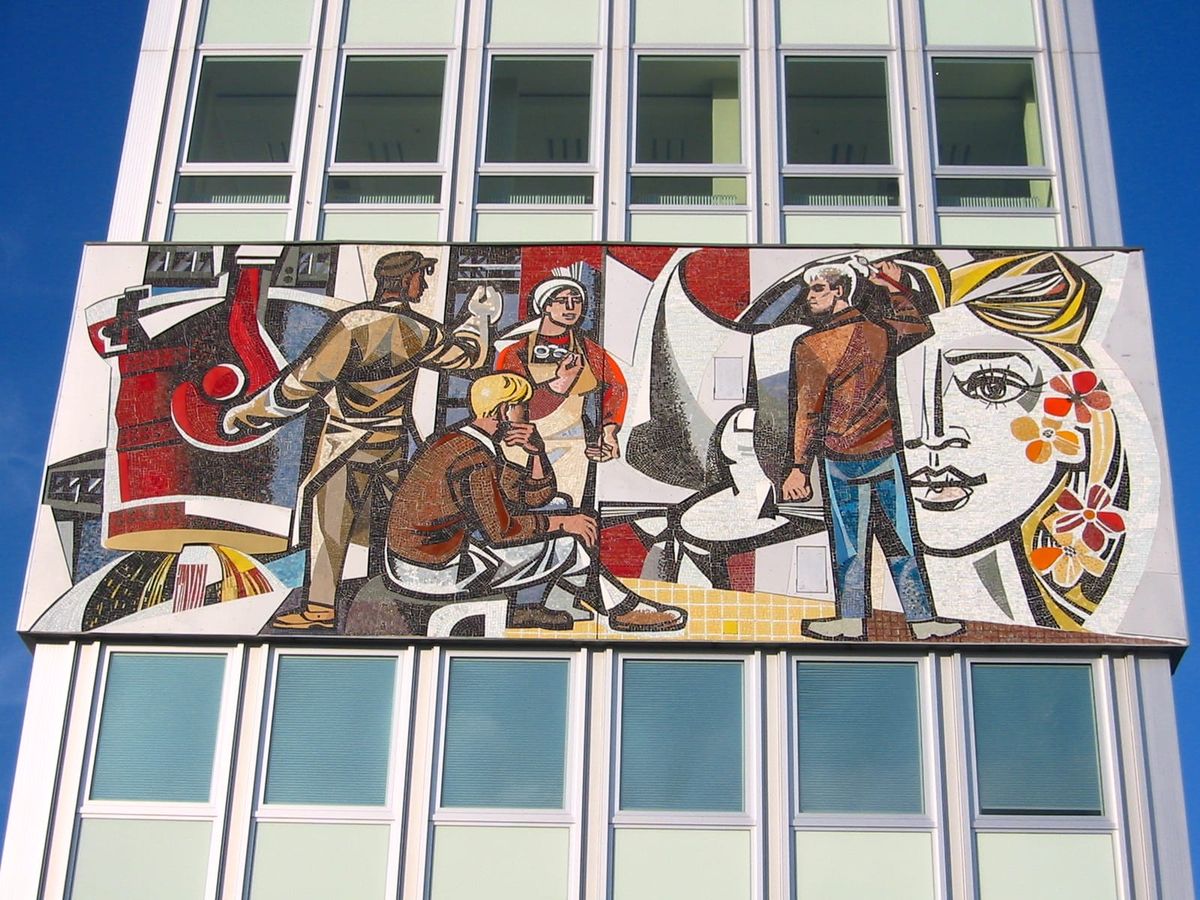

I have been asked many times about life in the GDR, where I was born and grew up. So, I am opening a blank page on my laptop to note some thoughts.
A Brief Historical Background
Following the defeat of fascism in Germany – above all by the Soviet Union – the country was divided into four zones administered by the USSR, the US, Britain and France. With the onset of the Cold War, the three Western zones were consolidated into one, separate from the Soviet zone, which comprised about a third of the country in the north-east. In May 1949, the Western zones unilaterally established the Federal Republic of Germany (FRG); four months later, the Soviet Union responded with the German Democratic Republic (GDR). Although the Allied agreements signed at the end of the war had clearly called for thorough denazification, the division of the country resulted in starkly different approaches to the Nazi past. While the GDR pursued rigorous denazification, removing hundreds of thousands of former Nazis from public office by 1947, by 1960 over 70 per cent of senior FRG public servants and 77 per cent of Justice Ministry officials were former Nazis, most of whom simply returned to their former jobs. The first chancellor of the Federal Republic, Konrad Adenauer, found nothing strange in appointing Hans Globke as his chief of staff. Globke was co-author of the Nuremberg Race Laws that had led directly to the Shoah. The GDR, by contrast, was led by anti-fascists such as Wilhelm Pieck, Otto Grotewohl, Walter Ulbricht and Erich Honecker. The land reform of 1945–48 expropriated all estates over 100 hectares, distributing 2.1 million hectares to 500,000 small farmers, workers, and refugees. The industrial reform placed nearly 10,000 enterprises into public ownership. These measures destroyed the Junker class and created the economic foundation of the new state.
Germany’s division into two states was never the intention of the Soviet Union. Throughout the 1950s, the USSR strove to create a united, neutral Germany, similar to Austria. The West resisted these efforts. From the outset, it sought to isolate the GDR, ruin its economy and its viability by attracting its graduates and skilled workers with higher wages, better material conditions and resettlement support. This brain drain became unsustainable. West Berlin, situated at the heart of the GDR, was turned into a shop window for the West and a channel for GDR citizens to move to the West. It was also an ideal centre for espionage, sabotage, and a possible flashpoint for a third world war.
By 1961, the drain on GDR resources had reached such dramatic proportions that the Wall was built around West Berlin, sealing it off to stem the haemorrhaging of qualified workers, academics and professionals and defuse a ticking time bomb. Even JFK stated at the time: “It’s not a very nice solution, but a wall is a hell of a lot better than a war”.
Why was the GDR considered such a threat? Its very existence represented an alternative to capitalism on the West’s doorstep, even if it could not compete with Western consumer goods, material well-being and affluence. It offered a stable and secure life, with the right to housing and work, free healthcare and excellent education.
The GDR kept everyday living costs at a minimum throughout its 40-year existence. Economically this represented a gigantic effort under inimical circumstances. From my experience, and comparing it with what I know of the West, people were always put first. Housing, heating, electricity, transport and basic foodstuffs were expenses nobody worried about. Healthcare was comprehensive and free, with polyclinics established countrywide and medical centres attached to workplaces. All education, from nursery through vocational training to university, was completely free, with everyone trained for a profession.
Women’s Liberation
From the outset, the full emancipation and social participation of women was a core objective of the GDR’s socialist project, with equal rights anchored in its constitution. Relevant policies were introduced soon after the state’s founding in 1949 and developed throughout its existence.
In reproductive health and rights, the GDR began producing a contraceptive pill as early as 1965, making it freely available. In 1972, it passed a new Termination of Pregnancy Act, legalising abortion and becoming the first of the two German states to give women the right to terminate a pregnancy within the first 12 weeks, no questions asked. In the FRG, abortion remained a criminal offence until 1974 and thereafter remained legally restricted. To this day, abortion in Germany remains technically illegal. Until 2022, doctors were banned from advertising abortion services — a law enacted in 1933, shortly after Hitler took power. It was only repealed after years of pressure and high-profile prosecutions of doctors who had stated on their websites that they performed abortions. Amnesty International has repeatedly called on Germany to fully decriminalise abortion and remove medically unnecessary waiting periods and mandatory counselling.
Support for working mothers was a cornerstone of GDR social policy. A year after its foundation, the GDR passed the Protection of Mothers and Children and the Rights of Women Act, establishing 14 weeks of paid maternity leave, extended to 18 weeks in 1972 and 26 weeks in 1976. From 1976, mothers with two or more children were entitled to one year’s paid leave. In 1986, this was extended to all mothers and, in certain cases, to fathers. My brother took this leave, as his wife was already working while he was still at university.
Child benefits and support for young families also increased steadily. Introduced in 1950 from the fourth child onward, child benefits were extended in 1972 to 20 GDR marks per month for the first and second child and 50 marks for the third, rising in 1987 to 50, 100 and 150 marks respectively. From 1972, first-time married couples under 26 received an interest-free loan of 5,000 marks, with partial or full repayment cancelled when children were born; a maternity grant of 1,000 marks was also introduced for every child.
The expansion of childcare was key to enabling women’s high employment rates. Crèche places per 100 children aged under three increased from 80 in 1955 to 165 in 1965, 256 in 1970 and 304 in 1972. By the early 1970s, there were more places than children, allowing full coverage and flexible care. By 1980, 60 per cent of children aged 0–3 attended crèches; by the late 1980s, coverage had reached approximately 80 per cent. Kindergarten places for ages 3–6 exceeded 90 per cent by 1980 and approached 95 per cent by the late 1980s.
Women’s employment rose from 61.2 per cent in 1955 to 81.9 per cent in 1970 and 91.2 per cent in 1989 – among the highest rates in the world at the time. Particularly remarkable was the range of professions women entered. By the late 1980s, women made up 55 per cent of students in higher education and technical colleges. The state actively promoted women’s professional development through targeted “women’s promotion plans” aimed at furthering the personal and professional careers of the female workforce.
In the West, professions like crane operator, construction worker, bus driver, locksmith, engineer, steelworker and miner were almost exclusively male domains. In the GDR, women did all of these routinely. In some factories, all the large workshop cranes were operated by women. In 1959, around 39,390 women worked in construction, approximately 8.7 per cent of the sector’s workforce. In 1970, 5,181 university-trained engineers graduated; from 1972, women consistently accounted for over 25 per cent of students enrolling in technical sciences.
Gender ceased to be a barrier to who you could become, as it remained in Western societies. Women did not need to define themselves in opposition to men; equality was a given, not a demand. This is not to imply that patriarchy had vanished – it lingered – but it was not the organising principle of life. Women were persons first; gender came second, if at all.
Remarkably, this transformation happened within a single generation – an incredibly short historical period to undo centuries of patriarchy. Women’s rights, easily accessible childcare, full employment and free education helped shape not just what women could do, but also how they saw themselves.
Housing: A Central Concern
In the context of Ireland’s housing crisis, it is worth mentioning that the GDR’s housing programme was a central concern throughout the state’s existence. In the aftermath of the war and the enormous destruction, housing was a vital but scarce resource. The goal was to provide adequate housing for the entire population of 16.4 million – no mean task. Rents never exceeded 4–5 per cent of income. In 1989, the proportion of household expenditure on rent was just 2.4 per cent. By the end of its 40-year existence, the GDR had largely achieved its goal of adequate housing for all citizens, with 3.5 million flats built, renovated or modernised.
Income and Living Standards
Incomes for most people were more than adequate. Professionals, public servants and managers were not paid substantially more than qualified workers. Wage differentials were much flatter than in the West, creating a more egalitarian society. In 1988, the average gross wage of a shop-floor blue-collar worker was 1,110 marks compared with 1,370 marks for a foreman. The same goes for wage comparisons between skilled workers and graduates. Nobody lived in poverty and no one was excessively rich: the wage system was designed to compress the income scale from top to bottom. Subsidised rent, heating, transport, food, healthcare, and education were extensions of personal income, adding real value to every wage. All of this was financed by the economy.
The class divisions, homelessness, and level of poverty widespread in the West were absent. People felt they were all essentially in the same boat, part of one community. In fact, when I speak to people who still remember the GDR, it is that sense of community they experienced then that they miss most.
Public Transport and Culture: Access for All
Public transport was inexpensive and access to culture was similarly very low cost. The state heavily subsidised theatres, concert halls, museums and cinemas, keeping tickets affordable for everyone. The GDR had 213 state-subsidised theatre companies, and many enterprises distributed theatre and concert tickets to their workers free of charge.
Children and young people had access to comprehensive cultural education through youth clubs, sports and interest groups, most of which were free. Entire sectors of the economy were oriented towards creating a state in which the overriding concern was the welfare of the people.
The GDR was not a perfect state, it had its contradictions and problems, but at its heart lay a genuine commitment to the collective good.
International Solidarity and Anti-Fascism
Active solidarity with liberation movements, opposition to imperialist war and a central concern for peace are among the GDR’s lasting contributions to world history. The same is true of its radical approach to confronting the Nazi past: replacing Nazis in public office, keeping alive the memory of the anti-fascist struggle, and acknowledging the central role played by the Soviet Union in the defeat of fascism.
The GDR was not internationally recognised by the West until the 1970s. The FRG had enacted the so-called Hallstein Doctrine by 1955, declaring itself the sole international representative of Germany and threatening sanctions against any country that traded with or recognised the GDR. Yugoslavia (1957) and Cuba (1963) were among those punished for defying these threats: Bonn severed diplomatic relations with both. Zanzibar was equally undaunted. In January 1964, the newly liberated island established diplomatic relations with the GDR – creating an awkward diplomatic puzzle when, a few months later, Zanzibar united with Tanganyika to form Tanzania. The FRG found itself maintaining relations with mainland Tanganyika while refusing to have anything to do with Zanzibar, now part of the same country. Sri Lanka (then Ceylon) learned that even a consulate could trigger sanctions. In February 1964, when the GDR’s mission in Colombo was upgraded to the status of Consulate General, Bonn reacted by cancelling its development aid.
Ironically, the doctrine ultimately backfired. It delayed the GDR’s international recognition for nearly two decades, but also tied the FRG’s hands, making normal relations difficult with any country that so much as smiled at East Berlin. With the decolonisation wave of the 1960s, that became an increasingly long list. The doctrine was quietly abandoned under Willy Brandt’s Ostpolitik in the late 1960s, having served its purpose – and demonstrated its absurdity. Amusingly, or should I say happily, this diplomatic aggression led students at Berlin’s Humboldt University to initiate pen friendships with counterparts at Western universities, which in turn led to my parents meeting. Nevertheless, the Hallstein Doctrine effectively prevented the GDR from gaining broad international recognition until the 1970s. For the GDR, this meant exclusion from many international organisations and scientific exchange groups, and it could not join the United Nations until 1973.
So What Went Wrong?
One of the big problems for individual citizens was the restriction of travel to the West. In one sense, the GDR government was not overly troubled by this: it reduced the number of citizens being seduced into defecting. But, before widespread recognition of the GDR, its passports were not recognised by most Western countries and its mark was not freely convertible outside the Council for Mutual Economic Assistance (Comecon), leaving GDR citizens without financial means when travelling in the West. Given widespread misconceptions, it is worth noting that travel within the socialist community – from Cuba to Mongolia – was relatively unproblematic. The GDR’s aid programmes also meant that many families involved in them spent time living in Africa and Asia.
After 1961, ordinary GDR citizens’ image of the West derived predominantly from West German television, accessible in most parts of the country. Imagine obtaining your sole impression of the US from its advertisements and soap operas – yet this is precisely what happened. Many GDR citizens therefore developed a rather rosy-eyed view of the FRG. Now add growing domestic discontent and the enormous economic struggle of maintaining social services and provisions at minimum cost. This was compounded by the GDR’s often ham-fisted information systems and poor propaganda, leaving it badly equipped to counter the sophistication of West German advertising, which presented a paradise just next door. With few opportunities to discover the realities of the West for themselves, discontent grew.
The GDR also had a relatively young, highly educated and curious population, increasingly unwilling to accept travel restrictions or state-regulated information. By the late 1980s, this disaffection had grown enormously. Significant numbers, mainly young people, were seeking to defect by travelling to socialist countries, entering West German embassies there and requesting political asylum. The growing economic and political problems throughout the socialist bloc, followed by Gorbachev’s glasnost (transparency) and perestroika (restructuring), did much to dismantle and discredit socialism. He too naively believed in the goodwill and honesty of Western leaders. This was the final straw. It is noteworthy that the GDR’s demise occurred without the use of state violence against its people; it was a peaceful transition.
One of the deeper problems – one that characterised the GDR from the beginning – was that the state had little confidence in its people, partly due to history. The GDR inherited a population indoctrinated in anti-Russian and anti-communist hatred and Nazi ideology. It did not emerge from a popular revolution led by its citizens, but from defeat and occupation. Its leadership, made up of old anti-fascist fighters shaped by the Stalin era, the war and exile, knew intimately the fragility of political systems and placed their trust in state control rather than in their people’s ability to make rational decisions. Ironically, the GDR’s restrictions were explicit and visible. In today’s Western states we see a perpetuation of the very practices they haughtily criticised the East for – and worse: mass surveillance, the criminalisation of dissent, non-jury trials and kangaroo courts, the silencing of unwanted voices, shoot-to-kill, increasing control of information, and the censorship of social media platforms are routine. The GDR government’s mistake was not that it sought to protect its society, but that it did so without putting greater trust in its citizens. Had it allowed more freedom and encouraged open debate, perhaps its citizens might have chosen socialism of their own accord.
All the GDR’s achievements rested on the people's ownership of the means of production. Yet, the sense among workers that they were truly the owners was not fully realised. This was a missed opportunity. Had ownership been more deeply felt – this is ours, we built it, we defend it – the transfer of that property into private hands after the Takeover might not have been so easy, or so quiet.
The Devastation: What Followed Annexation (euphemistically “Reunification”)
All this is 37 years ago now. What followed the annexation of the GDR by the FRG was a takeover – a systematic dismantling of everything East Germans had built for themselves. On 1 July 1990, the monetary, economic and social union came into force. The GDR mark was pegged to the West German mark at a 1:1 rate – a political decision that massively overvalued the GDR currency. Economists estimated a realistic rate would have been closer to 1:4.43. Consequently, GDR goods became instantly uncompetitive, and industrial production collapsed in a way unparalleled in history, with GDP falling by 42 per cent. GDR producers could no longer sell their goods profitably at prices buyers were willing to pay, while consumers diverted their spending towards Western products. Unlike Western capitalist nations, which had long lowered production costs through the exploitation of cheap labour in the Global South, the GDR never pursued such a path. When suddenly exposed to global competition, its industries – built on solidarity rather than exploitation – could not survive. The loss of traditional markets in the COMECON countries, combined with the shock-therapy dismantling of state-owned combines, completed the devastation.
The Treuhandanstalt (“Trust Agency”) was established to privatise the GDR’s state-owned enterprises. Between 1990 and 1994, it privatised or wound up some 8,000 enterprises. The results were catastrophic: 3 million jobs were destroyed, 30 per cent of enterprises closed, and two-thirds were sold, often for a symbolic 1 Deutschmark. The descending vultures must have felt like they were at an “everything-must-go sale” in a pound shop. Far-reaching deindustrialisation and mass unemployment followed. For most East Germans, the Treuhand was a “slaughterhouse” that extinguished their livelihoods and their life’s work.
Women bore the brunt of the job losses. Their unemployment rate was nearly double that of men in 1991 and worsened throughout the 1990s. Today, almost three out of four long-term unemployed people in the East are women. A key reason was the collapse of cheap, widely available childcare: crèches and kindergartens closed in huge numbers. Nearly 90 per cent of GDR women were qualified professionals. After unification, many of these qualifications were not recognised by the new Federal Republic, forcing women out of the workforce they had helped create. The 40-year project of women’s emancipation, which had achieved more than any other society in the world, was systematically dismantled.
The academic purge following unification was equally ruthless. At Humboldt University, 75 per cent of academics and 70 per cent of research assistants were dismissed, while nearly all social science lecturers were replaced by West Germans. Today, despite making up 19 per cent of the population, East Germans hold only 8.1 per cent of top academic positions. Nothing comparable happened in the West in the aftermath of the Second World War. Very few in terms of replacing Nazi civil servants in the West. In the immediate aftermath of annexation, over 1.2 million people migrated from East to West Germany. Whole regions were emptied; some towns lost over half their population.
The Erasure of Memory
From day one, the GDR and all its achievements were systematically discredited. A massive propaganda campaign, orchestrated by the establishment media, has delegitimised GDR biographies and history. The clarion call of the professional opinion-makers was to equate socialism in the GDR with fascism. Indeed, the word “fascism” is not generally used in the West; instead, the Nazis’ euphemism, “National Socialism”, is preferred, portraying socialism and fascism as two sides of the same coin.
A campaign of renaming streets, schools and even cities followed. Berlin’s Palace of the Republic – a significant cultural and political landmark – was controversially demolished, despite being a popular venue for concerts, exhibitions and social gatherings. East Germans were told their lives, their work, their achievements – everything they had built – were all worthless.
East Germans and Russia: A Different Relationship
People in the East are far less Russophobic than those in the West, a fact that puzzles Western observers.
After the war, the GDR paid 97 per cent of designated German war reparations to the Soviet Union. Meanwhile, the FRG paid nothing, instead receiving billions in Marshall Plan aid from the US and inheriting the industrial powerhouse of the Ruhrgebiet (Ruhr industrial region). Ties between the USSR and GDR were close, and Russian was the first foreign language taught in GDR schools. In 2022, 25 per cent of East Germans still felt culturally closer to Russia than to the US. Antifascist education and commemoration were central to political education in schools and extracurricular activities. This historical consciousness was internalised by millions of East Germans. Most remember Soviet soldiers not as invaders but as liberators. They remember learning the Russian Cyrillic script at school and occasionally still use it as a form of cultural demarcation. The West’s demonisation of Russia feels alien to many East Germans, conscious of a more complex history than that presented by Western media.
Despite the systematic erasure of their history, East German identity remains strong. The Alternative for Germany (AfD) – a largely right-wing extremist party – cynically exploits this. During the 2026 election campaign, its top candidate in Saxony-Anhalt, Ulrich Siegmund, mounted a Simson moped – a GDR cult brand – and led hundreds of riders on Simson motorcycles through the countryside. At another campaign rally in July, comedian Uwe Steimle – not an AfD supporter – struck up the GDR national anthem. AfD co-leader Tino Chrupalla and Siegmund himself joined hundreds of attendees in singing along. The appropriation of such symbols is calculated: the AfD seeks to tap into East German cultural memory and emotion, while routinely denouncing the GDR as an “unjust state” and instrumentalising widespread disillusionment in the East with mainstream parties. Its embrace of Ostalgie (nostalgia for the East) is therefore deeply cynical.
The East Fights Back
The East has fought back. Many leading figures from the worlds of the arts, economics and politics have written their memoirs to defend their lives against the onslaught and attempted eradication of memory – indeed, of history. Two novelists who have done this, Jenny Erpenbeck (Kairos) and Katja Oskamp (Marzahn, Mon Amour), won international prizes, much to the consternation of the German establishment. Even Katja Hoyer’s non-fiction history of the GDR, seeking to present a more balanced picture, was ignored or condemned in West Germany but proved surprisingly successful elsewhere. Interestingly, the trend towards writing personal histories has passed to the generation who were children in the 1980s. This last generation with a living memory of socialism is taking a stand to reappropriate and reclaim its history. The same is true of cinema, although the overwhelming majority of films about the GDR have been made by West Germans and invariably adopt the mainstream image of a totalitarian “Stasi state”, for example, The Lives of Others. Films made by Westerners about the East can feel, to those who lived in the GDR, rather like a Native American watching a Hollywood Western about their history.
Who Gets to Write History?
Since the annexation of the GDR, the West has determined that no positive memory whatsoever must remain. It is difficult to explain how deep this process goes. To this day, working people in the East receive lower salaries than those in the West; pensions too are lower. Rents, heating and public transport are unaffordable for many. Poverty and homelessness, unknown in the GDR, are now visible across the East. The memory of the GDR – its achievements, its contradictions, its history – will not be erased. Because the future belongs to those who remember, and those who remember will, we hope, one day rebuild.
For more detailed information, the reader may consult:
1. Bruni de la Motte and John Green, Stasi State or Workers’ Paradise? Socialism in the German Democratic Republic and What Became of It (Artery Publications, 2015).
2. Online publications from the Internationale Forschungsstelle DDR (international research centre GDR): https://ifddr.org/en/home/.
Dr Jenny Farrell, a GDR-born lecturer living in Galway since 1985, is an author of books and articles on literary criticism, the editor of three anthologies of Working People’s Writing from Contemporary Ireland, a founding member of the Liam and Tom O’Flaherty Society, and an associate editor of Culture Matters