

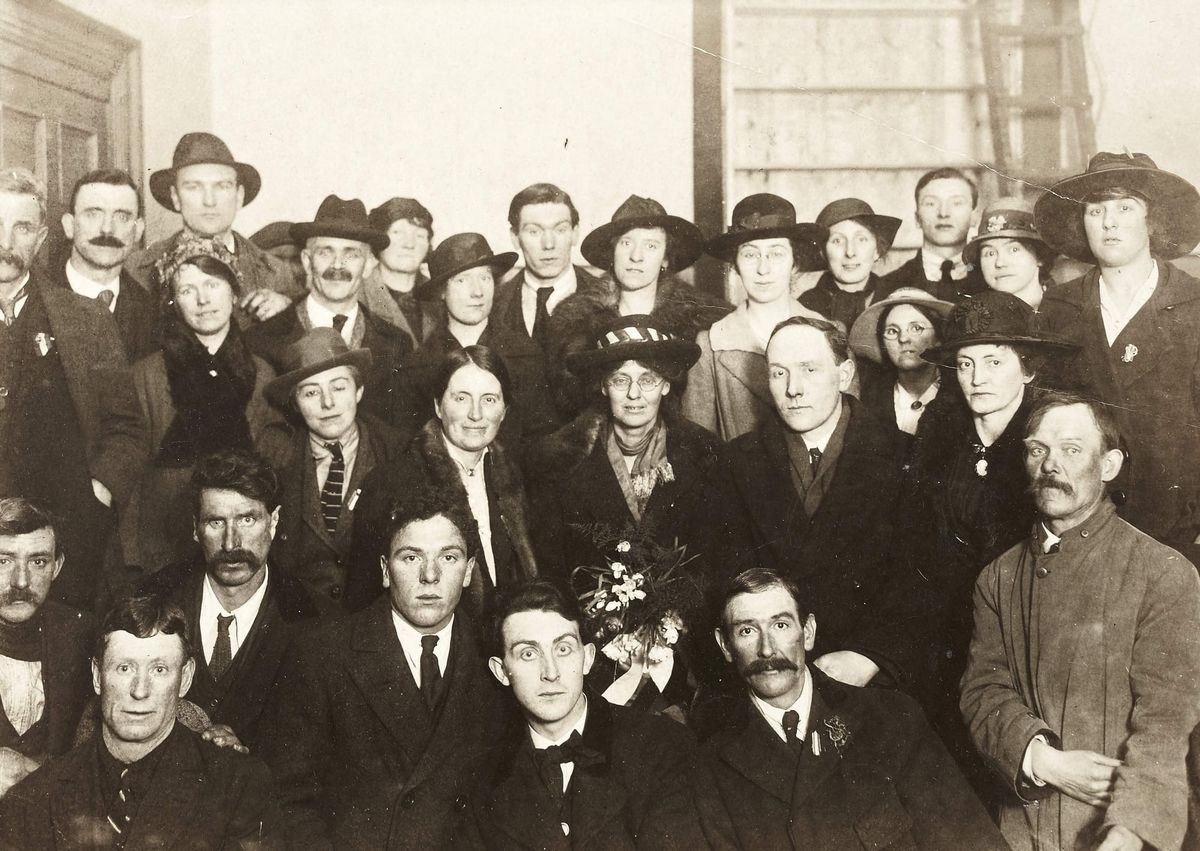

For the better part of a decade, scandals surrounding Ireland's still-unopened, as-yet-unbuilt National Children's Hospital have spiralled and deepened – with government ministers admitting last December that, for the sixteenth time, its construction deadline had been missed. As we continue to wait for its completion, there may be a virtue in reminding ourselves of an earlier – and far more radical – episode in the history of children's healthcare on this island.
Founded in 1919, Saint Ultan's Children's Hospital was established and run by a veritable flying column of women innovators, foremost among them Kathleen Lynn (1874-1955). “The most amazing of them all”, James Connolly remarked of the suffragettes who supported Dublin's striking workers in 1913, was “Dr. Lynn”, whose intelligence and energy as an organiser he considered “something to be constantly amazed at.” Long after Connolly's execution by imperial firing squad, Lynn's medical and political activism would ensure that the revolutionary promise of 1916 – “cherishing all the children of the nation equally” – would not be entirely forgotten in the beleaguered republic that ensued in the post-independence period.
Having been an active participant herself in the Easter Rising – serving as Chief Medical Officer in the Irish Citizen Army – when Lynn stood as an anti-Treaty candidate in the 1927 general election she identified explicitly as “a follower of Wolfe Tone and James Connolly”: as she put it, “because I desire, in the words of the Proclamation of Easter Week, “equal rights and equal opportunities for all our citizens””. By the latter (“no idle phrase”), she clarified, she meant “the abolition of privilege of every kind – privilege of birth, position, or possessions”.
Lynn's endeavours at Saint Ultan's gave a shape and direction to these socialist ideals. Politically engaged and notably non-sectarian in outlook, she and her colleagues operated at the cutting-edge of paediatric and public healthcare: as historian Mary McAuliffe notes, creating and then sustaining for six decades a progressive “medical space” that was also “a radical, feminist space”, where women “could and did set their own professional and ideological agendas”. The healthcare they provided was free at the point of access and transformative for innumerable Dublin children, including those living in the city's slums.
Medical and social innovations
In the Irish capital, the early decades of the twentieth century were characterised by vast social inequality, as evidenced by the proliferation of tenements to which the city's poor and working classes were consigned: living in crowded and unsanitary conditions that exacerbated their vulnerability to a range of mortal and life-altering diseases. As of 1914, estimates suggest that up to 20,000 families lived in one-room tenement dwellings. While TB lay waste to young and old alike, accounting for approximately 13% of overall deaths, child “mortality among the labouring classes” soared to a level approximately “five times” greater than that recorded among “the higher classes” of the city. Then as now, moreover, the poverty of the poor was far from metaphorical, and the physical hunger that many experienced heightened their susceptibility to other ailments and health hazards. As Lynn herself reminisced:
"The lack of knowledge of the treatment of infants at that time was appalling and the attention given to them in the general hospitals was very defective, only surgical cases being treated. No interest was taken in malnutrition and kindred complaints. We considered it high time that this state of affairs should be remedied."
Tellingly, the National Children's Hospital on Harcourt Street at the time refused to treat children with infectious diseases – a circumstance that motivated Lynn and her colleagues, using donations from Irish-American networks, to open a “bacteriological and pathological laboratory” in Saint Ultan's, to complement the care wards they had established for children unable to access medical treatment elsewhere.
The research laboratory on-site was one of a number of forward-looking measures envisaged and then put into practice by the hospital staff. Goats' milk, free of TB, was provided for infants, and a small herd kept and tended on the hospital grounds; breast pumps were introduced as practical aids for new mothers; by 1926 “an antenatal clinic was established along with Baby Clubs to educate mothers on diet and hygiene”; in 1933 the hospital founded a “Utility Society”, dedicated to the purchase of land and the construction of new and improved dwellings for inner-city families.
This last programme was especially noteworthy. By the early 1940s, a suite of modern flats had been designed and built with the assistance of architect Michael Scott, and handed over by the hospital board to Dublin Corporation for use as public housing – one reason among many that half a century later, in the 1990s, historian Medb Ruane could report encountering “old Dublin women and men who will light up at Dr. Kathleen Lynn's name. From 1919, St. Ultan's belonged to the community it served”.
If the women doctors at Saint Ultan's were literally ground-breaking in their socially informed conception of public healthcare – linking disease prevention to issues of housing and sanitation, and the like – the medical work they performed was innovative and effective in its own right. Lynn's colleague Dorothy Stopford-Price would become “an internationally renowned medical expert” for her roll-out of the BCG vaccine, making Saint Ultan's “the first hospital in Great Britain and Ireland to vaccinate infants against tuberculosis”. Importantly, Lynn herself was an active believer in “what is now called child-centred medicine and healthcare”, stressing the positive effects of physical and emotional nurture on the well-being of infants and young children. In Ruane's words,
"[Lynn] understood medicine as being genuine care in the fullest sense, devoted to the child's imaginative and intellectual needs, as well as their physical health. She acted on her belief that a few hours of cuddling and comforting could help ease a child back to health – a common enough view now, but an example of radical childcare in her time."
Public healthcare today
The medical ethos at Saint Ultan's, and the programmes and practices implemented there, remain pertinent to our understanding of public healthcare and children's well-being in Ireland today. Mounting levels of child homelessness are reported annually in Irish society, while children from minority backgrounds in particular often suffer complex and acute forms of marginalization, a trend exacerbated by public policies that continue to be informed by neoliberal thinking. As one study by scholars Joanne Wilson and Lindsay Prior summarizes:
"market values and actuarial tools have been fully integrated into public health policy, so that the 'field' is regarded very much like a business with clients, consumers, league tables, performance management systems and quality control mechanisms. In this respect, health, firmly entrenched in a neoliberal model, is yet just another 'good' or service, available in the marketplace to those who have the money and the capability to choose one service from another."
Sociologist Kathleen Lynch relates these developments to a wider crisis in “care” in our society, the prevailing dynamics of which, she suggests, will require political and ethical challenge if they are to be reformed at a practical level. She writes:
"One of the places in which capitalism's incoherencies and contradictions are most visible currently is in the world of care relations, where care deficits lead to ongoing crises and tensions over the care of children and older persons particularly... [However] we are not compelled to live forever in a capitalocentric world where all meaning and purposes are framed in terms of capitalist inevitabilities."
The example of Saint Ultan's hospital offers an implicit affirmation of such arguments, and the same might be said of Lynn's politics more broadly, with their fusion of socialist, republican, and feminist elements. “Our fight”, Camilla Fitzsimons has written, is still “for a society where resources are shared, where the market is based on need and not greed, and where there is a universal basic income along with universal basic services”.
Those ideals and objectives would not have been alien to Lynn, whose experience volunteering in “the soup kitchens in Liberty Hall” in 1913 alerted her to the needs of working-class women, and who would later equate the upsurge of “Bolshevism” in Russia with “the Spirit of Freedom” (as recorded in her diaries).
Revolutionary healthcare
The commitment of the Saint Ultan's staff to socially informed public healthcare, organized on the basis of medical need, suggests that there are other models and mindsets to be emulated and learned from. Indeed, the scale of the crisis in Irish healthcare today arguably compels us to consider those alternatives. We might recall that like Che Guevara – whose speech in August, 1960, “On Revolutionary Medicine”, laid the foundation for that country's world-renowned healthcare system – Lynn was a radical as well as a doctor. The wide scope of her efforts was commensurate with the depth and seeming intractability of the public health catastrophe faced by the children of Dublin's working poor.
When campaigners like Fitzsimons argue that “feminism” must strive to situate “those who are the most discriminated against at the centre of our struggle”, they might be understood as calling for the rejuvenation of the politics that Lynn and her comrades embodied. Lynn believed in an active equality that recognised no distinctions of “birth, position, or possessions”. Saint Ultan's was founded on those principles, even as it served Dublin's poorest and frailest infants, suffering preventable illnesses that nonetheless – due to the distribution of power and privilege in Irish society – would almost certainly have proved fatal to them without the care provided, and in some cases did, in spite of that care.
Every socialist should take that call to heart – whether our campaigns are for expanded public healthcare, or for increased democratic rights and opportunities, or for some combination of the two. To quote the late urban geographer, Mike Davis: “the best measure of the humanity of any society is the life and happiness of its children. We live in a rich society with poor children, and that should be intolerable”.
The time is ripe for us to dedicate our efforts to cultivating a new intolerance: no longer accepting as natural the hunger, homelessness and silence to which so many children have been condemned by the harsh calculus of neoliberal policy-makers and the profit-driven lobbyists they serve. Breaking with that status quo would be the finest tribute we could pay to the memory of Kathleen Lynn.
Ciarán O'Rourke is a poet and activist from Dublin. His most recent poetry collection, Prophetstown, is published by The Irish Pages Press.