


In the year 1170, a small band of 100 Cambro-Norman invaders landed at Baginbun, eight miles from Waterford town in the southeast of Ireland. They were led by a knight named Raymond Fitz William Fitz Gerald, nicknamed Le Gros (The Large). Occupying an ancient, abandoned promontory fort, the colonialists, while waiting for the arrival of their lord Strongbow from the Welsh Marches, made their first move, plundering the countryside for cattle. This was a manoeuvre of grave portent. As F.X. Martin wrote: “To raid cattle was to strike at the basic economy of the Gaelic system, and would guarantee an automatic reprisal”.
The reprisal came and soon the Normans were surrounded and besieged by a mixed force of Gaelic and Norse Irish. Greatly outnumbered, Le Gros weaponised the resources available to him, driving the stolen cattle into the Irish ranks. In the chaos that ensued, around 500 of the local resistors were killed. Seventy captives had their limbs broken before being beheaded and thrown off the cliffside into the sea. The Norman Conquest of Ireland had officially begun.
Over the next few years, Le Gros’s conquistadoring took him throughout Munster and Leinster. He eventually settled down on the banks of the Blackwater, not far from where he had first come ashore, sequestering an estate for himself on fertile land dispossessed from the Uí Faeláin, vanquished rulers of the Déise in modern-day County Waterford. He built a castle that became known as Strancally, a crass transliteration of Srón Chaillí, ‘nose of the hag’, for the shape of the rock at its base.
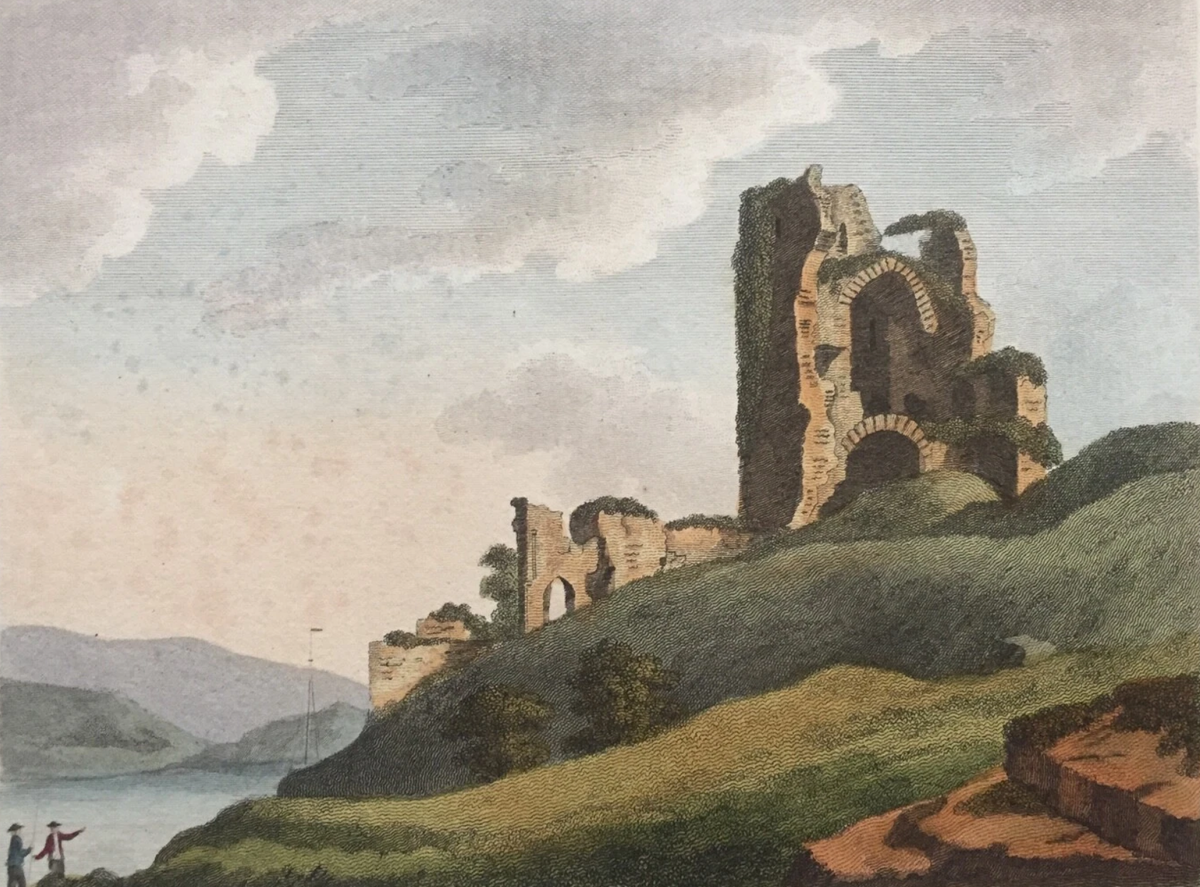
Le Gros’s Strancally Castle now teeters over the River Blackwater, almost fully reclaimed by the overgrowth. At nearby Molana Abbey, beneath the soil of another ruin, the Norman knight’s skeleton may have stirred in August 2026 when he heard the rumours going around – a new man had come from a foreign land to take his seat at Strancally.
Zuck in Éire
It’s true that American billionaire Mark Zuckerberg has purchased the home known as Strancally Castle for a reputed €51 million, a smidgeon of his estimated $248.7 billion net worth. What he has bought is not Le Gros’s exact home but a castellated Gothic-style demesne built on the site around the year 1827 for the Conservative MP for Clonmel, John Keily.
More than 650 years after Le Gros’s day, the Keily family – who had a penchant for grandiose architectural projects in the region – reigned during an equally immiserating time for the people of the Blackwater. When the Great Hunger descended in the valley, John’s brother Arthur, landowner at nearby Ballysaggartmore, refused to keep rents low as prices skyrocketed through speculation, hoarding and price gouging. He evicted around 700 desperate tenants. A Cork Examiner reporter, arriving in the area in May 1847, found “an awful sight […] before my eyes […] twelve to fourteen houses levelled to the ground […] Groups of famished women and crying children still hovered round the place of their birth, endeavouring to find shelter from the piercing cold of the mountain blast, cowering near the ruins or seeking refuge beneath the chimneys”.
Arthur Keily’s treatment of his tenants was so severe that an attempt was made on his life as he entered the gates to his lodge. He survived the shooting and the local gentry offered a bounty of £100 to the starving locals, who turned up seven men for arrest, all of whom were shipped to the penal colonies of Tasmania.
Whenever Mark Zuckerberg eventually arrives to take up his newly acquired residency, he is unlikely to be besieged in Dublin Airport or shot at as he enters through the gates of Strancally Castle. Unlike Le Gros, Sir Walter Raleigh and Oliver Cromwell (both of whom also scorched the region during the genocidal campaigns of the 16th and 17th centuries), Zuck does not travel with a personal army (though his would, of course, be Meta-branded). He does not need one because the Blackwater Valley was long ago pacified for him. No band of resisting guerrillas lies in wait – no Ostmen gallowglasses, no Gaelic woodkernes, no roving IRA units to burn the Big Houses.
Instead, following the sale of Strancally, a local Labour councillor said it was “great news for the area” and hoped that “people will do everything they can to make Mr Zuckerberg and his family feel welcome to our beautiful community”. Zuckerberg knew better than to arrive empty-handed. In return for such native hospitality, he and Chan have promised to donate a whopping €50,000 each (over a two-year period) to three local GAA clubs, just as Cortés brandished his glass beads at Cozumel.
According to RTÉ, Zuck will use Strancally Castle “when carrying out Meta business in Ireland”. Big Tech has become so normalised, through the government’s longstanding quasi-religious devotion to the cause of direct foreign investment, that the role Meta plays in the country is deemed unworthy of mention. Across mainstream Irish media, Zuckerberg is portrayed as a harmless tech geek, a benevolent investor-cum-saviour arriving to bring much-needed jobs that boost the Irish economy.
The truth is Meta benefits far more from the present arrangement than the Irish exchequer or the Irish people do. On top of the tax-avoidance services so liberally offered to foreign capitalists, there’s been an increasing return to the good-old, hard, natural resource extraction that drove British colonial projects in Ireland.
Zuckerberg need not brandish a sword for everything he wants to plunder is handed to him on a silver plate by the native administrators who, as Conor McCabe highlights, proudly persevere in their stubborn, decades-long commitment to a Free State economic model so uninterested in “indigenous growth that the country’s natural resources were sold off wholesale without second thought”. What Irish timber, grain and cattle were to the British Empire, Irish water and electricity are to the global expansion of the Silicon Valley AI Empire.
Data centres: our new overlords
Tech companies go further than most foreign corporations in Ireland. They don’t just benefit from a precariously contracted workforce and the full use of the Irish tax haven infrastructure, they are increasingly engaged in draining the land itself. Coupled with the pollution of waterways by foreign pharmaceutical companies, the AI boom in recent years is pushing already fragile ecosystems to the limit.
There are presently 108 data centres in the 26 counties (one of the highest concentrations per capita in the world) with a further 30 on the way, according to Ronan Kelly, the CEO of Digital Infrastructure Ireland. Last year, these data centres used 23% of the country’s electricity and millions of litres of water a day. Meta’s 250-acre site in Clonee, County Meath (Cluain Aodha, Aodh’s pasture), which also sits on land seized during the Norman invasion, is the worst offender. Its five data centres use more water than any other data centre site in Ireland – 556 million litres last year.
Who is footing the bill? Hardly the tech companies. Is it a coincidence that Irish household electricity prices are now the highest in the EU, 40% above average? Irish people are also being ordered to use less water – a bitterly comical demand upon a population who have to suffer the rain year-round.
Yet the Irish Independent partly blamed the astronomical increase in water usage on a “growing population”, a subtle anti-immigration dog whistle, while Taoiseach Micheál Martin says that the “demonisation of data centres” needs to end if we’re to keep up in the modern world. In short, we are being told to shut up and leave the poor data centres alone – turn off the tap and keep paying for Meta, Microsoft, Amazon, Google and others to suck up every last drop of water and every current of electricity.
As Róisín Agnew says in her essay Bog Communism, which outlines the transformation of Irish peatlands, a vital biodiverse ecosystem and once the sites of low-impact farming, as well as anti-colonial resistance, the 26-county Irish state “is merely a host for global platforms”, with no real sovereignty over the commerce that takes place within its contested borders. “The bog, once the terrain of anti-colonial struggle, now plays host to vast swathes of global fibre-optic cables and server halls”.
This is extractive colonialism for the modern age, Zuckerberg continuing the legacy set by his Strancally progenitor. The Normans introduced the first large-scale exporting colonial enterprise in Ireland, shipping out high-quality timber, oats and wool. They also profited by forcing the Irish commoners under their control into an exploitative serf-like villeinage system that taxed their livestock and bound them to the land.
Death and taxes
All this unfettered access to cleared land and flowing streams being given to American tech companies must benefit the Irish, surely? If Zuck is here “on business”, he must be busy providing worthwhile jobs and taxes to the Irish economy, correct?
Let’s look at jobs first: at the time of writing, Meta employs a mere 1,500 workers (i.e. 0.05% of the active workforce) across three sites, a 50% reduction from their peak of 3,000 in 2022. But don’t worry, the Irish Times article that announces these mass layoffs still finds the space to throw in an obligatory: “Big Tech companies are hugely important to the Irish economy, both in terms of corporation tax and employee taxes”. Indeed, Meta Platforms Ireland Ltd. paid corporation tax of €366 million in 2024. Big numbers, but a tax rate that amounts to just 12.6% on profits of €2.9 billion.
And what do we do with all these taxes? The Irish Independent claimed, rather obsequiously, in October 2026 that “Finance Minister Simon Harris will take to his feet in the Dáil to deliver a budget fuelled by the corporation tax bonanza that is underpinned by the tax strategies of a handful of big US firms, including Facebook”. Yet for all the government messaging around Budget 2027 being “fair to working people”, it came under heavy criticism from various sectors for failing to account for the exorbitant rise in the cost of rent, energy bills and housing, and failing to tackle record homelessness numbers and the debilitating financial burden of many people with disabilities.
The average person on the street is not feeling the benefits of Meta’s tax bill because that is how the system was designed. Ireland has been a roaring tax haven for neocolonial enterprise for decades. In fact, Zuckerberg arrives here triumphant from a massive recent legal victory over the American IRS, who had been trying for ten years to reclaim billions of dollars that Facebook washed through the Irish financial system.
This is all to reiterate: one person truly benefits from Meta’s operations in Ireland and that is Mark Zuckerberg and Mark Zuckerberg alone.
Resistance remains
As Zuckerberg and his wife Priscilla Chan settle into their new home, perhaps they’ll read a little of the area’s history. They may take a riverside stroll down to Le Gros’s original fortified abode. Will they ruminate on the ephemeral nature of settler-colonialism as they stare at the crumbling, roofless, ivy-covered walls?
Perhaps they’ll venture over to their neighbour’s home. Another foreign billionaire, the arch-Brexiteer James Dyson, bought the nearby colonial Ballynatray House in 2024. He may tell them of his current embroilment in a stand-off with locals over access to a graveyard on his land, and rights-of-way around sites that have traditionally been used by the community.
Perhaps someone down the pub will regale Zuck, as he struggles to consume a pint of Guinness, about the mosquito that bit Cromwell in the marshes of neighbouring Cork. Local lore says it was the “Cork Fever”, aka malaria, that followed and plagued The Devil From Over the Sea back in his native England, and eventually killed him. Will it evade Zuckerberg’s lofty attention that this mite-sized hero is still revered enough by the people of Cork that, 368 years later, they’ve considered making the world’s smallest statue in tribute?
There may be something not so insignificant in these tiny acts of resistance over the long course of colonialism in Ireland, a process which has yet to reach its conclusion. The Zuckerbergs will come and go. One day their Strancally Castle will also crumble into the bog. The data centres will cease to hum. The ruins that peek through the overgrowth the length and breadth of the country will have the relics of a strange new epoch to add to the monasteries, round towers and castles. It is up to us to ensure that the island that emerges from this wreckage is one that is shared in its entirety, from north to south, for the benefit only of the people living on it.
Alan O’Gorman is an Irish writer based in Los Angeles, working across film, fiction and non-fiction. He wrote the screenplay for the award-winning Irish film Christy, released in 2025. He is currently working on his debut novel with funding from the Irish Arts Council, and is in development on multiple film and TV projects.